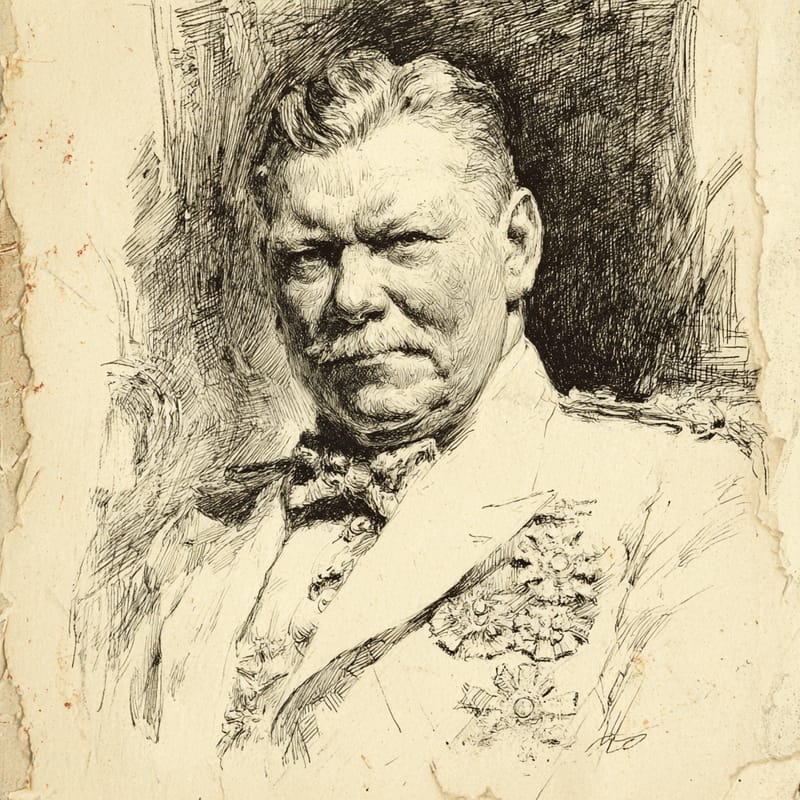
Hermann Göring
The war economy's boss
Plunder, the Four-Year Plan, the Luftwaffe.
Reactionary NaziOne of 729 ideologies · enter the Nazi hall →- Role
- Reichsmarschall
- Era
- 1893–1946
- Region
- Germany
- Social band
- Reactionary
- Placement
- +30 · +94 · −75
§ Where Hermann Göring stands
3 axesAs plenipotentiary of the Four-Year Plan from 1936, Göring drove autarky and rearmament through price controls, synthetic fuel and rubber programmes run with firms such as IG Farben, and the state-owned Reichswerke Hermann Göring founded in 1937. Yet most industry stayed private, and after the November 1938 pogrom he imposed a one-billion-Reichsmark fine on German Jews and decreed their exclusion from economic life, passing their businesses to 'Aryan' owners.
Göring was the regime's number two and a builder of its police state. As Prussian interior minister in 1933 he turned the political police into the Gestapo and opened early camps for opponents, in 1934 he helped direct the Night of the Long Knives purge, and on 31 July 1941 he signed the order commissioning Reinhard Heydrich to prepare a 'total solution' of the Jewish question.
Göring shared the regime's racial nationalism and turned it into policy. He presided over the 1935 Reichstag session in Nuremberg that passed the laws stripping German Jews of citizenship, and his 1938 measures completed their economic exclusion. His aristocratic pose as Reich Master Huntsman and collector of plundered art fused militarism, hierarchy and nationalist display.
How close are you to Hermann Göring?
Three statements, one per axis. Answer them and we’ll drop you on the compass next to them.
§ The story
HistoricalHermann Wilhelm Göring (1893–1946) was the second most powerful man in Nazi Germany. A decorated First World War fighter pilot who ended the war commanding Manfred von Richthofen's old fighter wing, he joined the Nazi Party in 1922, led its SA stormtroopers and was badly wounded in the 1923 Beer Hall Putsch. Elected to the Reichstag in 1928 and its president in 1932, he became Prussian interior minister and then minister-president of Prussia after Hitler took power, and from 1935 commanded the new Luftwaffe.
Göring built the first apparatus of Nazi terror, creating the Gestapo and early concentration camps in Prussia in 1933, and from 1936 ran the Four-Year Plan that geared the economy for war. Named Hitler's successor in 1939 and Reichsmarschall in 1940, he lost influence as his air force failed over Britain and at Stalingrad, while he amassed a vast collection of looted art. Convicted on all four counts at Nuremberg, he killed himself with cyanide on 15 October 1946, hours before he was due to hang.
Notable for
- 01Directed the Four-Year Plan
- 02Founded the Gestapo
- 03Convicted at Nuremberg
Key works & moments
- 1918Takes command of Jagdgeschwader 1, Richthofen's old fighter wing, as a decorated ace.
- 1923Leads the SA in Hitler's failed Beer Hall Putsch in Munich and is badly wounded.
- 1933Creates the Gestapo as Prussian interior minister and opens early concentration camps.
- 1936Appointed plenipotentiary of the Four-Year Plan to make the German economy ready for war.
- 1941Signs the 31 July order asking Heydrich to prepare a 'total solution' of the Jewish question.
- 1946Sentenced to death at Nuremberg; takes cyanide on 15 October, the night before his hanging.
In their own words
“Voice or no voice, the people can always be brought to the bidding of the leaders. That is easy. All you have to do is tell them they are being attacked and denounce the pacifists for lack of patriotism and exposing the country to danger. It works the same way in any country.”
§ Minds closest to Hermann Göring
All minds →

§ Also in the Nazi hall
Enter the hall →§ Common questions
4 answersWhat was Hermann Göring's political ideology?
Hermann Göring was a Nazi: on the 99ideologies three-axis compass, a Reactionary Nazi. Economically he sat right of centre (+30), running a state-steered war economy that left most industry in private hands while plundering Jewish property and occupied Europe. On governance he was at the authoritarian extreme (+94) as founder of the Gestapo and the regime's second man, and socially he was deeply reactionary (−75), turning racial antisemitism into law and confiscation.
Was Hermann Göring left-wing or right-wing?
Right-wing, on the far right. Göring was a nationalist war veteran who joined Hitler to destroy the Weimar Republic, and in power he crushed the Communists and Social Democrats, partly through the Gestapo and camps he created in 1933. His Four-Year Plan expanded state control of the economy, but in partnership with private industry and for the purpose of war, not equality. Combined with his racial antisemitism, that places him firmly on the authoritarian right.
Why was Hermann Göring convicted at Nuremberg?
Because the tribunal found him guilty on all four counts: conspiracy, crimes against peace, war crimes and crimes against humanity. The judges cited his part in planning aggressive war, his direction of the slave-labour and plunder programmes of the Four-Year Plan, the looting of art across occupied Europe, and his 31 July 1941 order to Heydrich to prepare a 'total solution' of the Jewish question. Sentenced to death, he swallowed cyanide in his cell on 15 October 1946 rather than hang.
Which minds are closest to Hermann Göring?
On the 99ideologies three-axis compass, the minds closest to Hermann Göring are Hans Landa (97% alike), Frederick Zoller (97% alike) and Joseph Goebbels (96% alike). The furthest is Emma Goldman (0% alike).