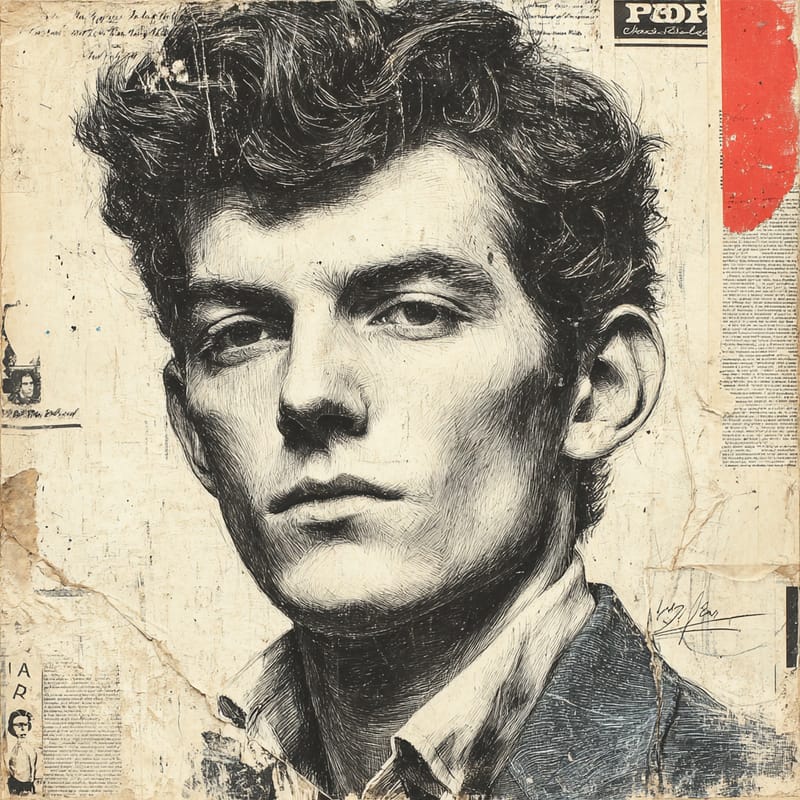
José Antonio Primo de Rivera
Founder of the Falange
National syndicalism, romanticised.
Reactionary FalangistOne of 729 ideologies · enter the Falangist hall →- Role
- Falange founder
- Era
- 1903–1936
- Region
- Spain
- Social band
- Reactionary
- Placement
- −28 · +92 · −78
§ Where José Antonio Primo de Rivera stands
3 axesJosé Antonio's national syndicalism promised a third way beyond capitalism and Marxism. The Twenty-Seven Points of 1934 called for the economy to be organised in vertical syndicates of employers and workers, the nationalisation of banking and a sweeping agrarian reform, while protecting private property from both big finance and class struggle, which places him left of centre for the far right.
José Antonio rejected liberal democracy even while sitting in parliament. His founding speech of 29 October 1933 dismissed party politics and endorsed the violence of fists and pistols in defence of justice and the fatherland, the Falange formed armed squads that fought leftist militants in the streets, and his programme called the state a totalitarian instrument of national integrity.
His nationalism was Catholic and traditionalist. Point 25 of the 1934 programme wrote the Catholic tradition into national reconstruction, he defined Spain as a unity of destiny in the universal and opposed regional separatism, and his romantic vision of an imperial Spain made him the chief icon of the Francoist right after his death.
How close are you to José Antonio Primo de Rivera?
Three statements, one per axis. Answer them and we’ll drop you on the compass next to them.
§ The story
HistoricalJosé Antonio Primo de Rivera (1903–1936) was a Spanish lawyer and politician who founded the Falange, Spain's main fascist movement. The eldest son of General Miguel Primo de Rivera, dictator of Spain from 1923 to 1930, and heir to his title of Marquis of Estella, he entered politics to defend his father's memory. He launched Falange Española at Madrid's Teatro de la Comedia on 29 October 1933, won a seat in the Cortes for Cádiz weeks later and in 1934 merged his party with Ramiro Ledesma's JONS.
As national chief of FE de las JONS he gave the movement its blue shirts, its anthem Cara al Sol and its Twenty-Seven Points, but it remained small until the Civil War. Jailed in March 1936 as the Republic cracked down on Falangist violence, he was in Alicante prison when the war began, and a Republican court sentenced him to death; he was shot on 20 November 1936. Franco's regime made him a martyr, the Absent One, while absorbing his party into a single state movement, and in 2023 his remains were removed from the Valley of the Fallen.
Notable for
- 01Founded the Falange Española
- 02National-syndicalist doctrine
- 03Posthumous regime myth
Key works & moments
- 1933Founds Falange Española at Madrid's Teatro de la Comedia on 29 October; elected to the Cortes.
- 1934Merges with the JONS, becomes national chief and issues the Twenty-Seven Points programme.
- 1935Helps write the lyrics of Cara al Sol, which becomes the Falange's anthem.
- 1936Jailed in March as the Republic cracks down on the Falange; held in Alicante when war breaks out.
- 1936Tried by a Republican court and shot in Alicante prison on 20 November.
- 2023His remains are moved from the Valley of the Fallen under Spain's Democratic Memory Law.
In their own words
“There is no admissible dialectic other than the dialectic of fists and pistols when justice or the Fatherland is offended.”
§ Minds closest to José Antonio Primo de Rivera
All minds →

§ Also in the Falangist hall
Enter the hall →The closest minds above are this hall’s whole roster.
§ Common questions
4 answersWhat was José Antonio Primo de Rivera's political ideology?
José Antonio was the founder of Spanish national syndicalism, Spain's main form of fascism: on the 99ideologies three-axis compass, a Reactionary Falangist. Economically he sat left of centre (−28), promising a syndicalist third way with nationalised banking and agrarian reform. On governance he was near the authoritarian extreme (+92), calling the state a totalitarian instrument of national unity, and socially he was firmly traditional (−78), rooting his movement in Catholicism and imperial nationalism.
Was José Antonio Primo de Rivera left-wing or right-wing?
Far right. José Antonio founded an anti-Marxist, anti-democratic and ultranationalist movement whose squads fought the left in the streets, and his memory became the founding myth of Franco's regime. His national syndicalism did borrow anti-capitalist language, calling for nationalised banking and land reform, which places him left of centre economically, but its aim was to dissolve class conflict into national unity under an authoritarian state, the hallmark of fascism rather than socialism.
Was José Antonio Primo de Rivera a fascist?
Most historians say yes. José Antonio met Mussolini in Rome in 1933, adopted the fascist repertoire of uniforms, salutes, militias and a supreme leader, and described his ideal state as a totalitarian instrument. At times he resisted the label, stressing Spain's Catholic roots and distancing himself from Italian and German models. After his execution Franco merged the Falange with the Carlists in 1937 and subordinated it to his own military dictatorship, so Francoism and Falangism are related but not identical.
Which minds are closest to José Antonio Primo de Rivera?
On the 99ideologies three-axis compass, the minds closest to José Antonio Primo de Rivera are Plínio Salgado (98% alike), Léon Degrelle (97% alike) and Roderick Spode (97% alike). The furthest is Emma Goldman (0% alike).