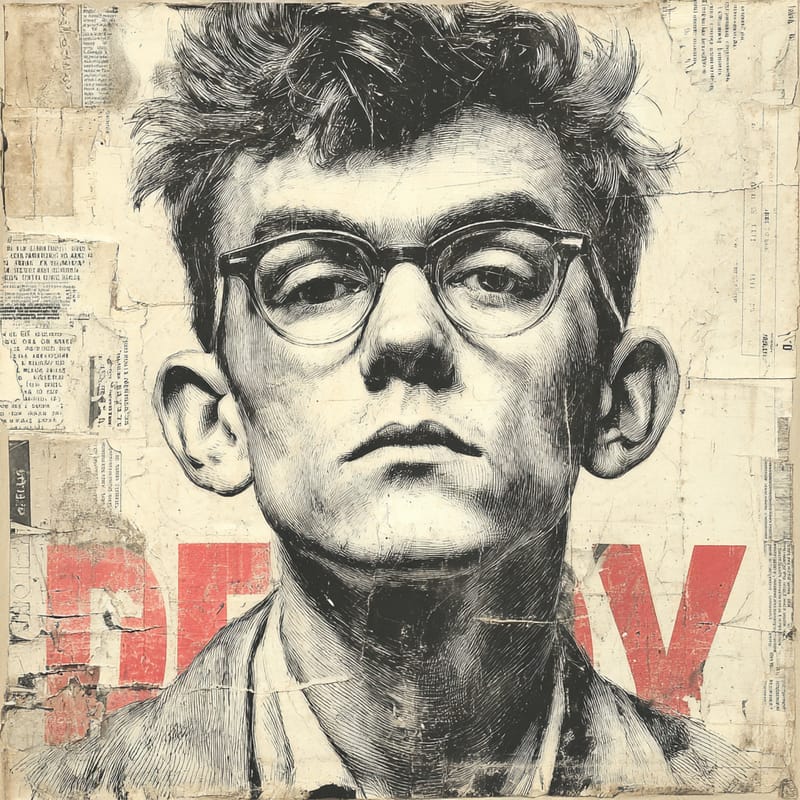
Ramiro Ledesma Ramos
The national-syndicalist theorist
Coined the JONS.
Reactionary FalangistOne of 729 ideologies · enter the Falangist hall →- Role
- Theorist
- Era
- 1905–1936
- Region
- Spain
- Social band
- Reactionary
- Placement
- −30 · +88 · −70
§ Where Ramiro Ledesma Ramos stands
3 axesLedesma aimed his movement at the workers of the anarcho-syndicalist CNT, promising a national-syndicalist economy organised through state-backed syndicates. La Conquista del Estado, launched in 1931, attacked both liberal capitalism and Marxist internationalism, which puts him to the left of most Spanish rightists but well short of socialism.
Ledesma wanted a revolutionary seizure of power by a disciplined nationalist vanguard. The very title of his 1931 weekly, The Conquest of the State, announced the goal, and the JONS organised paramilitary squads, rejected parliamentary democracy and the Second Republic, and demanded an all-powerful national state.
Ledesma's nationalism was intensely traditional in its aims: he exalted Spain's imperial past and national unity, opposed Catalan and Basque autonomy and treated liberalism as foreign decadence. Personally he was less clerical than his Catholic ally Onésimo Redondo, but the JONS he founded in 1931 upheld Catholicism as part of the national tradition, placing him firmly at the traditional pole.
How close are you to Ramiro Ledesma Ramos?
Three statements, one per axis. Answer them and we’ll drop you on the compass next to them.
§ The story
HistoricalRamiro Ledesma Ramos (1905–1936) was the founding theorist of Spanish national syndicalism. Born in a village in the province of Zamora, he worked as a post office clerk in Madrid while studying philosophy and the sciences, wrote for José Ortega y Gasset's Revista de Occidente and absorbed the work of German philosophers. In March 1931 he launched the weekly La Conquista del Estado, and in October that year he and Onésimo Redondo founded the JONS, the Juntas de Ofensiva Nacional-Sindicalista.
The JONS gave Spanish fascism its yoke-and-arrows emblem and red-and-black flag, and in February 1934 it merged with José Antonio Primo de Rivera's Falange Española to form FE de las JONS. Ledesma clashed with José Antonio, whom he considered too conservative and aristocratic, and was expelled in January 1935, after which he wrote ¿Fascismo en España? and Discurso a las juventudes de España. Arrested in Madrid after the Civil War began, he was taken from prison and shot by Republican militiamen in October 1936.
Notable for
- 01Founded the JONS
- 02National-syndicalist theory
- 03Merged into the Falange
Key works & moments
- 1931Launches the weekly La Conquista del Estado in Madrid in March.
- 1931Founds the JONS with Onésimo Redondo in October, adopting the yoke-and-arrows emblem.
- 1934The JONS merge with Falange Española in February, forming FE de las JONS.
- 1935Expelled after clashing with José Antonio; publishes ¿Fascismo en España? under a pseudonym.
- 1936Seized by Republican militiamen in Madrid and shot in October.
§ Minds closest to Ramiro Ledesma Ramos
All minds →

§ Also in the Falangist hall
Enter the hall →The closest minds above are this hall’s whole roster.
§ Common questions
4 answersWhat was Ramiro Ledesma Ramos's political ideology?
Ledesma was the founder of Spanish national syndicalism: on the 99ideologies three-axis compass, a Reactionary Falangist. Economically he sat left of centre (−30), promising workers a syndicate-run national economy beyond both capitalism and Marxism. On governance he was strongly authoritarian (+88), calling for a revolutionary conquest of the state by a nationalist vanguard, and socially he was firmly traditional (−70), devoted to national unity, imperial memory and hostility to liberalism.
Was Ramiro Ledesma Ramos left-wing or right-wing?
Far right, though with a deliberately radical, worker-oriented style. Ledesma courted members of the anarcho-syndicalist CNT and attacked the bourgeois order, which puts him left of centre economically and made him impatient with the more conservative José Antonio Primo de Rivera. But his movement was ultranationalist, anti-Marxist and anti-democratic, used street violence against the left and was absorbed into the Falange, so he belongs to the radical wing of Spanish fascism rather than to the left.
Was Ramiro Ledesma Ramos a fascist?
Most historians say yes, and regard him as the first theorist of Spanish fascism. Ledesma admired the movements of Mussolini and Hitler, founded a paramilitary national-revolutionary party in 1931 and merged it into the Falange in 1934. He nonetheless insisted that Spain needed its own national syndicalism rather than an imported fascism, and in ¿Fascismo en España?, published in 1935, he discussed the label critically, partly to distinguish his revolutionary vision from the conservative right.
Which minds are closest to Ramiro Ledesma Ramos?
On the 99ideologies three-axis compass, the minds closest to Ramiro Ledesma Ramos are Roderick Spode (97% alike), Plínio Salgado (97% alike) and José Antonio Primo de Rivera (96% alike). The furthest is Emma Goldman (1% alike).