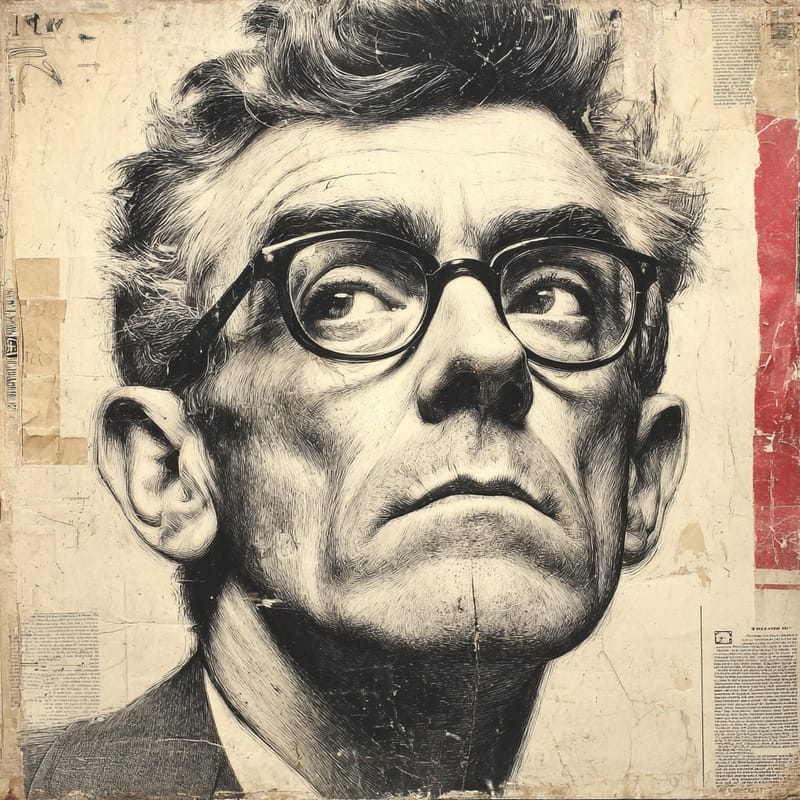
Plínio Salgado
Brazilian Integralism
God, country, family — in green shirts.
Reactionary FalangistOne of 729 ideologies · enter the Falangist hall →- Role
- Integralist leader
- Era
- 1895–1975
- Region
- Brazil
- Social band
- Reactionary
- Placement
- −24 · +90 · −75
§ Where Plínio Salgado stands
3 axesSalgado's October Manifesto of 1932 condemned liberal capitalism and international finance as well as communism, proposing instead an integral state in which economic life would be organised through corporations representing each profession. That corporatism, hostile to finance but protective of private property and the family, places him modestly left of centre.
The Integralists were organised as a hierarchical militia under Salgado as national chief, with uniforms, oaths, ranks and mass parades, and they aimed to replace liberal democracy with an authoritarian integral state. When Vargas banned the movement, militants attacked the Guanabara Palace in May 1938 in a failed attempt to seize power.
Salgado's creed was Catholic and traditionalist, summed up in the motto God, Country and Family. Integralism exalted the spiritual nation over materialism and opposed communism and liberal secularism, and while it celebrated Brazil's indigenous heritage in symbols such as the Tupi greeting Anauê, its leading ideologue Gustavo Barroso gave part of the movement a strongly antisemitic cast in the 1930s.
How close are you to Plínio Salgado?
Three statements, one per axis. Answer them and we’ll drop you on the compass next to them.
§ The story
HistoricalPlínio Salgado (1895–1975) was a Brazilian writer and politician who founded and led Brazilian Integralist Action, often described as the largest fascist movement in Latin American history. Born in São Bento do Sapucaí in São Paulo state, he worked as a journalist and belonged to the nationalist wing of Brazil's modernist movement in the 1920s, publishing the novel O Estrangeiro in 1926. After visiting Italy and meeting Mussolini in 1930, he launched the Integralist movement with his October Manifesto of 1932.
The green-shirted Integralists, with their Greek letter sigma, Tupi greeting Anauê and motto God, Country and Family, recruited hundreds of thousands of members in the mid-1930s. Salgado backed Getúlio Vargas's Estado Novo coup of November 1937, only for Vargas to ban all parties weeks later; after an Integralist assault on the presidential palace failed in May 1938, Salgado was exiled to Portugal. Returning after the war, he led the Party of Popular Representation, won about 8 per cent as a presidential candidate in 1955, served in Congress and supported the military regime after 1964.
Notable for
- 01Led Brazilian Integralism
- 02'God, Country and Family' creed
- 03Mass green-shirt movement
Key works & moments
- 1926Publishes the novel O Estrangeiro, part of Brazil's nationalist modernist current.
- 1930Visits Italy and meets Benito Mussolini, an encounter that shapes his politics.
- 1932Issues the October Manifesto, founding Brazilian Integralist Action.
- 1937Backs Vargas's Estado Novo coup, after which all parties, including his own, are banned.
- 1938An Integralist assault on the Guanabara Palace fails; Salgado is later exiled to Portugal.
- 1955Runs for president for the Party of Popular Representation, winning about 8 per cent.
§ Minds closest to Plínio Salgado
All minds →

§ Also in the Falangist hall
Enter the hall →The closest minds above are this hall’s whole roster.
§ Common questions
4 answersWhat was Plínio Salgado's political ideology?
Salgado was the founder of Brazilian Integralism, a Catholic, corporatist form of fascism: on the 99ideologies three-axis compass, a Reactionary Falangist. Economically he sat slightly left of centre (−24), proposing a corporatist economy that rejected liberal capitalism and communism alike. On governance he was strongly authoritarian (+90), leading a uniformed mass movement that sought an integral state, and socially he was firmly traditional (−75), under the motto God, Country and Family.
Was Plínio Salgado left-wing or right-wing?
Right-wing, on the far right. Salgado built a uniformed, anti-communist mass movement devoted to God, nation and family, modelled in style on Italian fascism, and later supported Brazil's military regime after 1964. His corporatism criticised liberal capitalism and international finance, which pulls him slightly left of centre economically, but it was designed to harmonise classes under national authority, not to empower workers, so his politics belong firmly to the authoritarian right.
Was Brazilian Integralism fascist?
Largely yes, though with distinctly Brazilian and Catholic features. Integralism copied the fascist repertoire of the 1930s: coloured shirts, a raised-arm salute, a supreme leader, mass rallies and a corporatist programme, and Salgado had met Mussolini in 1930. But it put Catholic spirituality at its core, used indigenous Tupi symbols and was less uniformly racist than Nazism, although its ideologue Gustavo Barroso was virulently antisemitic. Historians commonly describe it as the largest fascist movement in Latin America.
Which minds are closest to Plínio Salgado?
On the 99ideologies three-axis compass, the minds closest to Plínio Salgado are Léon Degrelle (99% alike), Roderick Spode (99% alike) and Gabriele D'Annunzio (98% alike). The furthest is Emma Goldman (0% alike).