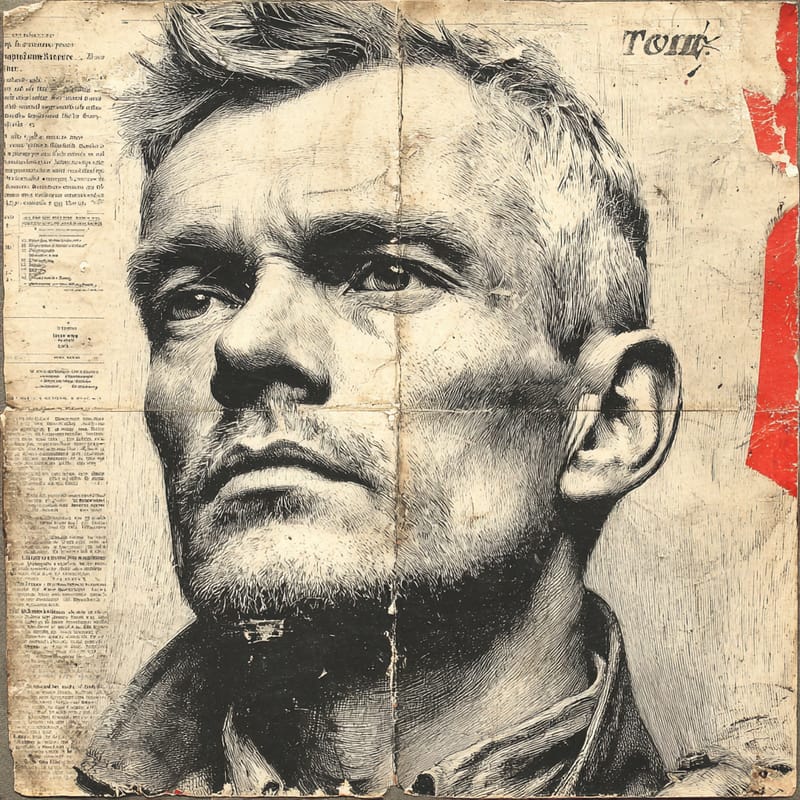
Ernst Röhm
The 'second revolution'
The street army's radicalism.
Restorationist StrasseriteOne of 729 ideologies · enter the Strasserite hall →- Role
- SA commander
- Era
- 1887–1934
- Region
- Germany
- Social band
- Restorationist
- Placement
- −48 · +94 · −88
§ Where Ernst Röhm stands
3 axesRöhm was a soldier rather than an economist, but his SA drew on unemployed men who expected the Nazi seizure of power to sweep away the old elites. In a June 1933 article for the party's monthly journal he insisted that the national revolution was unfinished and warned against compromise with the conservative establishment, a radical posture that put him to the left of Hitler's alliance with big business.
Röhm commanded the SA as a private army, which by 1934 numbered in the millions after absorbing other nationalist leagues, and used it for intimidation and street violence. He wanted it to become the core of a new people's militia under his own control, superseding the Reichswehr, a bid for armed power that Hitler crushed in the 1934 purge.
Röhm's outlook was brutally nationalist and militarist: he idealised the soldier's life, despised the Weimar Republic and shared the movement's antisemitism. His homosexuality, exposed by the Munich press in 1931–32, was tolerated by Hitler until it became a pretext for the purge, after which the regime tightened Paragraph 175 against gay men in 1935.
How close are you to Ernst Röhm?
Three statements, one per axis. Answer them and we’ll drop you on the compass next to them.
§ The story
HistoricalErnst Röhm (1887–1934) was a German army officer and an early ally of Adolf Hitler who commanded the Nazi Party's paramilitary SA, the stormtroopers, in the early 1930s. Born in Munich, he was wounded several times in the First World War, then served with the Freikorps Epp and used his army post to arm right-wing groups in Bavaria. He joined the party in its infancy, took part in the 1923 Beer Hall Putsch and, after a spell as a military adviser in Bolivia, returned at Hitler's request to lead the SA from January 1931.
Under Röhm the SA grew into a mass army of millions that fought communists and socialists in the streets and helped bring the Nazis to power in 1933. He then demanded a 'second revolution' against the conservative establishment and wanted the SA to absorb the regular army, alarming the generals, President Hindenburg and Hitler's business backers. On 30 June 1934 Hitler had him arrested at Bad Wiessee, and he was shot in Munich's Stadelheim prison on 1 July. The regime cited his homosexuality to justify the purge, known as the Night of the Long Knives.
Notable for
- 01Commanded the SA
- 02Demanded a 'second revolution'
- 03Killed in the Night of the Long Knives
Key works & moments
- 1919Serves with the Freikorps Epp in Bavaria and joins the tiny German Workers' Party.
- 1923Seizes the Bavarian War Ministry during the failed Beer Hall Putsch in Munich.
- 1928Publishes his memoirs and leaves Germany to serve as a military adviser in Bolivia.
- 1931Takes command of the SA as chief of staff, building it into a mass paramilitary army.
- 1933Enters Hitler's cabinet as a minister without portfolio in December.
- 1934Arrested at Bad Wiessee and shot in Stadelheim prison during the Night of the Long Knives.
§ Minds closest to Ernst Röhm
All minds →


§ Also in the Strasserite hall
Enter the hall →The closest minds above are this hall’s whole roster.
§ Common questions
4 answersWhat was Ernst Röhm's political ideology?
Röhm was a Nazi paramilitary leader identified with the party's radical wing: on the 99ideologies three-axis compass, a Restorationist Strasserite. Economically he sat left of centre (−48), voicing the SA rank and file's demand for a 'second revolution' against the old elites. On governance he was near the authoritarian extreme (+94), commanding a private army of millions, and socially he was deeply traditional (−88), a militarist and nationalist who shared the movement's antisemitism.
Was Ernst Röhm left-wing or right-wing?
Right-wing, on the far right, despite his radical rhetoric. Röhm was a nationalist army officer, a founding figure of the Nazi movement and the commander of a paramilitary force that fought the left in the streets. His demand for a 'second revolution' against the conservative establishment gave him an anti-elitist edge that the compass registers as left of centre economically, but it was a revolution of nationalist soldiers, not of socialists, and he never questioned Nazism's racial nationalism.
Why did Hitler have Ernst Röhm killed?
Because Röhm's ambitions threatened Hitler's alliance with the army and the conservative establishment. By 1934 the SA dwarfed the 100,000-strong Reichswehr, and Röhm wanted to merge them under his command while demanding a 'second revolution'. The generals, President Hindenburg and business leaders pressed Hitler to rein him in, and Göring and Himmler fed him claims of an SA coup. Hitler struck on 30 June 1934, killing Röhm and scores of others, and in August the army swore a personal oath to him.
Which minds are closest to Ernst Röhm?
On the 99ideologies three-axis compass, the minds closest to Ernst Röhm are The Brown Radical (archetype) (98% alike), Gregor Strasser (98% alike) and Otto Strasser (96% alike). The furthest is Lysander Spooner (0% alike).