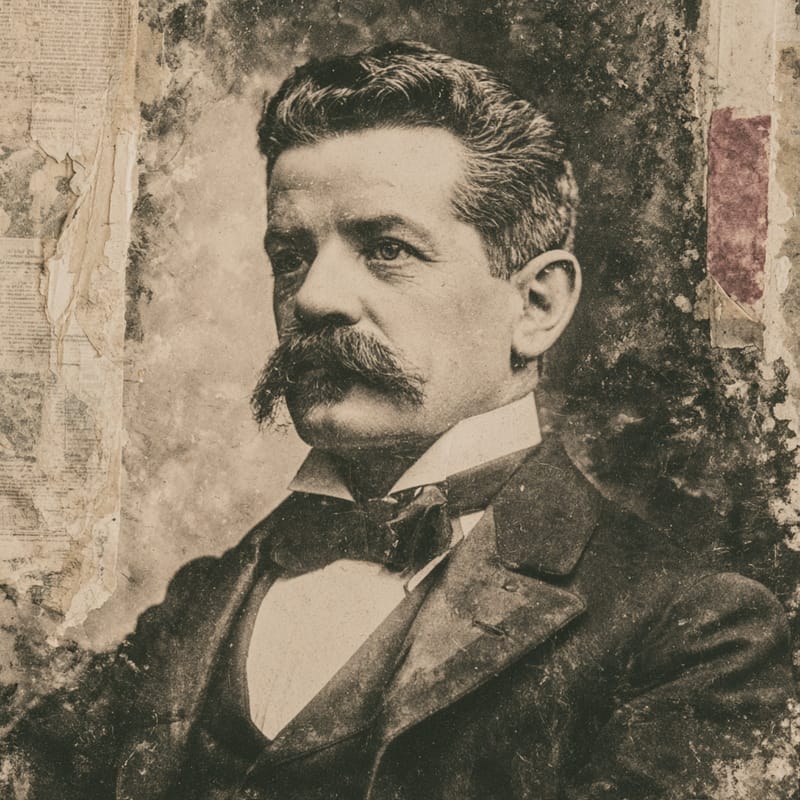
George A. Schilling
GeoanarchistOne of 729 ideologies · enter the Geoanarchist hall →- Role
- —
- Era
- —
- Region
- —
- Social band
- Centre (no modifier)
- Placement
- +25 · −100 · 0
§ Where George A. Schilling stands
3 axesSchilling's economics leaned toward free exchange as he moved away from the state socialism of his youth. Like many Chicago radicals of the 1880s, he was drawn to Henry George's Progress and Poverty (1879), which blamed poverty on private monopoly of land rather than on markets as such, and he came to see freed labour and exchange, with land rent returned to the community, as the path to justice.
On governance Schilling stood at the anti-state pole of the labour movement. His mature anarchism was philosophical and individualist rather than insurrectionary: government appeared as the protector of monopoly, and voluntary association as its replacement. He was nonetheless willing to work inside the system for concrete gains, serving Governor Altgeld's administration from 1893 while pressing for the Haymarket pardon.
Socially Schilling was a labour radical of Gilded Age Chicago, rooted in its large German immigrant working class. He campaigned for the eight-hour day in 1886 and, after the Haymarket trial, for clemency for the condemned men, whose trial Altgeld's 1893 pardon message would denounce as unfair.
How close are you to George A. Schilling?
Three statements, one per axis. Answer them and we’ll drop you on the compass next to them.
§ The story
HistoricalGeorge A. Schilling was a German-American labour organiser and one of the leading figures in Chicago's workers' movement from the 1870s to the 1890s. He came up through the city's socialist movement, where he worked alongside Albert Parsons, and was prominent in the campaign for the eight-hour day that culminated in the strikes of May 1886. Over time he moved away from state socialism toward individualist anarchism and Henry George's argument that monopoly of land lay at the root of poverty.
Schilling's significance lies in the bridge he built between Chicago's radicals and mainstream reform. After the Haymarket bombing of May 1886 he worked for clemency for the condemned anarchists, among them his old comrade Parsons, who was hanged in 1887. He became a trusted adviser to Governor John Peter Altgeld, who appointed him secretary of the Illinois Bureau of Labor Statistics in 1893 and that year pardoned the three surviving defendants, a decision Schilling had pressed for and one that cost Altgeld dearly with the press and voters.
Key works & moments
- 1870sJoins Chicago's socialist movement, working alongside Albert Parsons.
- 1886Campaigns for the eight-hour day during Chicago's May strikes, which end in the Haymarket bombing.
- 1887Works for clemency for the condemned Haymarket anarchists; four are hanged in November.
- 1893Governor Altgeld names him secretary of the Illinois Bureau of Labor Statistics.
- 1893Altgeld pardons the three surviving Haymarket defendants, a cause Schilling had urged on him.
§ Minds closest to George A. Schilling
All minds →


§ Also in the Geoanarchist hall
Enter the hall →§ Common questions
4 answersWhat was George A. Schilling's political ideology?
George A. Schilling was a labour radical who joined individualist anarchism to Henry George's land reform: on the 99ideologies three-axis compass, a Geoanarchist. Economically he sat moderately on the market side (+25), blaming land monopoly rather than exchange for poverty, and on governance he stood at the anti-state extreme (−100), preferring voluntary association to coercive government. Socially he belonged to the egalitarian immigrant labour movement of Gilded Age Chicago, campaigning for shorter hours and for clemency for the Haymarket defendants.
Was George A. Schilling left-wing or right-wing?
Left-wing in his own time and setting, though his ideas do not map neatly onto later divisions. Schilling came out of the socialist and labour movements of 1870s Chicago and spent his career on workers' causes, from the eight-hour day to the Haymarket clemency campaign. Yet his mature views, which blamed land monopoly rather than markets and distrusted the state itself, belong to the libertarian strand of American radicalism, closer to individualist anarchism than to Marxist socialism.
Was George A. Schilling an anarchist?
Yes, but of the philosophical, individualist kind rather than the revolutionary kind associated with the Haymarket defendants. Schilling began as a socialist in the 1870s and came to see government as the protector of monopoly, pairing that view with Henry George's land ideas. He was also a pragmatist who worked with reform politicians and served in Governor Altgeld's administration from 1893, so his anarchism was an ideal of voluntary association rather than a call to insurrection.
Which minds are closest to George A. Schilling?
On the 99ideologies three-axis compass, the minds closest to George A. Schilling are Albert Jay Nock (87% alike), Leonard Peikoff (87% alike) and The Geo-Anarchist (archetype) (86% alike). The furthest is Pol Pot (3% alike).