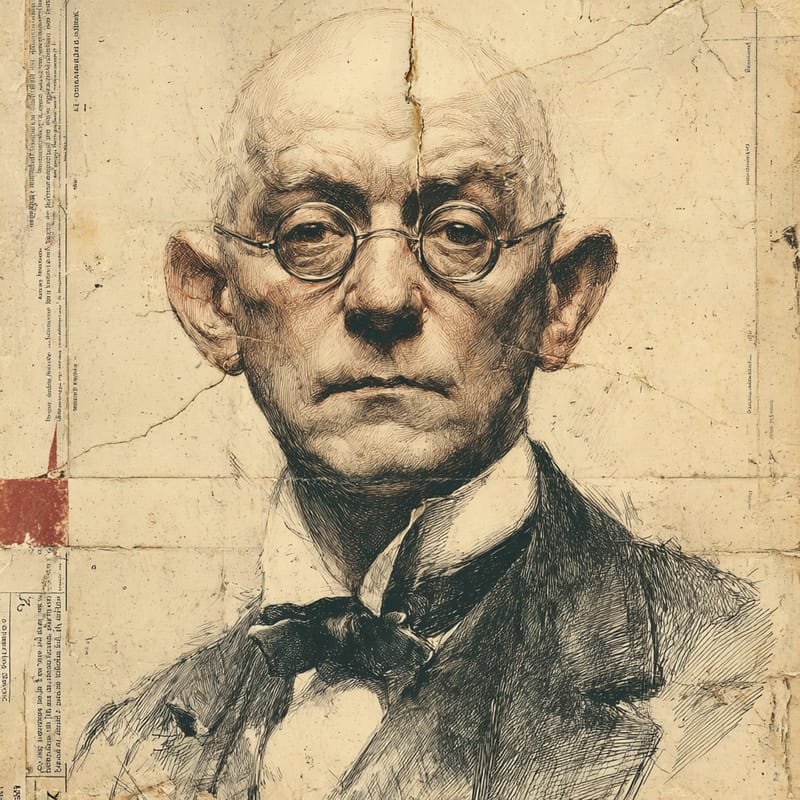
Albert Jay Nock
Our enemy, the state
Georgist and radically anti-state.
Heterodox GeoanarchistOne of 729 ideologies · enter the Geoanarchist hall →- Role
- Writer
- Era
- 1870–1945
- Region
- United States
- Social band
- Heterodox
- Placement
- +20 · −88 · +30
§ Where Albert Jay Nock stands
3 axesNock was a free-market man with a Georgist exception. He wanted exchange, enterprise and trade left alone and attacked the New Deal's economic controls, but followed Henry George in holding that private monopoly of land let owners pocket rent created by the community; his Henry George: An Essay (1939) praised that diagnosis. The land carve-out keeps him only mildly right of centre.
Our Enemy, the State (1935) is the core of his anti-statism. Borrowing Franz Oppenheimer's distinction between the economic means of getting wealth, work and exchange, and the political means, seizure, Nock argued that every gain in state power, including the New Deal, came at the expense of voluntary social power. Deeply pessimistic, he sought no political cure and urged individuals to see the state clearly rather than capture it.
Socially Nock was a nonconformist rather than a conservative. A priest who quit the ministry, he challenged the Allies' claim of sole German war guilt in The Myth of a Guilty Nation (1922) and treated private conduct as nobody's business but the individual's. The progressive lean has firm limits: his humanism was openly elitist, and Isaiah's Job (1936) dismissed the masses in favour of a small cultivated Remnant.
How close are you to Albert Jay Nock?
Three statements, one per axis. Answer them and we’ll drop you on the compass next to them.
§ The story
HistoricalAlbert Jay Nock (1870–1945) was an American essayist, editor and social critic. Born in Scranton, Pennsylvania, and educated at St Stephen's College (now Bard), he served as an Episcopal priest before leaving the ministry for muckraking journalism at The American Magazine. He then joined The Nation, and in 1920 co-founded The Freeman, a radical weekly that ran until 1924, before turning to books such as Jefferson (1926) and Our Enemy, the State (1935).
Nock's significance lies in fusing Henry George's land economics with an uncompromising hostility to the state, which he defined, after Franz Oppenheimer, as the organisation of the political means. His opposition to American involvement in both world wars and to the New Deal made him a founding voice of the Old Right, and he shaped Frank Chodorov, William F. Buckley Jr and Murray Rothbard. His legacy is clouded by his open contempt for the masses and by two 1941 Atlantic Monthly essays on American Jews that are widely judged antisemitic.
Notable for
- 01'Our Enemy, the State'
- 02Georgist anti-statism
- 03'Isaiah's Job'
Key works & moments
- 1920Co-founds The Freeman, a radical weekly that runs until 1924.
- 1922Publishes The Myth of a Guilty Nation, disputing claims of Germany's sole war guilt.
- 1935Publishes Our Enemy, the State, contrasting voluntary social power with coercive state power.
- 1936The Atlantic Monthly publishes Isaiah's Job, his essay on serving the Remnant.
- 1939Publishes Henry George: An Essay, a study of the land reformer.
- 1943Publishes his autobiography, Memoirs of a Superfluous Man.
In their own words
“It is unfortunately none too well understood that, just as the State has no money of its own, so it has no power of its own.”
§ Minds closest to Albert Jay Nock
All minds →

§ Also in the Geoanarchist hall
Enter the hall →§ Common questions
4 answersWhat was Albert Jay Nock's political ideology?
Albert Jay Nock was a Georgist individualist and a founding voice of modern American anti-statism: on the 99ideologies three-axis compass, a Heterodox Geoanarchist. Economically he sat mildly right of centre (+20), favouring free exchange while treating land monopoly as the root of exploitation. On governance he was radically anti-state (−88), as Our Enemy, the State (1935) shows, and socially he leaned mildly progressive (+30) as a nonconformist individualist, though an openly elitist one.
Was Albert Jay Nock left-wing or right-wing?
Mostly right-wing, as a founding figure of the American Old Right, though he does not fit neatly. In the 1920s his Freeman was a radical journal, and his Georgist attack on land monopoly had a left-wing edge. What made him a hero of the right was his hostility to the New Deal and the expanding federal state in the 1930s. He is best described as a radical individualist whose anti-statism cut across party labels.
What did Albert Jay Nock mean by social power and state power?
Nock meant two rival ways of organising life. Social power, in Our Enemy, the State (1935), is the energy of people acting voluntarily: working, trading, building institutions and helping one another. State power is coercive and, following Franz Oppenheimer, lives by the political means of seizing what others produce. Nock argued that the two exist in inverse proportion, so every crisis that enlarges the state, from war to the New Deal, permanently weakens society's capacity to govern itself.
Which minds are closest to Albert Jay Nock?
On the 99ideologies three-axis compass, the minds closest to Albert Jay Nock are The Geo-Anarchist (archetype) (97% alike), The Community Land Trust (archetype) (95% alike) and Bolton Hall (95% alike). The furthest is Adam Sutler (8% alike).