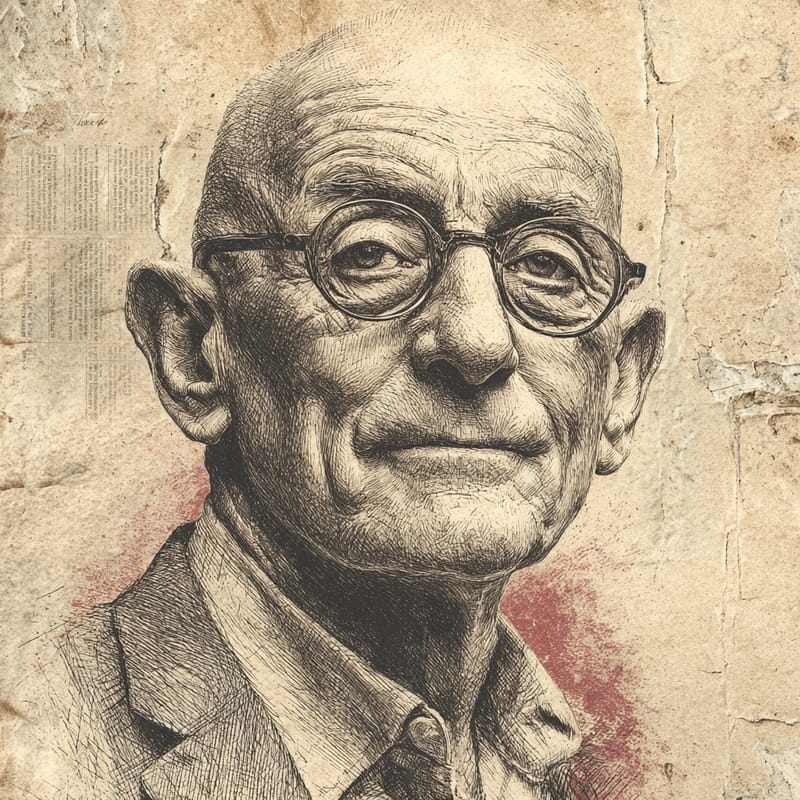
Leonard Read
I, Pencil
No one can make even a pencil alone.
MinarchistOne of 729 ideologies · enter the Minarchist hall →- Role
- Founder & writer
- Era
- 1898–1983
- Region
- United States
- Social band
- Centre (no modifier)
- Placement
- +4 · −70 · +5
§ Where Leonard Read stands
3 axesRead's case for markets was moral and educational rather than technical. I, Pencil (1958) argued that countless people coordinate to make a simple pencil without any directing mind, and his books condemned subsidies, tariffs and price controls alike. He opposed businesses seeking favours from government as firmly as welfare, framing the market as peaceful cooperation rather than a programme for any interest group.
Read wanted government strictly limited to keeping the peace. In Anything That's Peaceful (1964) he argued that people should be free to do anything peaceful, with government confined to restraining fraud, violence and predation. He spurned party politics and lobbying, insisting that liberty would spread only through self-improvement and example, which is why he built an educational foundation rather than a political movement.
Read was an optimistic, spiritually minded individualist who rarely engaged cultural controversies. He believed moral self-improvement was the root of social progress, and the seminars FEE ran from its founding in 1946 aimed to change individuals one at a time. He left family, faith and custom to voluntary society, neither defending tradition by law nor campaigning to overturn it.
How close are you to Leonard Read?
Three statements, one per axis. Answer them and we’ll drop you on the compass next to them.
§ The story
HistoricalLeonard Edward Read (1898–1983) was an American free-market organiser and writer who founded the Foundation for Economic Education. Born in Hubbardston, Michigan, he served in the First World War, ran a wholesale produce business and built a career in chambers of commerce, becoming general manager of the Los Angeles Chamber of Commerce in 1939. Converted to laissez-faire in the 1930s, he left to establish FEE in 1946 at Irvington-on-Hudson, New York, as one of the first American institutions devoted to teaching free-market ideas.
Read's significance was as an institution-builder and popular educator rather than a theorist. FEE published books and pamphlets, ran seminars, gave Ludwig von Mises an American platform and from the mid-1950s published The Freeman, while Read himself wrote dozens of books. His 1958 essay I, Pencil, in which a pencil explains that no single person knows how to make it, became one of the most reprinted defences of the market. He was a founding member of the Mont Pelerin Society in 1947 and rejected electoral politics in favour of persuasion.
Notable for
- 01Founded FEE
- 02'I, Pencil'
- 03Popular free-market education
Key works & moments
- 1939Becomes general manager of the Los Angeles Chamber of Commerce.
- 1946Founds the Foundation for Economic Education at Irvington-on-Hudson, New York.
- 1947Joins Hayek, Mises and Friedman at the founding meeting of the Mont Pelerin Society.
- 1950sFEE takes over The Freeman, which becomes its long-running monthly magazine.
- 1958Publishes the essay I, Pencil in The Freeman.
- 1964Publishes Anything That's Peaceful, setting out his case for strictly limited government.
In their own words
“Simple? Yet, not a single person on the face of this earth knows how to make me.”
§ Minds closest to Leonard Read
All minds →

§ Also in the Minarchist hall
Enter the hall →§ Common questions
4 answersWhat was Leonard Read's political ideology?
Leonard Read was a classical liberal and early libertarian who wanted government kept to the bare protection of peace: on the 99ideologies three-axis compass, a Minarchist. Economically he sits just right of centre (+4), defending markets as voluntary cooperation and attacking privileges for business and other groups alike. On governance he was strongly libertarian (−70), confining the state to restraining violence and fraud, and socially he sat near the centre (+5), leaving culture and faith to voluntary society.
Was Leonard Read left-wing or right-wing?
Right of centre by American convention, though he resisted the label. Read's defence of free markets and opposition to the New Deal state placed him in the postwar conservative and libertarian camp, and businessmen funded his foundation. Yet he disdained party politics, criticised corporate subsidies and tariffs, and preferred the word libertarian, which FEE helped popularise in the 1950s. He is best seen as a founder of the modern libertarian movement rather than a conservative.
What is the lesson of Leonard Read's I, Pencil?
I, Pencil (1958) argues that complex goods emerge from spontaneous cooperation that no one plans or fully understands. Narrated by an ordinary pencil, the essay traces its cedar, graphite, rubber, brass and lacquer back through countless workers and firms around the world, concluding that no single person knows how to make it. Read's point was that free markets coordinate knowledge better than any central planner, so creative energies should be left uninhibited. Milton Friedman retold the story in his 1980 television series Free to Choose.
Which minds are closest to Leonard Read?
On the 99ideologies three-axis compass, the minds closest to Leonard Read are Harry Browne (92% alike), Robert Heinlein (90% alike) and Frank Chodorov (88% alike). The furthest is Adam Sutler (16% alike).