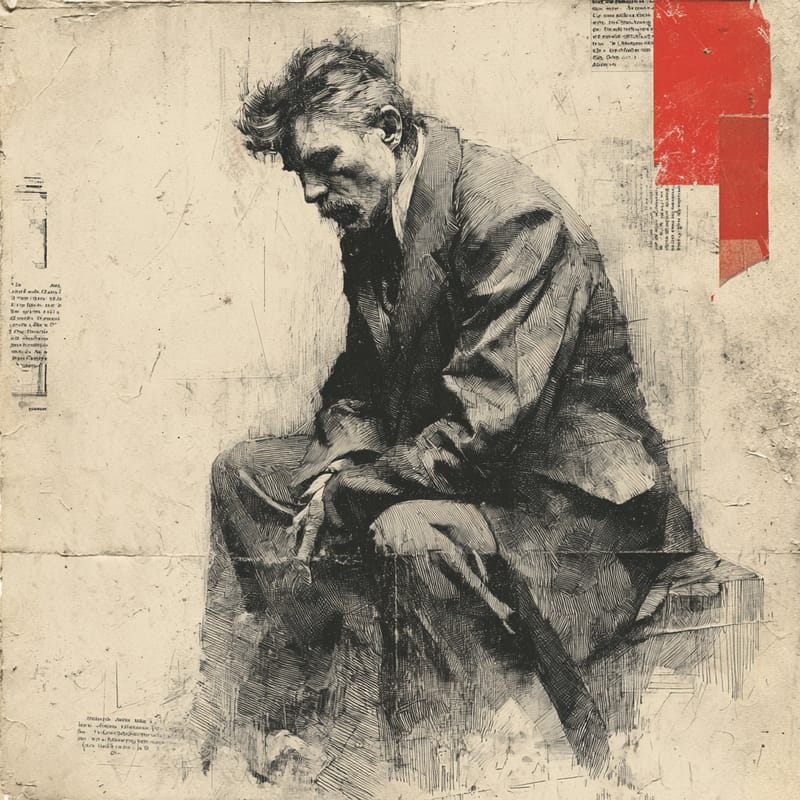
The Grey-Market Smuggler (archetype)
Free trade, unlicensed
The market the state can't see.
Heterodox AgoristOne of 729 ideologies · enter the Agorist hall →- Role
- Counter-economic trader
- From
- Archetype
- Region
- —
- Social band
- Heterodox
- Placement
- +4 · −88 · +30
§ Where The Grey-Market Smuggler (archetype) stands
3 axesThe Smuggler sits at the economic centre. It trades freely and responds to prices and demand, but its enterprise is usually small, informal and driven by survival rather than accumulation. Hernando de Soto's The Other Path (1986) found Lima's informal traders and builders to be capable entrepreneurs held back by costly legal barriers, not enemies of the market.
It erodes state power simply by ignoring it: licences, customs duties, taxes and prohibitions are routed around rather than challenged. Samuel Edward Konkin III's New Libertarian Manifesto (1980) made such evasion the core of agorist strategy, arguing that as more people trade outside state control, the state's revenue and authority wither.
The archetype is pragmatic and unsentimental. It serves forbidden desires, from alcohol under American Prohibition in 1920–33 to Western records and jeans in the Soviet Union, which gives it a mildly progressive edge against moral and cultural controls; but it is driven by profit and need rather than ideology, and often relies on tight family and clan networks.
How close are you to The Grey-Market Smuggler (archetype)?
Three statements, one per axis. Answer them and we’ll drop you on the compass next to them.
§ The story
ArchetypeThe Grey-Market Smuggler is the everyday hero of agorist theory: the trader who sells untaxed, unlicensed or forbidden goods and services, and whose ordinary acts of evasion agorists see as the real revolution against the state. History is full of such figures, from the tea smugglers of eighteenth-century Britain and the bootleggers of American Prohibition to Soviet black marketeers and the street vendors of Lima studied by Hernando de Soto in The Other Path (1986).
The archetype recurs because wherever states tax, license or prohibit, parallel markets grow to meet demand; the International Labour Organization estimated in 2018 that about six in ten of the world's workers earn their living informally. It also reveals the costs of life outside the law. Black markets offer no courts to enforce contracts, and Prohibition-era bootlegging enriched violent gangs. States can also shrink them by changing policy, as when Britain's 1784 cut in tea duty collapsed the smuggling trade.
Notable for
- 01The counter-economy in action
- 02Erosion-by-evasion
- 03Agorist everyman
Key works & moments
- 1784Britain's Commutation Act slashes tea duty, wiping out much of the smuggling trade.
- 1920–33US Prohibition creates a vast bootlegging economy and powerful criminal gangs.
- 1977Economist Gregory Grossman describes the Soviet Union's thriving second economy.
- 1980Konkin's New Libertarian Manifesto names the counter-economy the engine of revolution.
- 1986Hernando de Soto's The Other Path documents Peru's informal economy.
- 2018The ILO estimates about two billion people work in the informal economy.
§ Minds closest to The Grey-Market Smuggler (archetype)
All minds →


§ Also in the Agorist hall
Enter the hall →§ Common questions
4 answersWhat is the Grey-Market Smuggler archetype's political ideology?
The Grey-Market Smuggler stands for agorism at street level: on the 99ideologies three-axis compass, a Heterodox Agorist. Economically it sits at the centre (+4), trading freely but on a small, informal scale driven by need. On governance it is strongly libertarian (−88), eroding state power by ignoring taxes, licences and prohibitions, and socially it leans mildly progressive (+30), serving forbidden tastes while remaining pragmatic and unideological.
Is the Grey-Market Smuggler archetype left-wing or right-wing?
Neither; it is anti-state rather than left or right. The smuggler's free trading and entrepreneurship appeal to the market right, while its defiance of authority and its role in the survival of the poor, from Lima's street vendors to Soviet black marketeers, appeal to parts of the left. Agorists value it precisely because it practises freedom without ideology, eroding the state through everyday exchange rather than through any political programme.
What is counter-economics?
Counter-economics is Samuel Edward Konkin III's term for all peaceful economic activity that the state forbids, taxes or regulates and that people carry on anyway, from smuggling and unlicensed trading to working off the books. In his New Libertarian Manifesto (1980) he argued that this counter-economy is the true engine of liberation: by moving trade beyond the state's reach, ordinary people starve it of revenue and legitimacy. Critics reply that informal markets also shelter fraud, exploitation and organised crime.
Which minds are closest to The Grey-Market Smuggler (archetype)?
On the 99ideologies three-axis compass, the minds closest to The Grey-Market Smuggler (archetype) are J. Neil Schulman (97% alike), Samuel Edward Konkin III (96% alike) and The Crypto-Trader (archetype) (95% alike). The furthest is Adam Sutler (6% alike).