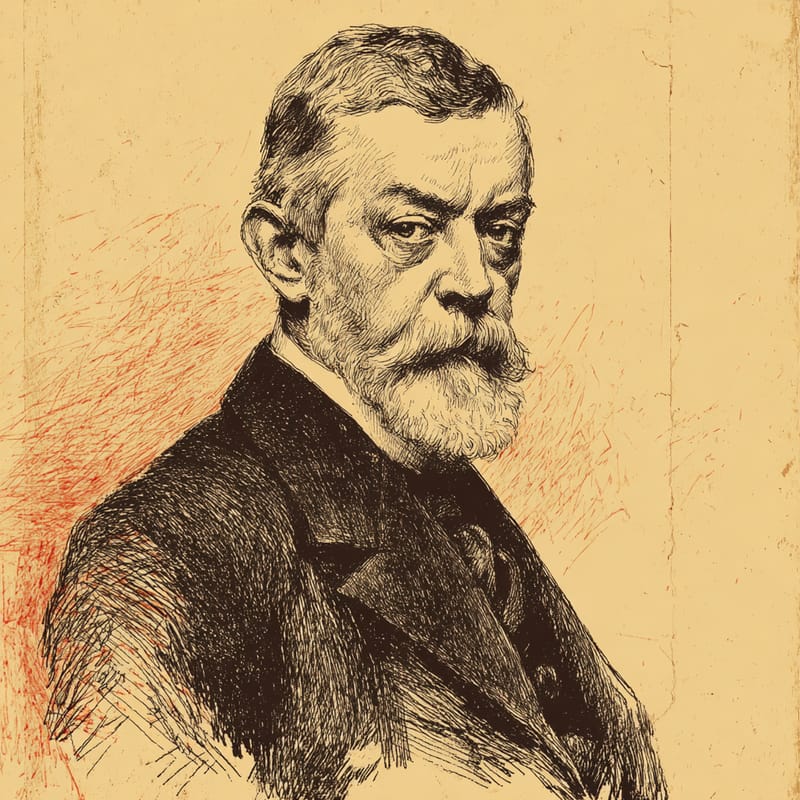
Bolton Hall
A little land and a living
Single-tax georgism meets anarchism.
Reformist GeoanarchistOne of 729 ideologies · enter the Geoanarchist hall →- Role
- Writer & activist
- Era
- 1854–1938
- Region
- United States
- Social band
- Reformist
- Placement
- +24 · −90 · +42
§ Where Bolton Hall stands
3 axesHall sits right of centre economically. He accepted private enterprise, trade and the right to the fruits of one's labour, but followed Henry George's Progress and Poverty (1879) in holding that land values belong to the community. Free Acres, founded in 1910, put that into practice by collecting land rent for common purposes instead of taxing labour or buildings.
Hall was a Tolstoyan anarchist who distrusted coercive government. Rather than wait for a state to enact the single tax, he pursued land justice by voluntary means: the vacant-lot gardens of the 1890s opened idle land to the jobless, and the Free Acres colony of 1910, run by its own residents, collected land rent by agreement rather than compulsion.
Hall's progressivism was cooperative and agrarian, grounded in Tolstoy's Christian ethics rather than secular radicalism. He championed the urban poor and the back-to-the-land movement, and his writing mixed practical farming advice with moral exhortation, a religious framing that kept him a moderate progressive rather than a cultural iconoclast.
How close are you to Bolton Hall?
Three statements, one per axis. Answer them and we’ll drop you on the compass next to them.
§ The story
HistoricalBolton Hall (1854–1938) was an Irish-born American lawyer and writer, the son of the Presbyterian minister John Hall, who led New York's Fifth Avenue Presbyterian Church. Trained in the law, he became a follower of Henry George's single-tax movement and of Leo Tolstoy's Christian anarchism, and in the depression of the 1890s he led efforts in New York to let the jobless grow food on vacant city lots.
Hall spread his ideas through essays and practical manuals such as Three Acres and Liberty and A Little Land and a Living, which urged city workers to win independence through small-scale intensive farming. In 1910 he founded Free Acres in New Jersey, a single-tax community in which residents lease their land and pay its rental value to the community rather than to a landlord. His blend of Georgist economics and Tolstoyan anti-statism made him a forerunner of what came to be called geoanarchism.
Notable for
- 01Vacant-lot gardening movement
- 02'A Little Land and a Living'
- 03Georgist anarchism
Key works & moments
- 1879Henry George's Progress and Poverty launches the single-tax movement Hall would champion.
- 1890sOrganises vacant-lot gardening in New York, letting the unemployed farm idle city land.
- 1900sPublishes Three Acres and Liberty and A Little Land and a Living, manuals for self-sufficiency.
- 1910Founds Free Acres, a single-tax community in New Jersey.
§ Minds closest to Bolton Hall
All minds →

§ Also in the Geoanarchist hall
Enter the hall →§ Common questions
4 answersWhat was Bolton Hall's political ideology?
Bolton Hall was a Georgist single-taxer and Tolstoyan anarchist: on the 99ideologies three-axis compass, a Reformist Geoanarchist. Economically he sat right of centre (+24), accepting private enterprise and trade while holding that land values belong to the community. On governance he was strongly libertarian (−90), preferring voluntary land-sharing to state compulsion, and socially he was moderately progressive (+42), a cooperative, back-to-the-land reformer grounded in Christian ethics.
Was Bolton Hall left-wing or right-wing?
He mixed both. Hall's acceptance of private enterprise and free trade and his distrust of government place him right of centre economically, closer to classical liberalism than to socialism. But his campaigns against land monopoly, his work for the urban poor and his Tolstoyan ethics drew on the reforming left of his day. Georgism itself has long attracted both progressives and free-marketeers, and Hall's anarchism added a rejection of state compulsion that neither side fully shared.
What is geoanarchism?
Geoanarchism combines Henry George's view that land and its rental value belong to the whole community with anarchism's rejection of the state. Instead of a government collecting a single tax on land values, voluntary communities lease land to their members and use the rent for common purposes. Single-tax enclaves such as Fairhope, Alabama (1894), Arden, Delaware (1900), and Bolton Hall's Free Acres in New Jersey (1910) are its best-known experiments, and community land trusts draw on the same idea.
Which minds are closest to Bolton Hall?
On the 99ideologies three-axis compass, the minds closest to Bolton Hall are The Community Land Trust (archetype) (99% alike), The Geo-Anarchist (archetype) (97% alike) and Albert Jay Nock (95% alike). The furthest is Gregor Strasser (5% alike).