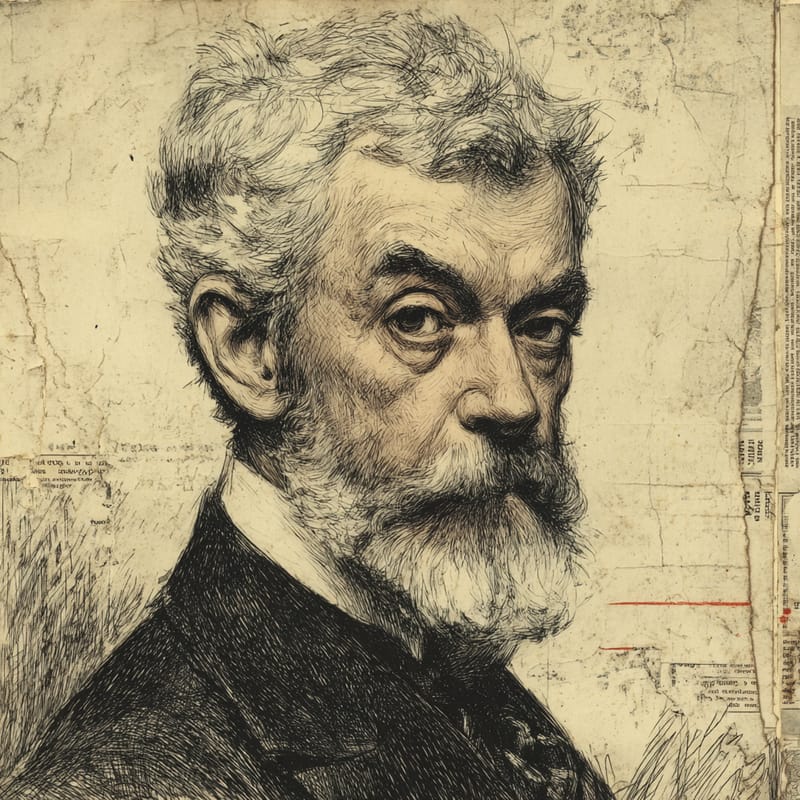
Georg Brandes
The modern breakthrough
Liberalism of mind and culture.
Reformist Nordic LiberalOne of 729 ideologies · enter the Nordic Liberal hall →- Role
- Critic
- Era
- 1842–1927
- Region
- Denmark
- Social band
- Reformist
- Placement
- −20 · −46 · +50
§ Where Georg Brandes stands
3 axesEconomics was never Brandes's main concern, but he leaned toward the radical, reform-minded wing of Danish liberalism rather than toward laissez-faire. He wrote a sympathetic study of the socialist Ferdinand Lassalle in 1877 and moved in the circle of the newspaper Politiken, co-founded in 1884 by his brother Edvard and Viggo Hørup, though he never embraced socialism and later championed an aristocratic radicalism of exceptional individuals.
Brandes defended free thought, free speech and individual conscience against church, state and academic orthodoxy, and paid for it with his exclusion from a Copenhagen chair. He took the side of small nations against empires, writing on partitioned Poland in 1888 and protesting the persecution of Armenians, and during the First World War he refused to champion either side.
Brandes was a radical secularist: he translated John Stuart Mill's The Subjection of Women into Danish in 1869 and called for literature that confronted marriage, sexuality and religion openly. In old age he wrote Jesus: A Myth (1925), denying the historical existence of Jesus, which drew fierce attacks from the church.
How close are you to Georg Brandes?
Three statements, one per axis. Answer them and we’ll drop you on the compass next to them.
§ The story
HistoricalGeorg Morris Cohen Brandes (1842–1927) was a Danish literary critic and scholar, born into a secular Jewish family in Copenhagen. A brilliant student at the University of Copenhagen, he shocked the Danish establishment in 1871 with lectures, later published as Main Currents in Nineteenth-Century Literature, that measured Danish culture against European radicalism and called for a literature that would put social problems up for debate. Denied a professorship because of his views, he lived in Berlin from 1877 to 1883.
Brandes became the leading spirit of the Modern Breakthrough, the realist and naturalist turn in Scandinavian writing associated with Ibsen, Strindberg, Bjørnson and J. P. Jacobsen; the name came from his 1883 book Men of the Modern Breakthrough. A freethinker and cosmopolitan, he translated John Stuart Mill on women's rights, gave the first university lectures on Nietzsche in 1888 and championed oppressed nationalities such as the Poles and Armenians. Conservatives and clergy vilified him as a corrupter of morals for decades.
Notable for
- 01Led the 'Modern Breakthrough'
- 02Champion of free thought
- 03Introduced Nietzsche to the North
Key works & moments
- 1869Translates John Stuart Mill's The Subjection of Women into Danish.
- 1871Begins his Copenhagen lectures on Main Currents in Nineteenth-Century Literature.
- 1877–83Lives and writes in Berlin after being passed over for a Copenhagen professorship.
- 1883Publishes Men of the Modern Breakthrough, giving the movement its name.
- 1888Gives the first university lectures on Friedrich Nietzsche, in Copenhagen.
- 1925Publishes Jesus: A Myth, provoking outrage among Danish clergy.
§ Minds closest to Georg Brandes
All minds →


§ Also in the Nordic Liberal hall
Enter the hall →§ Common questions
4 answersWhat was Georg Brandes's political ideology?
Georg Brandes was a radical liberal freethinker: on the 99ideologies three-axis compass, a Reformist Nordic Liberal. Economically he sat slightly left of centre (−20), sympathetic to social reform without embracing socialism. On governance he leaned libertarian (−46), defending free thought and individual conscience against church, state and academic orthodoxy, and backing small nations against empires. Socially he was progressive (+50), a secularist who championed women's rights and open debate on morality and religion.
Was Georg Brandes left-wing or right-wing?
Left of centre, chiefly on cultural and social questions. Brandes was the leading radical of Danish culture, allied with the liberal opposition and loathed by conservatives and the church for his secularism and his defence of free expression. On economics he was moderate and largely uninterested, and his later admiration for Nietzsche's aristocratic radicalism added an elitist, individualist strain that does not fit neatly on the left. He is best seen as a cultural liberal radical.
What was the Modern Breakthrough?
It was the turn of Scandinavian literature in the 1870s and 1880s toward realism, naturalism and social criticism, and Brandes was its chief inspirer. His 1871 lectures urged writers to put problems up for debate rather than retreat into romantic idealism, and authors such as Henrik Ibsen, August Strindberg, Bjørnstjerne Bjørnson and J. P. Jacobsen took up marriage, religion, sexuality and social hypocrisy. The name comes from Brandes's 1883 book Men of the Modern Breakthrough, and the movement helped make Nordic literature a European force.
Which minds are closest to Georg Brandes?
On the 99ideologies three-axis compass, the minds closest to Georg Brandes are Hans Rosling (98% alike), Johan Norberg (95% alike) and Birger (the reasonable Scandinavian, archetype) (95% alike). The furthest is Adam Sutler (9% alike).