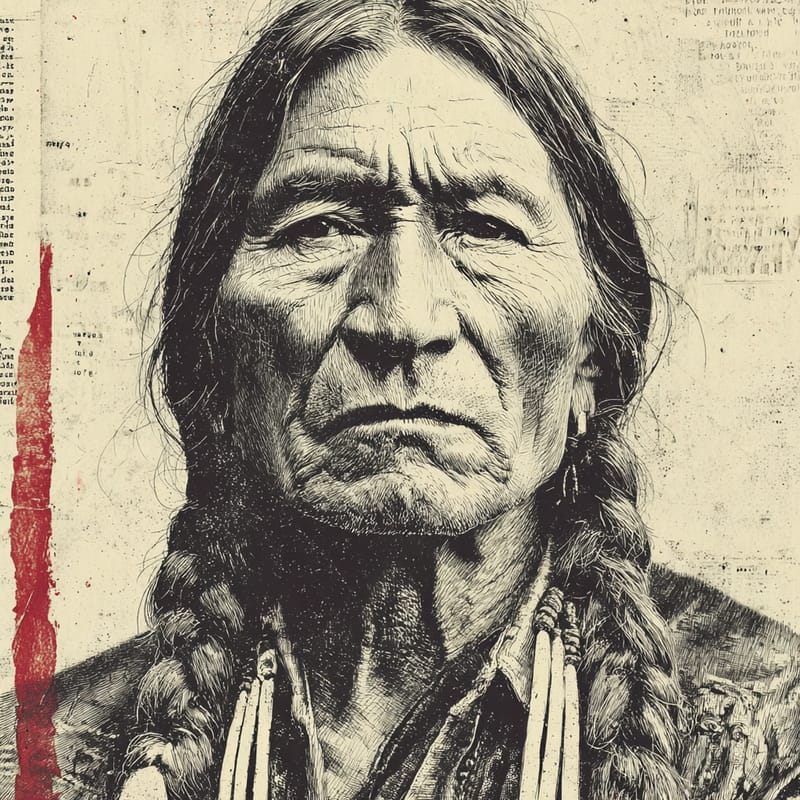
Russell Means
Liberty for the first nations
Self-determination and personal freedom.
Reformist Social LibertarianOne of 729 ideologies · enter the Social Libertarian hall →- Role
- Activist
- Era
- 1939–2012
- Region
- United States
- Social band
- Reformist
- Placement
- −8 · −56 · +60
§ Where Russell Means stands
3 axesMeans rejected capitalism and Marxism alike as products of a European worldview that treats land and people as resources, the theme of his 1980 speech at the Black Hills International Survival Gathering. He demanded the return of treaty land rather than cash, as in the Lakota refusal of the 1980 Black Hills award, and wanted reservations rebuilt on self-sufficiency, a mix just left of centre.
Means distrusted every layer of government over Indian life, from the Bureau of Indian Affairs to the Pine Ridge tribal council of Richard Wilson, whom AIM accused of corruption and intimidation. That anti-statism carried him into the Libertarian Party, whose 1988 nomination he lost to Ron Paul in 1987, and in 2007 he joined activists declaring a sovereign Republic of Lakotah.
His progressivism centred on Indigenous dignity and self-rule: he attacked Native caricatures such as the Cleveland Indians' Chief Wahoo logo and fought for treaty and religious rights. Yet his remedy was a revival of traditional Lakota spirituality and kinship rather than secular modernism, as his 1995 autobiography Where White Men Fear to Tread makes plain, which tempers his placement.
How close are you to Russell Means?
Three statements, one per axis. Answer them and we’ll drop you on the compass next to them.
§ The story
HistoricalRussell Charles Means (1939–2012) was an Oglala Lakota activist, born on the Pine Ridge Reservation in South Dakota and raised largely in the San Francisco Bay Area. After years of odd jobs he ran the American Indian centre in Cleveland, joined the American Indian Movement and in 1970 became its first national director, leading protests that ranged from the Mayflower II replica at Plymouth to the occupation of the Bureau of Indian Affairs in Washington in 1972.
Means became the best-known face of Indian protest during the 71-day occupation of Wounded Knee in 1973, a standoff with federal agents in which two Native men were killed and a federal marshal was paralysed; the federal charges against him were dismissed in 1974 for government misconduct. Later he broke with former allies by siding with Miskito Indians against Nicaragua's Sandinista government, sought the Libertarian presidential nomination in 1987 and became a film actor, notably as Chingachgook in The Last of the Mohicans (1992).
Notable for
- 01Led the American Indian Movement
- 02Wounded Knee occupation
- 03Indigenous self-determination
Key works & moments
- 1970Becomes the American Indian Movement's first national director.
- 1972Helps lead the Trail of Broken Treaties to Washington and the occupation of the Bureau of Indian Affairs.
- 1973Leads the 71-day armed occupation of Wounded Knee on the Pine Ridge Reservation.
- 1974A federal judge dismisses the Wounded Knee charges against him and Dennis Banks for government misconduct.
- 1987Loses the Libertarian Party's 1988 presidential nomination to Ron Paul.
- 2007Joins Lakota activists declaring withdrawal from US treaties and a Republic of Lakotah.
§ Minds closest to Russell Means
All minds →

§ Also in the Social Libertarian hall
Enter the hall →The closest minds above are this hall’s whole roster.
§ Common questions
4 answersWhat was Russell Means's political ideology?
Russell Means was an Indigenous sovereignty activist who became a libertarian: on the 99ideologies three-axis compass, a Reformist Social Libertarian. Economically he sat just left of centre (−8), rejecting both capitalism and Marxism and demanding the return of treaty land. On governance he was strongly anti-statist (−56), hostile to the Bureau of Indian Affairs and to tribal governments he considered federal puppets. Socially he was progressive (+60), fighting for Native dignity, religious freedom and self-determination.
Was Russell Means left-wing or right-wing?
Neither label fits well, though he is closest to the libertarian left. Means rose with the radical protest movements of the early 1970s and was a hero to much of the left, but he called Marxism just another European ideology, sided with Miskito Indians against Nicaragua's Sandinista government and sought the Libertarian Party's presidential nomination in 1987. The constant was Lakota self-determination: he backed whatever politics promised less federal control over Indian lives.
What happened at Wounded Knee in 1973?
On 27 February 1973 about 200 Oglala Lakota and American Indian Movement activists, led by Means and Dennis Banks, seized the hamlet of Wounded Knee on South Dakota's Pine Ridge Reservation, site of the 1890 massacre. They were protesting against the tribal chairman Richard Wilson and the federal government's failure to honour treaties. Federal agents besieged them for 71 days; two Native men were killed and a US marshal was paralysed. The 1974 federal trial of Means and Banks ended when the judge dismissed the charges for government misconduct.
Which minds are closest to Russell Means?
On the 99ideologies three-axis compass, the minds closest to Russell Means are Floyd Abrams (98% alike), Aryeh Neier (97% alike) and Anthony Lewis (96% alike). The furthest is Adam Sutler (6% alike).