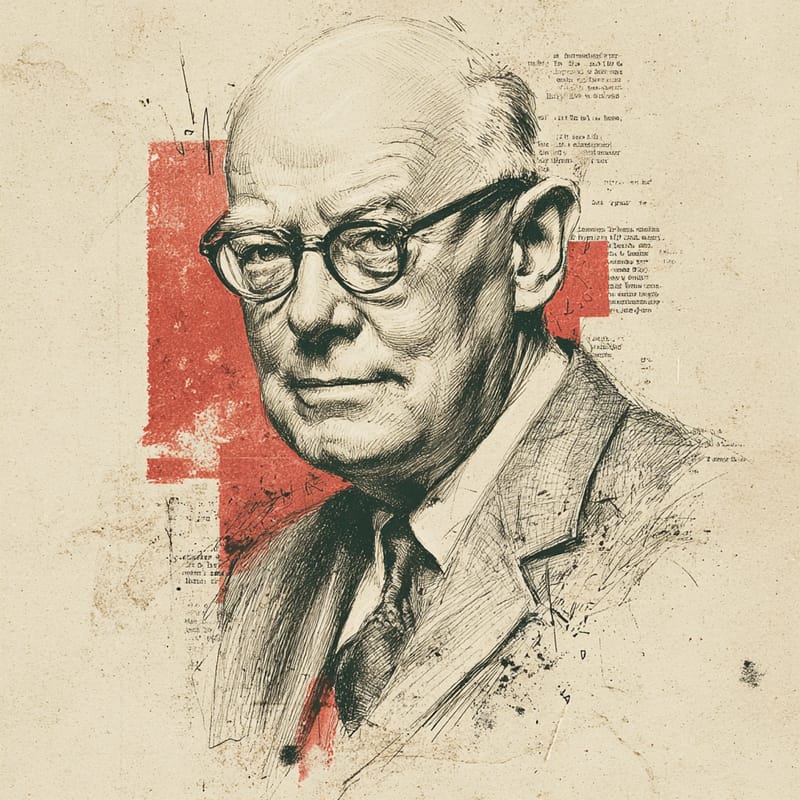
Bertil Ohlin
The social liberal economist
Markets with a humane floor.
Heterodox Nordic LiberalOne of 729 ideologies · enter the Nordic Liberal hall →- Role
- Economist & party leader
- Era
- 1899–1979
- Region
- Sweden
- Social band
- Heterodox
- Placement
- −22 · −44 · +34
§ Where Bertil Ohlin stands
3 axesOhlin defended free trade and private enterprise against socialist planning, leading the opposition to the labour movement's postwar programme in the planned-economy debate of the 1940s. Yet his liberalism was social: as a Stockholm school economist he backed public works and active fiscal policy against unemployment in the 1930s, and his party accepted universal social insurance, differing mainly over its scale and compulsion.
A committed parliamentary democrat, Ohlin spent more than two decades leading the opposition in the Riksdag. He argued in Free or Directed Economy (1936) for limiting state direction of economic life, and his politics centred on pluralism, the rule of law and individual choice rather than on centralised planning.
Ohlin's social liberalism favoured equal opportunity, education and an outward-looking, internationalist Sweden, in keeping with his lifelong case for open trade. His party also drew strength from the free-church and temperance movements, which gave Swedish liberalism a moralistic, traditional streak and kept it more moderate on social questions than radical liberals elsewhere.
How close are you to Bertil Ohlin?
Three statements, one per axis. Answer them and we’ll drop you on the compass next to them.
§ The story
HistoricalBertil Gotthard Ohlin (1899–1979) was a Swedish economist and politician, born in Klippan in Skåne. A student of Eli Heckscher at the Stockholm School of Economics, he became a professor at Copenhagen at 26 and later succeeded Heckscher as professor at the Stockholm School of Economics. His Interregional and International Trade (1933) built on Heckscher's work to explain trade by countries' differing endowments of labour, land and capital, and he was a leading member of the Stockholm school of macroeconomics.
Ohlin led the Liberal People's Party from 1944 to 1967, serving briefly as minister of trade in the wartime coalition, and for two decades he was the main parliamentary challenger to Social Democratic dominance. He fought the labour movement's postwar planning programme and later its compulsory earnings-related pension, but his social liberalism accepted much of the welfare state. In 1977 he shared the Nobel Memorial Prize in Economic Sciences with James Meade for their work on international trade and capital movements.
Notable for
- 01Heckscher–Ohlin trade theory
- 02Nobel Prize in Economics, 1977
- 03Led the Swedish Liberals
Key works & moments
- 1929Debates John Maynard Keynes in the Economic Journal over German war reparations.
- 1933Publishes Interregional and International Trade, the basis of the Heckscher–Ohlin model.
- 1944Becomes leader of the Liberal People's Party and minister of trade in the wartime coalition.
- 1948Leads the Liberals to a surge that makes them Sweden's largest opposition party.
- 1967Steps down as party leader after 23 years.
- 1977Shares the Nobel Memorial Prize in Economic Sciences with James Meade.
§ Minds closest to Bertil Ohlin
All minds →

§ Also in the Nordic Liberal hall
Enter the hall →§ Common questions
4 answersWhat was Bertil Ohlin's political ideology?
Bertil Ohlin was a Swedish social liberal: on the 99ideologies three-axis compass, a Heterodox Nordic Liberal. Economically he sat slightly left of centre (−22), championing free trade and private enterprise while accepting a broad welfare state and active policy against unemployment. On governance he leaned libertarian (−44), a parliamentary democrat who sought to limit state direction of the economy. Socially he was moderately progressive (+34), an internationalist leading a party with free-church roots.
Was Bertil Ohlin left-wing or right-wing?
He belonged to the liberal centre. In Swedish politics Ohlin led the non-socialist opposition against the Social Democrats for over two decades, opposing their planning ambitions and compulsory pension scheme, so contemporaries saw him as a leader of the centre-right. But his social liberalism embraced active employment policy and universal welfare, setting him apart from conservatives, and he consistently defended free trade against protectionists of every party. On the 99ideologies compass that mix places him slightly left of centre economically.
What is the Heckscher–Ohlin theory?
It is the theory that countries export goods that make intensive use of the factors of production they have in abundance and import goods that use their scarce factors. Eli Heckscher sketched the idea in 1919, and Ohlin developed it fully in Interregional and International Trade (1933). A capital-rich country, for example, will tend to export capital-intensive products, while a labour-rich one exports labour-intensive goods. The model became a cornerstone of trade economics and contributed to Ohlin's 1977 Nobel Memorial Prize.
Which minds are closest to Bertil Ohlin?
On the 99ideologies three-axis compass, the minds closest to Bertil Ohlin are Birger (the reasonable Scandinavian, archetype) (98% alike), Venstre liberal (Danish archetype) (96% alike) and Johan Norberg (96% alike). The furthest is Adam Sutler (13% alike).