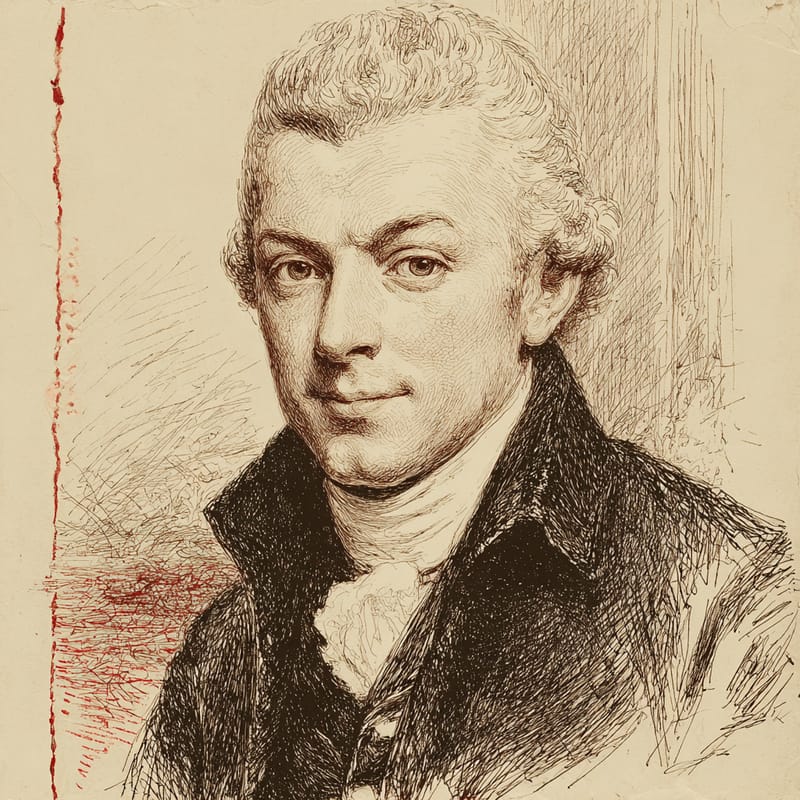
Anders Chydenius
Free trade before Smith
Liberty of press and commerce.
Heterodox Nordic LiberalOne of 729 ideologies · enter the Nordic Liberal hall →- Role
- Priest & legislator
- Era
- 1729–1803
- Region
- Finland / Sweden
- Social band
- Heterodox
- Placement
- −18 · −48 · +24
§ Where Anders Chydenius stands
3 axesChydenius was a free-trader, but his target was privilege rather than the poor. The National Gain (1765) attacked the trading monopolies of Stockholm merchants, guild restrictions and controls that held back Ostrobothnia's tar producers and peasants, and his 1778 pamphlet on the natural rights of masters and servants demanded that farmhands be free to choose employers and bargain over wages.
He championed openness against an oligarchic state. In the Riksdag of 1765–66 he was the leading force behind the Freedom of the Press Act of 1766, which ended prior censorship of political writing and opened government records to the public. His liberalism worked through the estates parliament of the Age of Liberty rather than against monarchy as such.
Chydenius was an Enlightenment reformer within the Lutheran church: he pressed at the Riksdag of 1778–79 for religious toleration for foreign immigrants and defended servants against harsh labour laws. His progressivism was moderate, that of a clergyman who sought humane reform and economic opportunity rather than a break with the established order.
How close are you to Anders Chydenius?
Three statements, one per axis. Answer them and we’ll drop you on the compass next to them.
§ The story
HistoricalAnders Chydenius (1729–1803) was a Lutheran clergyman, economist and politician from Ostrobothnia in Finland, then part of the Swedish realm. Born in Sotkamo and educated at Åbo and Uppsala, he served as a chaplain in Nedervetil and from 1770 as vicar of Gamlakarleby, modern Kokkola. Elected to the clergy estate of the Riksdag in 1765, during Sweden's parliamentary Age of Liberty, he became a leading figure of the Caps party and its campaign against economic privileges.
Chydenius's pamphlet The National Gain (1765) argued that free competition and free trade would serve the common good better than regulation, anticipating ideas later associated with Adam Smith. He fought for his region's towns to trade freely abroad and was the driving force behind the Freedom of the Press Act of 1766, which abolished political censorship and established public access to official documents, a principle widely regarded as the world's first freedom-of-information law. Finland and Sweden both claim him as a founder of Nordic liberalism.
Notable for
- 01World's first freedom-of-information law (1766)
- 02Early free-trade theorist
- 03'The National Gain'
Key works & moments
- 1765Publishes The National Gain, a case for economic freedom eleven years before The Wealth of Nations.
- 1765–66Wins the right for several Ostrobothnian towns to trade directly abroad.
- 1766The Freedom of the Press Act he championed ends political censorship and opens official records.
- 1770Becomes vicar of Gamlakarleby, modern Kokkola.
- 1778Writes on the natural rights of masters and servants, attacking restrictions on farmhands.
- 1778–79Presses the Riksdag to grant religious toleration to foreign immigrants.
§ Minds closest to Anders Chydenius
All minds →

§ Also in the Nordic Liberal hall
Enter the hall →§ Common questions
4 answersWhat was Anders Chydenius's political ideology?
Anders Chydenius was an Enlightenment liberal: on the 99ideologies three-axis compass, a Heterodox Nordic Liberal. Economically he sat slightly left of centre (−18), a free-trader whose arguments targeted the privileges of merchants and guilds on behalf of peasants, labourers and servants. On governance he leaned libertarian (−48), driving the 1766 Freedom of the Press Act and public access to official documents. Socially he was mildly progressive (+24), a clergyman who backed religious toleration and humane reform.
Was Anders Chydenius left-wing or right-wing?
The terms postdate him, but his politics were liberal and egalitarian for the eighteenth century. Chydenius opposed the privileges of the Stockholm merchant elite, the guilds and officials, and defended the rights of peasants, provincial towns and servants. By modern standards his free-trade economics would count on the market-liberal side, while his anti-privilege, pro-transparency and pro-labour-mobility arguments appeal across the spectrum. He is best seen as a founder of Nordic liberalism rather than of the right or left.
Did Anders Chydenius create the first freedom-of-information law?
He is widely credited with it. Sweden's Freedom of the Press Act of 1766, adopted when Finland was part of the Swedish realm, abolished prior censorship of political writing and gave the public a right of access to official documents, and Chydenius was the leading force behind it in the Riksdag of 1765–66. The principle of public access survived later setbacks, including Gustav III's restrictions on the press, and remains part of Swedish and Finnish law, so the act is often called the world's first freedom-of-information law.
Which minds are closest to Anders Chydenius?
On the 99ideologies three-axis compass, the minds closest to Anders Chydenius are Venstre liberal (Danish archetype) (97% alike), Bertil Ohlin (95% alike) and Birger (the reasonable Scandinavian, archetype) (94% alike). The furthest is Adam Sutler (15% alike).