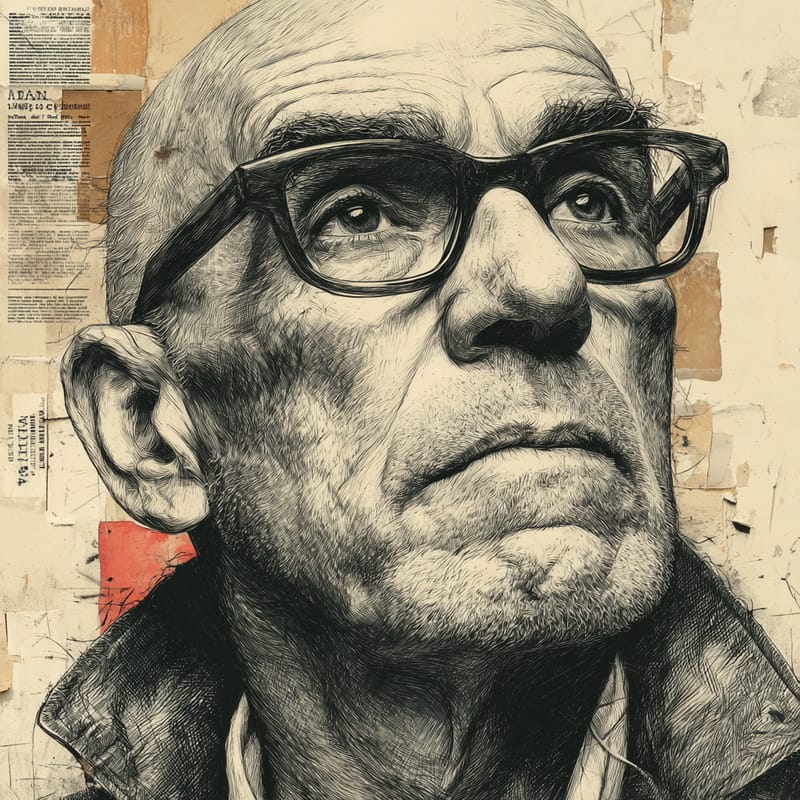
Anthony Lewis
Make no law
The First Amendment's chronicler.
Reformist Social LibertarianOne of 729 ideologies · enter the Social Libertarian hall →- Role
- Journalist
- Era
- 1927–2013
- Region
- United States
- Social band
- Reformist
- Placement
- −6 · −48 · +54
§ Where Anthony Lewis stands
3 axesLewis wrote little about economics and held the mainstream mixed-economy views of postwar American liberalism. His one recurring economic theme was that justice should not depend on means: Gideon's Trumpet (1964) celebrated the Supreme Court's 1963 ruling in Gideon v. Wainwright that states must pay for lawyers for poor defendants, a modest public commitment rather than a redistributive programme.
His great subject was the limits of state power. Make No Law (1991) told the story of New York Times v. Sullivan (1964), which made it far harder for public officials to win libel suits against their critics, and his 1955 Pulitzer reporting exposed the injustices of the federal loyalty-security programme. As a columnist he condemned Nixon's abuses of power and, later, indefinite detention without trial.
Lewis was progressive on civil rights and civil liberties. Portrait of a Decade (1964) chronicled the civil-rights movement and the legal struggle against segregation, and Freedom for the Thought That We Hate (2007) took its title from Justice Oliver Wendell Holmes's 1929 dissent in United States v. Schwimmer. His instincts were those of a reformist liberal who trusted courts and constitutional law to widen freedom.
How close are you to Anthony Lewis?
Three statements, one per axis. Answer them and we’ll drop you on the compass next to them.
§ The story
HistoricalJoseph Anthony Lewis (1927–2013) was an American journalist who spent almost his whole career at The New York Times. A Harvard graduate, he won a Pulitzer Prize in 1955 at the Washington Daily News for reporting on a Navy employee unjustly dismissed as a security risk, then rejoined the Times, studied law as a Nieman fellow at Harvard and covered the Supreme Court from 1957. A second Pulitzer followed in 1963. He later ran the paper's London bureau and wrote its op-ed column from 1969 to 2001.
Lewis did more than any journalist of his generation to explain the Warren Court's rights revolution to ordinary readers. Gideon's Trumpet (1964), the story of a Florida drifter whose handwritten petition won poor defendants the right to a lawyer, became a classic and a 1980 television film. In his column and later books, Make No Law (1991) and Freedom for the Thought That We Hate (2007), he defended press freedom and due process, and attacked the Vietnam War and the Bush administration's treatment of terrorism suspects.
Notable for
- 01'Gideon's Trumpet'
- 02'Freedom for the Thought That We Hate'
- 03Supreme Court journalism
Key works & moments
- 1955Wins a Pulitzer Prize for reporting on a Navy employee dismissed as a security risk.
- 1963Wins a second Pulitzer for his Supreme Court coverage in The New York Times.
- 1964Publishes Gideon's Trumpet, on the right of poor defendants to a lawyer.
- 1969Launches his New York Times op-ed column, which runs until 2001.
- 1991Publishes Make No Law, on New York Times v. Sullivan and press freedom.
- 2007Publishes Freedom for the Thought That We Hate: A Biography of the First Amendment.
§ Minds closest to Anthony Lewis
All minds →


§ Also in the Social Libertarian hall
Enter the hall →The closest minds above are this hall’s whole roster.
§ Common questions
4 answersWhat was Anthony Lewis's political ideology?
Anthony Lewis was a liberal civil libertarian: on the 99ideologies three-axis compass, a Reformist Social Libertarian. Economically he sat just left of centre (−6), holding the mainstream mixed-economy views of postwar American liberalism. On governance he was firmly anti-authoritarian (−48), devoting his career to press freedom, fair trials and limits on executive power. Socially he was progressive (+54), a strong supporter of civil rights who trusted constitutional law to widen individual freedom.
Was Anthony Lewis left-wing or right-wing?
Left of centre, in the liberal rather than socialist sense. For three decades his New York Times column was one of the best-known liberal voices in American journalism, critical of the Vietnam War, of Richard Nixon and of governments that curtailed civil liberties. But his politics were constitutional rather than economic: he championed courts, due process and a free press, and his heroes were judges and lawyers rather than parties or mass movements.
What is Gideon's Trumpet about?
It tells the story behind Gideon v. Wainwright, the 1963 Supreme Court decision that states must provide lawyers to criminal defendants who cannot afford one. Clarence Earl Gideon, a Florida drifter charged with breaking into a pool hall in 1961, was refused a lawyer, convicted and then petitioned the Supreme Court in pencil from prison. The Court appointed Abe Fortas to argue his case and ruled unanimously in his favour; retried with a lawyer, Gideon was acquitted. Lewis's 1964 book became a classic of legal journalism.
Which minds are closest to Anthony Lewis?
On the 99ideologies three-axis compass, the minds closest to Anthony Lewis are Floyd Abrams (98% alike), Aryeh Neier (96% alike) and Russell Means (96% alike). The furthest is Adam Sutler (10% alike).