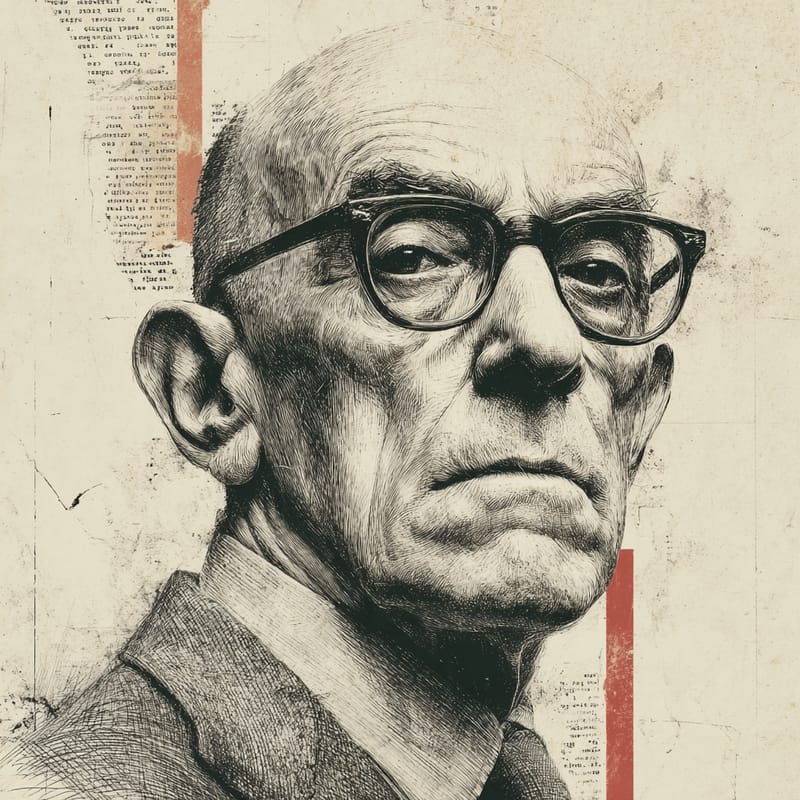
Frank Meyer
Fusionism's architect
Liberty and virtue, reconciled.
Traditional Conservative LibertarianOne of 729 ideologies · enter the Conservative Libertarian hall →- Role
- Theorist & editor
- Era
- 1909–1972
- Region
- United States
- Social band
- Traditional
- Placement
- +72 · −28 · −44
§ Where Frank Meyer stands
3 axesMeyer regarded the free market as the economic form of a free society, arguing in In Defense of Freedom (1962) that a state powerful enough to direct the economy would inevitably crush the person. As National Review's books editor from 1955 he promoted free-market critiques of planning, and he opposed the New Deal and Great Society welfare state while accepting a strong military against communism.
In In Defense of Freedom (1962) Meyer limited the state to three functions: national defence, the preservation of domestic order and the administration of justice. Everything else, including the moral formation of persons, belonged to individuals, families and voluntary institutions. His libertarianism stopped at the Cold War, however: he backed a militant anti-communist foreign policy, informed by his years inside the party and his 1961 book The Moulding of Communists.
Meyer was a traditionalist about ends: he believed in objective moral truth and held that the purpose of human life was the pursuit of virtue, grounded in Western and Christian tradition. But he insisted that virtue must be freely chosen, not coerced, which set him against traditionalists such as Russell Kirk and L. Brent Bozell, whose 1962 essay Freedom or Virtue? attacked his position in National Review.
How close are you to Frank Meyer?
Three statements, one per axis. Answer them and we’ll drop you on the compass next to them.
§ The story
HistoricalFrank Straus Meyer (1909–1972) was an American political philosopher and editor. Born to a prosperous Jewish family in Newark, New Jersey, he studied at Princeton and Oxford and joined the Communist Party while a student in Britain in the early 1930s, becoming a leading party organiser and educator there and later in Chicago. During the Second World War he began to doubt Marxism, influenced in part by Friedrich Hayek's The Road to Serfdom, and in 1945 he broke with the party for good.
Meyer became a senior editor of William F. Buckley's National Review from its founding in 1955, running its books section and writing the column Principles and Heresies. In In Defense of Freedom (1962) he argued that conservatives should pursue virtue through persuasion and tradition while defending individual liberty against the state, a synthesis that came to be called fusionism. The formula held together the Cold War right's libertarians and traditionalists, and he helped found the American Conservative Union in 1964. He was received into the Catholic Church shortly before his death.
Notable for
- 01Coined fusionism
- 02'In Defense of Freedom'
- 03National Review senior editor
Key works & moments
- 1930sJoins the Communist Party as a student in Britain and becomes a party organiser.
- 1945Breaks with the Communist Party after more than a decade as an organiser and teacher.
- 1955Joins the founding staff of National Review as a senior editor.
- 1961Publishes The Moulding of Communists, a study of how the party trained its cadres.
- 1962Publishes In Defense of Freedom: A Conservative Credo.
- 1964Edits the symposium What Is Conservatism? and helps found the American Conservative Union.
§ Minds closest to Frank Meyer
All minds →


§ Also in the Conservative Libertarian hall
Enter the hall →§ Common questions
4 answersWhat was Frank Meyer's political ideology?
Frank Meyer was the chief theorist of fusionism, the synthesis of libertarian means and traditionalist ends that defined the post-war American right: on the 99ideologies three-axis compass, a Traditional Conservative Libertarian. Economically he sat firmly on the market side (+72), defending free markets as the economic form of a free society. On governance he leaned libertarian (−28), limiting the state to defence, order and justice, and socially he was traditional (−44), holding that free people should pursue virtue rooted in Western and Christian tradition.
Was Frank Meyer left-wing or right-wing?
Right-wing, after an early life on the far left. Meyer spent more than a decade as a Communist Party organiser before breaking with the party in 1945, and he became one of the leading intellectuals of the American conservative movement at National Review. His mature politics combined free-market economics, a minimal domestic state, militant anti-communism and traditional morality, the package that shaped the Republican right from Barry Goldwater to Ronald Reagan.
What is fusionism?
Fusionism is the idea, most fully argued by Frank Meyer, that libertarianism and traditional conservatism are not rivals but two halves of one position. Meyer held that the state should protect freedom and that individuals should freely use it to pursue virtue, so liberty was the political means and virtue the moral end. Traditionalists such as L. Brent Bozell objected that freedom without virtue was empty, but the term came to describe the alliance of free-marketeers, traditionalists and anti-communists that National Review held together.
Which minds are closest to Frank Meyer?
On the 99ideologies three-axis compass, the minds closest to Frank Meyer are M. Stanton Evans (99% alike), Davy Crockett (frontier archetype) (97% alike) and Hank Hill (97% alike). The furthest is Pol Pot (5% alike).