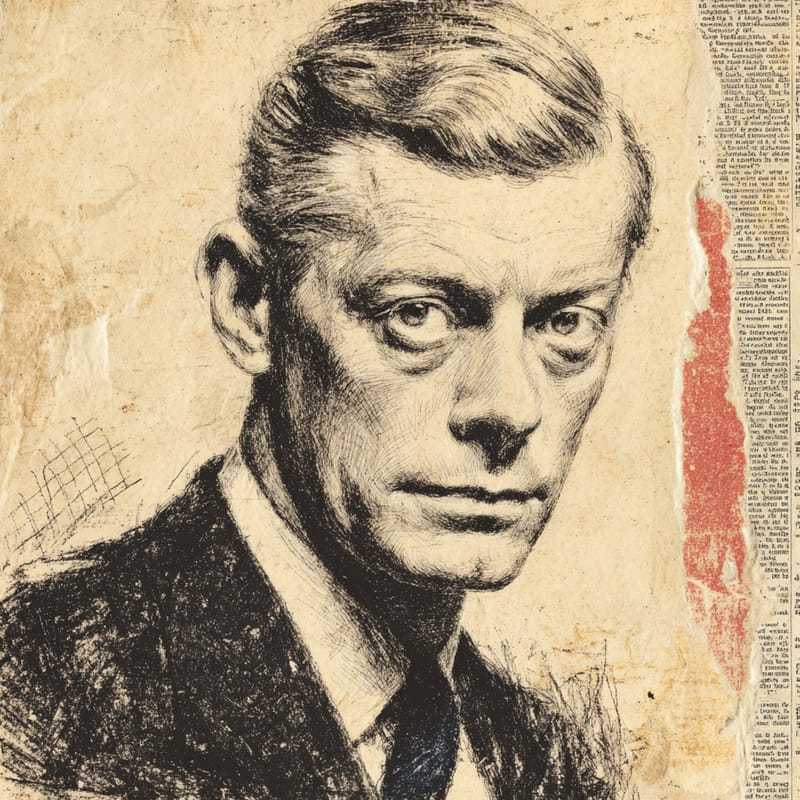
L. Brent Bozell Jr.
The conscience of a conservative
Liberty disciplined by virtue.
Traditional Conservative LibertarianOne of 729 ideologies · enter the Conservative Libertarian hall →- Role
- Writer
- Era
- 1926–1997
- Region
- United States
- Social band
- Traditional
- Placement
- +74 · −30 · −52
§ Where L. Brent Bozell Jr. stands
3 axesThe Conscience of a Conservative (1960), which Bozell wrote for Goldwater, called for cutting federal spending, ending farm subsidies and returning welfare to the states and private charity, giving the conservative revival its free-market programme. His later Triumph years brought sharper criticism of consumer capitalism, but he never embraced socialism, and his placement reflects the market economics of his fusionist period.
Bozell's case for limited government rested on the Constitution: The Conscience of a Conservative defended states' rights against Washington, and The Warren Revolution (1966) argued that the Supreme Court under Earl Warren had usurped powers belonging to the people and the states. His libertarianism was a means rather than an end, and in Triumph he increasingly argued that politics should serve Christian moral order.
Bozell was an ardent Catholic traditionalist who put moral order first. His 1962 essay Freedom or Virtue? argued against Frank Meyer that freedom was valuable only as a means to virtue, and in 1970 he led a group of Catholic activists into a Washington hospital in one of the first direct-action protests against legal abortion.
How close are you to L. Brent Bozell Jr.?
Three statements, one per axis. Answer them and we’ll drop you on the compass next to them.
§ The story
HistoricalLeo Brent Bozell Jr. (1926–1997) was an American writer and activist who helped found the post-war conservative movement. Born in Omaha, Nebraska, he studied at Yale, where he was William F. Buckley's debating partner, and married Buckley's sister Patricia in 1949. The two men co-wrote McCarthy and His Enemies (1954), and Bozell became a senior editor of National Review and the ghostwriter of Barry Goldwater's bestselling The Conscience of a Conservative (1960), the manifesto of the conservative revival.
In the 1960s Bozell moved toward an uncompromising Catholic traditionalism. His 1962 essay Freedom or Virtue? attacked Frank Meyer's fusionism, The Warren Revolution (1966) assailed the Supreme Court, and in 1966 he founded Triumph, a Catholic magazine increasingly critical of American liberalism and consumer capitalism alike. In 1970 he led one of the first direct-action protests against abortion, at a Washington hospital. His son L. Brent Bozell III later founded the conservative Media Research Center.
Notable for
- 01Wrote 'The Conscience of a Conservative'
- 02Founded 'Triumph' magazine
- 03Fusionist-turned-traditionalist
Key works & moments
- 1954Co-writes McCarthy and His Enemies with his brother-in-law William F. Buckley.
- 1960Ghostwrites Barry Goldwater's The Conscience of a Conservative.
- 1962Publishes Freedom or Virtue?, attacking Frank Meyer's fusionism in National Review.
- 1966Publishes The Warren Revolution and founds the Catholic magazine Triumph.
- 1970Leads one of the first direct-action protests against abortion, at a Washington hospital.
§ Minds closest to L. Brent Bozell Jr.
All minds →




§ Also in the Conservative Libertarian hall
Enter the hall →§ Common questions
4 answersWhat was L. Brent Bozell Jr.'s political ideology?
L. Brent Bozell Jr. was a Catholic traditionalist conservative who began as a fusionist and moved steadily toward a politics of moral order: on the 99ideologies three-axis compass, a Traditional Conservative Libertarian. Economically he sat firmly on the market side (+74), writing the free-market programme of Goldwater's The Conscience of a Conservative. On governance he leaned libertarian (−30), defending constitutional limits and states' rights against Washington and the Warren Court, and socially he was strongly traditional (−52), placing virtue and Catholic teaching above freedom.
Was L. Brent Bozell Jr. left-wing or right-wing?
Right-wing throughout, though his right moved over time. In the 1950s and early 1960s Bozell was a mainstream movement conservative, co-writing a defence of Joseph McCarthy and ghostwriting Barry Goldwater's manifesto. From the mid-1960s his Triumph magazine pursued a more radical Catholic traditionalism that criticised American liberalism, secularism and consumer capitalism alike and made opposition to abortion a central cause, setting him apart from both libertarians and mainstream Republicans.
Did L. Brent Bozell write The Conscience of a Conservative?
Yes. The 1960 book appeared under Barry Goldwater's name, but Bozell, a National Review editor and Goldwater speechwriter, wrote it from Goldwater's speeches and ideas. Its short chapters on states' rights, farm subsidies, welfare, taxes, labour unions and the Soviet threat set out a programme of limited government and anti-communism. The book sold millions of copies, helped build support for Goldwater's 1964 presidential nomination and became one of the founding texts of modern American conservatism.
Which minds are closest to L. Brent Bozell Jr.?
On the 99ideologies three-axis compass, the minds closest to L. Brent Bozell Jr. are Hank Hill (99% alike), M. Stanton Evans (97% alike) and Frank Meyer (97% alike). The furthest is Pol Pot (2% alike).