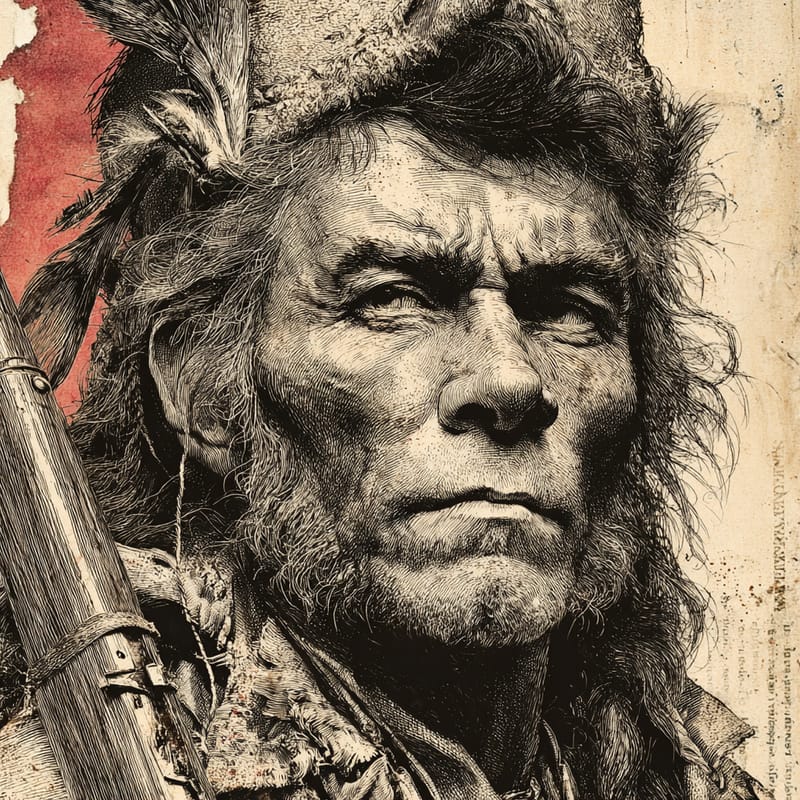
Davy Crockett (frontier archetype)
Be sure you're right, then go ahead
Frontier self-reliance, in office.
Traditional Conservative LibertarianOne of 729 ideologies · enter the Conservative Libertarian hall →- Role
- Frontiersman & congressman
- Era
- 1786–1836
- Region
- United States
- Social band
- Traditional
- Placement
- +74 · −30 · −38
§ Where Davy Crockett (frontier archetype) stands
3 axesCrockett's economics were those of the frontier smallholder: property earned by settlement and labour, not granted to speculators. In Congress from 1827 he pushed to let western Tennessee's squatters buy the land they had cleared cheaply, against a plan to sell it to fund colleges. Libertarians later adopted Not Yours to Give, an anti-welfare speech attributed to him, though it surfaced decades after his death and is widely considered apocryphal.
Crockett distrusted concentrated power and prided himself on independence from party discipline. He voted against Andrew Jackson's Indian Removal Act in 1830, defying the president who had been his commander and much opinion at home, and he attacked Jackson's use of executive power, joining the opposition that became the Whig Party. His 1834 Narrative presents him as a plain citizen answerable only to his conscience.
Crockett embodied the frontier's traditional ideals of self-reliance, plain speech and martial honour. He volunteered against the Creek nation in 1813, cultivated a backwoods persona of hunting tales and homespun humour in his 1834 autobiography, and in 1836 went to Texas to fight for its independence. His vote against Indian removal showed a moral independence that did not fit neatly with frontier opinion.
How close are you to Davy Crockett (frontier archetype)?
Three statements, one per axis. Answer them and we’ll drop you on the compass next to them.
§ The story
HistoricalDavid 'Davy' Crockett (1786–1836) was an American frontiersman, soldier and politician from Tennessee. Born in Greene County in what was then the western edge of settlement, he had little schooling, worked his way up as a farmer and hunter, and served as a militia scout under Andrew Jackson in the Creek War of 1813–14. He became a justice of the peace and militia colonel, sat in the Tennessee legislature from 1821, and represented West Tennessee in the US House of Representatives from 1827 to 1831 and again from 1833 to 1835.
In Congress Crockett broke with Jackson, voting against the Indian Removal Act in 1830 and fighting for poor squatters' claims to western Tennessee land, and the emerging Whig opposition promoted him as a homespun alternative to the president. After losing his seat in 1835 he left for Texas, joined the rebellion against Mexico and was killed at the Alamo on 6 March 1836; whether he died fighting or was executed after capture is still debated. His legend, built by almanacs, his own 1834 autobiography and a Disney television series in the 1950s, has largely eclipsed the man.
Notable for
- 01Frontier folk hero
- 02Independent congressman
- 03Died at the Alamo
Key works & moments
- 1813Volunteers for the Tennessee militia in the Creek War under Andrew Jackson.
- 1821Elected to the Tennessee General Assembly.
- 1827Elected to the US House of Representatives from West Tennessee.
- 1830Votes against the Indian Removal Act, breaking with President Jackson.
- 1834Publishes A Narrative of the Life of David Crockett of the State of Tennessee.
- 1836Killed at the Alamo during the Texas Revolution, on 6 March.
§ Minds closest to Davy Crockett (frontier archetype)
All minds →

§ Also in the Conservative Libertarian hall
Enter the hall →§ Common questions
4 answersWhat was Davy Crockett's political ideology?
Davy Crockett was a frontier populist who began as a Jackson supporter and ended as an ally of the anti-Jackson Whigs: on the 99ideologies three-axis compass, a Traditional Conservative Libertarian. Economically he sat firmly on the market side (+74), championing small settlers' property rights over speculators and institutions. On governance he leaned libertarian (−30), distrusting executive power and party discipline, and socially he was traditional (−38), embodying the frontier values of self-reliance, plain speech and martial honour.
Was Davy Crockett left-wing or right-wing?
Neither label fits the 1830s neatly, but his politics are closest to a populist, small-government right. Crockett championed poor frontier settlers against speculators, which gives him a populist edge, yet his independence from Jackson, distrust of executive power and alliance with the Whigs align him with limited-government traditions. His 1830 vote against Indian removal cut against the expansionist frontier politics of his day, which is one reason later movements of very different kinds have claimed his image.
Did Davy Crockett oppose the Indian Removal Act?
Yes. Although he had fought against the Creek nation under Andrew Jackson in 1813–14, Crockett voted against the Indian Removal Act in 1830. In his 1834 autobiography he wrote that his conscience still told him it had been an honest vote, and the stance is widely seen as contributing to his defeat in 1831. The episode, with his broader break with Jackson, underpins his reputation as a congressman who voted his conscience.
Which minds are closest to Davy Crockett (frontier archetype)?
On the 99ideologies three-axis compass, the minds closest to Davy Crockett (frontier archetype) are Frank Meyer (97% alike), M. Stanton Evans (96% alike) and L. Brent Bozell Jr. (94% alike). The furthest is Pol Pot (5% alike).