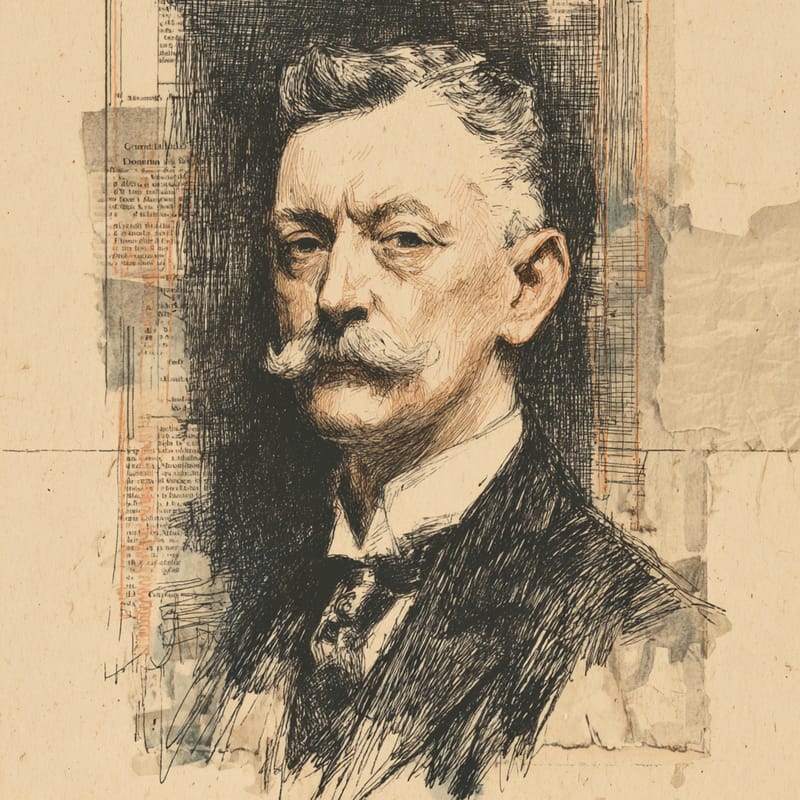
Clarence Lee Swartz
What is mutualism?
Codified the mutualist program.
Reformist MutualistOne of 729 ideologies · enter the Mutualist hall →- Role
- Writer
- Era
- 1868–1936
- Region
- United States
- Social band
- Reformist
- Placement
- −30 · −72 · +38
§ Where Clarence Lee Swartz stands
3 axesSwartz sat left of centre because he treated interest, rent and profit as tributes extracted through state-backed monopolies over money and land, not as natural rewards of capital. Yet What Is Mutualism? (1927) relied on markets, competition and personal possession to abolish them, proposing mutual banks that issue currency at cost rather than collective ownership of industry.
Following Tucker, whose writings he collected in Individual Liberty (1926), Swartz held that the state is an invasive institution resting on compulsion, and that defence of person and property could be supplied by voluntary associations. He expected change to come through education and the peaceful growth of mutualist institutions rather than insurrection, which marks his anarchism as gradualist.
Swartz's progressivism was the individualist kind. The reforms he wanted would strip privileges from bankers and landlords rather than impose a moral programme, and the mutualism he set out in 1927 rested on equal liberty and the sovereignty of the individual, leaving religion, morals and private life to personal conscience in the tradition of Josiah Warren.
How close are you to Clarence Lee Swartz?
Three statements, one per axis. Answer them and we’ll drop you on the compass next to them.
§ The story
HistoricalClarence Lee Swartz (1868–1936) was an American individualist anarchist writer who carried the mutualist tradition of Pierre-Joseph Proudhon, Josiah Warren and William Batchelder Greene into the twentieth century. He belonged to the circle around Benjamin Tucker, whose journal Liberty (1881–1908) was the chief voice of American individualist anarchism, and after Liberty closed he became one of the main custodians of its ideas. In 1926 he edited Individual Liberty, a selection of Tucker's writings, and in 1927 he published What Is Mutualism?
Swartz's significance lies in synthesis rather than originality. What Is Mutualism? restated the old individualist programme as a coherent system for a new generation: free banking to bring interest down to the cost of administration, land held by occupancy and use rather than absentee title, free trade, and voluntary association in place of compulsory government. Published in a decade when American radicalism was dominated by communists and state socialists, it kept alive a market-based, anti-capitalist anarchism that later mutualists and left-libertarians rediscovered.
Notable for
- 01'What Is Mutualism?'
- 02Codified mutualist principles
- 03Occupancy-and-use property
Key works & moments
- 1881Benjamin Tucker launches Liberty, the individualist anarchist journal whose circle shapes Swartz's thought.
- 1908Fire destroys Tucker's New York bookshop and Liberty ceases, leaving disciples like Swartz to carry the ideas.
- 1926Edits Individual Liberty, a selection of Benjamin Tucker's writings.
- 1927Publishes What Is Mutualism?, a systematic case for free banking, occupancy-and-use land tenure and voluntary association.
- 1936Dies; his book later becomes a reference point for revived mutualist and left-libertarian writing.
§ Minds closest to Clarence Lee Swartz
All minds →




§ Also in the Mutualist hall
Enter the hall →§ Common questions
4 answersWhat was Clarence Lee Swartz's political ideology?
Clarence Lee Swartz was a mutualist, an individualist anarchist in the line of Proudhon and Benjamin Tucker: on the 99ideologies three-axis compass, a Reformist Mutualist. Economically he sat left of centre (−30), condemning interest and rent as products of monopoly while defending markets and personal possession. On governance he was strongly libertarian (−72), preferring voluntary association to the state, and socially he was moderately progressive (+38), treating morals and private life as matters for the individual.
Was Clarence Lee Swartz left-wing or right-wing?
Left-wing, in the older individualist sense. Swartz opposed capitalism as he understood it, a system in which state privileges let bankers and landlords take income without labour, and he wanted those gains abolished. But his remedy was more competition, not less: free banking, free trade and land held by those who use it. That mix of anti-capitalism and pro-market reasoning puts him on the libertarian left, far from both state socialism and modern free-market conservatism.
What is mutualism, according to Clarence Lee Swartz?
Mutualism is a stateless economic system based on reciprocal exchange among free individuals and voluntary associations. The idea is usually traced to Proudhon, and its American version drew on Josiah Warren's cost principle and William Batchelder Greene's mutual banks. In What Is Mutualism? (1927) Swartz set out its main planks: banks owned by their borrowers and lending at cost, occupancy and use as the basis of land tenure, free competition, and the replacement of compulsory government by voluntary cooperation.
Which minds are closest to Clarence Lee Swartz?
On the 99ideologies three-axis compass, the minds closest to Clarence Lee Swartz are Josiah Warren (99% alike), Pierre-Joseph Proudhon (99% alike) and The Time-Store Keeper (archetype) (98% alike). The furthest is Adam Sutler (3% alike).