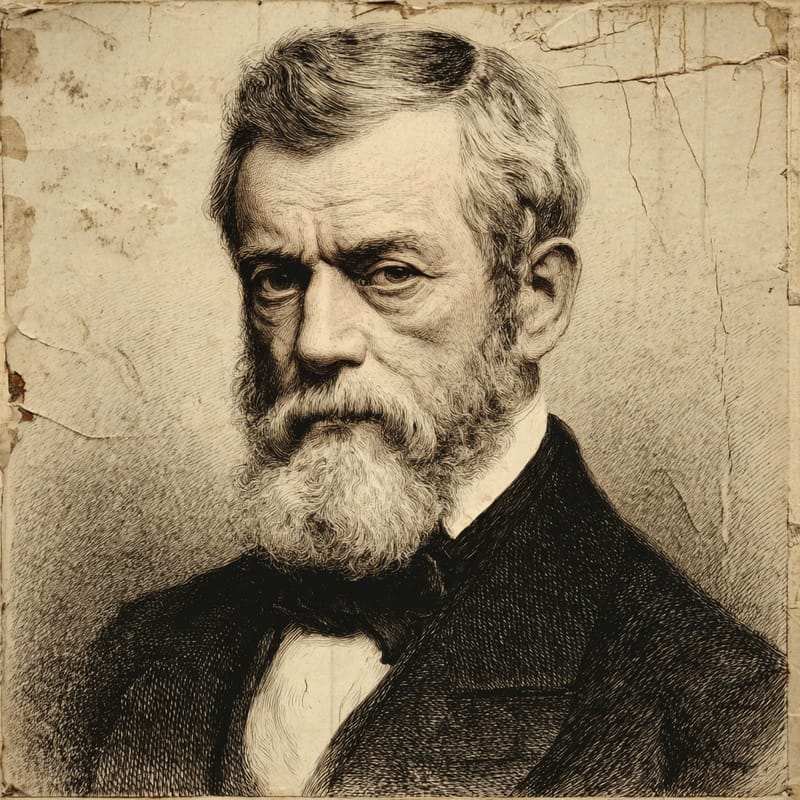
William B. Greene
Mutual banking
Free credit against usury.
Reformist Anarcho-MutualistOne of 729 ideologies · enter the Anarcho-Mutualist hall →- Role
- Theorist
- Era
- 1819–1878
- Region
- United States
- Social band
- Reformist
- Placement
- −26 · −90 · +48
§ Where William B. Greene stands
3 axesGreene sits just left of centre. Mutual Banking (1850) kept private property and markets but attacked interest as the lever of exploitation: a mutual bank, owned by its borrowers and issuing notes secured by their property, would lend at a fee covering only its running costs, making credit nearly free and freeing labour from dependence on capitalists.
Greene looked to voluntary association rather than the state, blaming legally privileged banking for usury and proposing mutual banks, cooperatives and free contract in its place. In the 1870s he carried these ideas into the New England labour-reform movement alongside Ezra Heywood, helping form the individualist anarchism that Benjamin Tucker later developed in his paper Liberty, founded in 1881.
Greene's progressivism grew out of New England reform. A Unitarian minister with Transcendentalist friends, he backed the labour movement and served as a Union colonel in the Civil War, but his radicalism was mainly economic, and his religious and moral framing kept him a moderate progressive rather than a cultural iconoclast.
How close are you to William B. Greene?
Three statements, one per axis. Answer them and we’ll drop you on the compass next to them.
§ The story
HistoricalWilliam Batchelder Greene (1819–1878) was born in Haverhill, Massachusetts. He attended West Point and served briefly as an army officer before studying at Harvard Divinity School and becoming a Unitarian minister in Massachusetts, moving in the circles of New England Transcendentalism. Reading the French socialist debates around 1848, and above all Pierre-Joseph Proudhon, he set out to adapt Proudhon's free-credit banking to America, and during the Civil War he served as a Union colonel.
Greene's Mutual Banking (1850) became the founding text of American mutualism, arguing that banks owned by their borrowers could issue currency against members' property and lend at cost, dissolving the power of capital. After the war he was active in the labour-reform movement of the 1870s, where his ideas shaped the young Benjamin Tucker, and he collected his writings in Socialistic, Communistic, Mutualistic, and Financial Fragments (1875). Critics dismissed mutual banking as a recipe for inflation; admirers saw it as the key to ending usury. He died in England in 1878.
Notable for
- 01'Mutual Banking'
- 02Brought Proudhon to America
- 03Free-credit theory
Key works & moments
- 1840sBecomes a Unitarian minister after training at Harvard Divinity School.
- 1850Publishes Mutual Banking, adapting Proudhon's free-credit bank for the United States.
- 1860sServes as a Union colonel in the Civil War.
- 1870sJoins Ezra Heywood in New England's labour-reform movement, influencing the young Benjamin Tucker.
- 1875Publishes Socialistic, Communistic, Mutualistic, and Financial Fragments.
§ Minds closest to William B. Greene
All minds →



§ Also in the Anarcho-Mutualist hall
Enter the hall →The closest minds above are this hall’s whole roster.
§ Common questions
4 answersWhat was William B. Greene's political ideology?
William B. Greene was a mutualist who brought Proudhon's free-credit ideas to America: on the 99ideologies three-axis compass, a Reformist Anarcho-Mutualist. Economically he sat just left of centre (−26), keeping markets and property while seeking to abolish interest through mutual banks. On governance he was strongly libertarian (−90), preferring voluntary association to state power, and socially he was moderately progressive (+48), a Unitarian reformer and labour sympathiser.
Was William B. Greene left-wing or right-wing?
Mildly left-wing. Greene's goal was to free labour from the power of capital, a socialist aim, and he worked in the labour-reform movement of the 1870s. But his method was market-based: he accepted private property and trade and focused his attack on interest and banking privilege rather than on ownership itself. That places him just left of centre economically, in the individualist and mutualist current that later fed into Benjamin Tucker's anarchism.
What is mutual banking?
Mutual banking is Greene's plan, published in 1850, for a bank owned by its own borrowers. Members would pledge property, such as land or houses, as security and receive the bank's notes, which other members agreed to accept as money. Because the bank would charge only enough to cover its running costs, credit would become almost free, and interest, which Greene saw as the main tool of exploitation, would fade away. The idea adapted Proudhon's 1849 Bank of the People.
Which minds are closest to William B. Greene?
On the 99ideologies three-axis compass, the minds closest to William B. Greene are Dyer Lum (99% alike), The Cost-Price Market (archetype) (97% alike) and Stephen Pearl Andrews (97% alike). The furthest is Adam Sutler (0% alike).