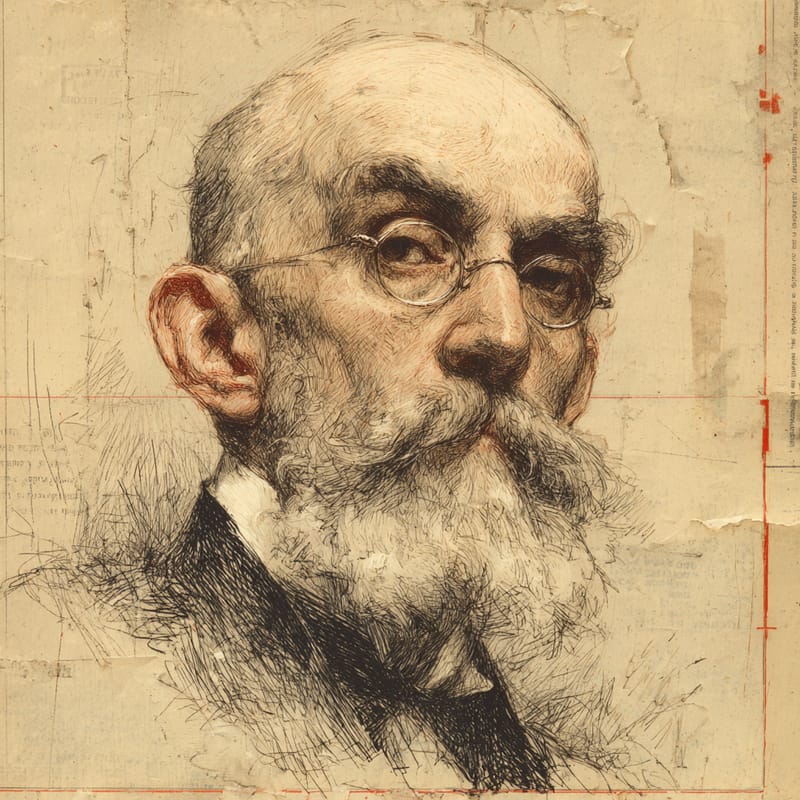
Benjamin Tucker
Individualist anarchism
Liberty, the mother of order.
Reformist MutualistOne of 729 ideologies · enter the Mutualist hall →- Role
- Editor & theorist
- Era
- 1854–1939
- Region
- United States
- Social band
- Reformist
- Placement
- −28 · −76 · +45
§ Where Benjamin Tucker stands
3 axesTucker accepted markets and private property in the product of labour but attacked the four monopolies he blamed for exploitation: money and banking, land, tariffs and patents. Following Warren's principle that cost should be the limit of price, he argued in Instead of a Book (1893) that free competition in banking would drive interest towards zero and end the extraction of rent, interest and profit.
Tucker described anarchists as unterrified Jeffersonian democrats and held that all human affairs should be managed by individuals or voluntary associations. His essay State Socialism and Anarchism, collected in Instead of a Book (1893), contrasted the two heirs of socialist economics and sided with liberty against Marx's state. He accepted voluntary defence associations to protect person and property.
Tucker was a freethinking progressive who defended free speech, free love and women's independence against the Comstock laws of his era. In 1882 he published an edition of Walt Whitman's Leaves of Grass after Boston authorities threatened its publisher with prosecution, daring them to act, and Liberty defended the free-love campaigner Ezra Heywood during his prosecutions.
How close are you to Benjamin Tucker?
Three statements, one per axis. Answer them and we’ll drop you on the compass next to them.
§ The story
HistoricalBenjamin Ricketson Tucker (1854–1939) was an American individualist anarchist, editor and publisher. Born in Massachusetts, he was drawn into radicalism as a teenager through Josiah Warren, Ezra Heywood and William B. Greene, and in 1876 he published the first English translation of Proudhon's What Is Property? In 1881 he founded the journal Liberty in Boston, which he edited until 1908 and made the leading organ of American individualist anarchism.
Tucker's essays, collected in Instead of a Book, by a Man Too Busy to Write One (1893), argued that capitalism's injustices sprang from state-protected monopolies, and in the 1880s he moved from natural-rights arguments to Max Stirner's egoism. He also published Whitman's Leaves of Grass in defiance of censorship and translated Bakunin's God and the State. After a fire destroyed his New York bookshop and stock in 1908, he closed Liberty and moved to Europe, dying in Monaco in 1939, increasingly pessimistic about the prospects for his ideas.
Notable for
- 01Edited 'Liberty'
- 02Individualist anarchism
- 03The 'four monopolies' critique
Key works & moments
- 1876Publishes his English translation of Proudhon's What Is Property?
- 1881Founds the journal Liberty in Boston, the voice of individualist anarchism.
- 1882Defies censorship by publishing Whitman's Leaves of Grass in Boston.
- 1883Publishes his translation of Bakunin's God and the State.
- 1893Publishes Instead of a Book, by a Man Too Busy to Write One.
- 1908A fire destroys his New York bookshop; Liberty closes and he leaves for Europe.
§ Minds closest to Benjamin Tucker
All minds →


§ Also in the Mutualist hall
Enter the hall →§ Common questions
4 answersWhat was Benjamin Tucker's political ideology?
Benjamin Tucker was an individualist anarchist and mutualist: on the 99ideologies three-axis compass, a Reformist Mutualist. Economically he sat modestly left of centre (−28), favouring free markets but seeking to abolish the state-backed monopolies that he believed produced rent, interest and profit. On governance he was strongly libertarian (−76), wanting society run by individuals and voluntary associations. Socially he was progressive (+45), a freethinker who defended free speech and free love.
Was Benjamin Tucker left-wing or right-wing?
Left-wing in his own time, though both left and right claim him. Tucker called himself a socialist, opposed capitalist profit and saw his movement as a rival to Marxism, which places him on the left of the nineteenth-century spectrum. But his defence of markets, competition and private property in the product of labour anticipates later free-market libertarians, which is why both left-libertarians and anarcho-capitalists cite him as a forerunner.
What were Benjamin Tucker's four monopolies?
Tucker argued that exploitation under capitalism came from four monopolies created or protected by the state. The money monopoly, which restricted banking and the issue of currency, enabled interest; the land monopoly, which enforced titles to land the owner did not occupy or use, enabled rent; and tariffs and patents shielded profits from competition. Abolish these privileges, he said, and free competition would reduce rent, interest and profit towards zero, so that workers received the full product of their labour.
Which minds are closest to Benjamin Tucker?
On the 99ideologies three-axis compass, the minds closest to Benjamin Tucker are The Time-Store Keeper (archetype) (98% alike), Josiah Warren (98% alike) and Pierre-Joseph Proudhon (97% alike). The furthest is Adam Sutler (1% alike).