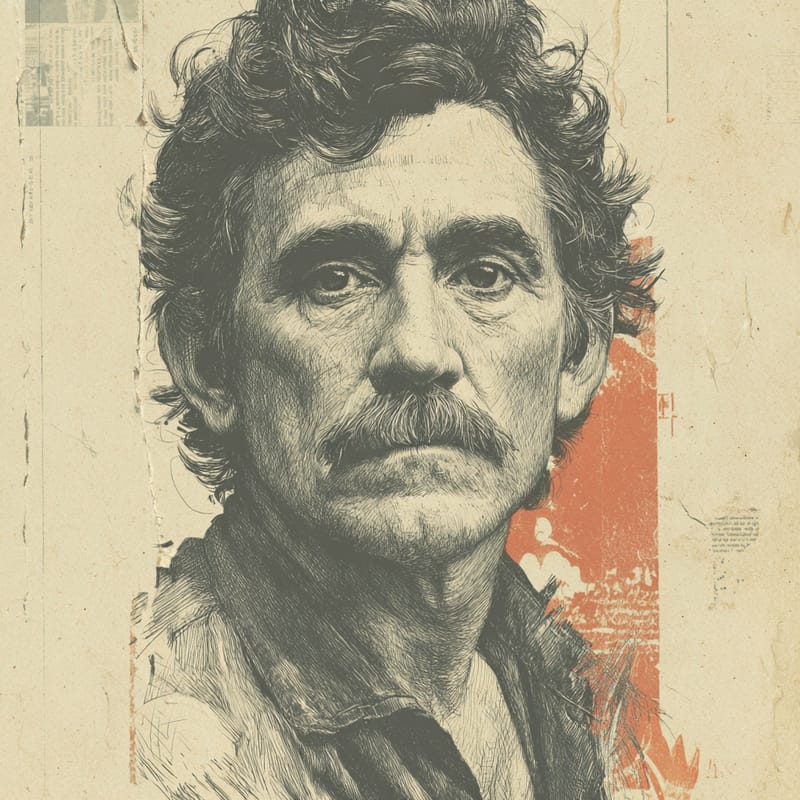
Chico Mendes
Defender of the rainforest
Rubber tappers and the forest commons.
Reformist Eco-SocialistOne of 729 ideologies · enter the Eco-Socialist hall →- Role
- Union & eco activist
- Era
- 1944–1988
- Region
- Brazil
- Social band
- Reformist
- Placement
- −78 · −48 · +58
§ Where Chico Mendes stands
3 axesMendes fought the conversion of common forest into private cattle ranches and the debt bondage that tied tappers to rubber bosses and traders. His alternative, adopted by the National Council of Rubber Tappers in 1985, was the extractive reserve: public land held in common, where communities hold use rights and market rubber and Brazil nuts through cooperatives rather than selling off the forest.
His politics were built from the bottom up: union locals, community assemblies and the empate, in which families linked arms in front of clearing crews without violence. He also worked through institutions, serving on Xapuri's council from 1977, helping found the Workers' Party in Acre in 1980 and lobbying the Inter-American Development Bank in Washington in 1987.
Mendes broadened a labour struggle into a defence of everyone who lived in the forest. In the late 1980s he helped forge the Alliance of the Peoples of the Forest, uniting rubber tappers with Indigenous peoples who had often been their rivals, and he framed rainforest protection as a question of social justice and human rights rather than wilderness preservation.
How close are you to Chico Mendes?
Three statements, one per axis. Answer them and we’ll drop you on the compass next to them.
§ The story
HistoricalFrancisco Alves Mendes Filho (1944–1988), known as Chico Mendes, was a Brazilian rubber tapper, trade unionist and environmentalist from Xapuri in the Amazonian state of Acre. He began tapping rubber as a child and learned to read as a young man, then helped build rural workers' unions in Brasiléia and Xapuri in the 1970s, won a seat on Xapuri's town council in 1977 and was a founding member of the Workers' Party in Acre.
As cattle ranchers cleared Acre's forests in the 1970s and 1980s, Mendes led rubber tappers in empates, peaceful standoffs that blocked chainsaw crews, and pressed for extractive reserves where forest communities could live from rubber and Brazil nuts without destroying the trees. His lobbying of international lenders made the Amazon a global cause. He was shot dead in December 1988 by the son of a rancher whose forest clearance he had blocked; both father and son were convicted in 1990, the year Brazil created its first extractive reserves, one named after him.
Notable for
- 01Led the rubber tappers' union
- 02Won extractive forest reserves
- 03Martyr of the Amazon
Key works & moments
- 1975Helps found the rural workers' union in Brasiléia alongside Wilson Pinheiro.
- 1976Joins the first empates, peaceful human-chain standoffs against forest-clearing crews.
- 1985The National Council of Rubber Tappers forms in Brasília and calls for extractive reserves.
- 1987Receives a UN Global 500 award and lobbies development banks in Washington over Amazon roads.
- 1988Shot dead at his home in Xapuri on 22 December.
- 1990Brazil creates the Chico Mendes Extractive Reserve; his killers are convicted.
§ Minds closest to Chico Mendes
All minds →




§ Also in the Eco-Socialist hall
Enter the hall →§ Common questions
4 answersWhat was Chico Mendes's political ideology?
Chico Mendes was a socialist trade unionist and forest defender: on the 99ideologies three-axis compass, a Reformist Eco-Socialist. Economically he sat well to the left (−78), opposing ranchers' enclosure of the forest and championing extractive reserves held in common and run through cooperatives. On governance he leaned libertarian (−48), building power through unions, community assemblies and non-violent direct action. Socially he was progressive (+58), uniting rubber tappers and Indigenous peoples in defence of the forest.
Was Chico Mendes left-wing or right-wing?
Left-wing. Mendes was a rural union leader and a founding member of Brazil's Workers' Party in Acre, and his fight pitted poor forest workers against cattle ranchers and land speculators. His achievement was to merge labour politics with environmentalism: he argued that protecting the rainforest meant protecting the livelihoods of those who lived from it. That combination of class struggle and ecology made him an icon of the eco-socialist left after his murder in 1988.
Why was Chico Mendes murdered?
Because his campaign threatened powerful ranching interests. In 1988 Mendes and the rubber tappers blocked the rancher Darly Alves da Silva from clearing a forest estate known as Seringal Cachoeira. On 22 December 1988 Darly's son Darci shot Mendes outside his home in Xapuri. Father and son were convicted in 1990 and each sentenced to 19 years in prison. The killing, one of many against rural activists in Brazil, drew worldwide attention to violence over Amazon land.
Which minds are closest to Chico Mendes?
On the 99ideologies three-axis compass, the minds closest to Chico Mendes are William Morris (98% alike), André Gorz (98% alike) and John Bellamy Foster (98% alike). The furthest is Adam Sutler (0% alike).