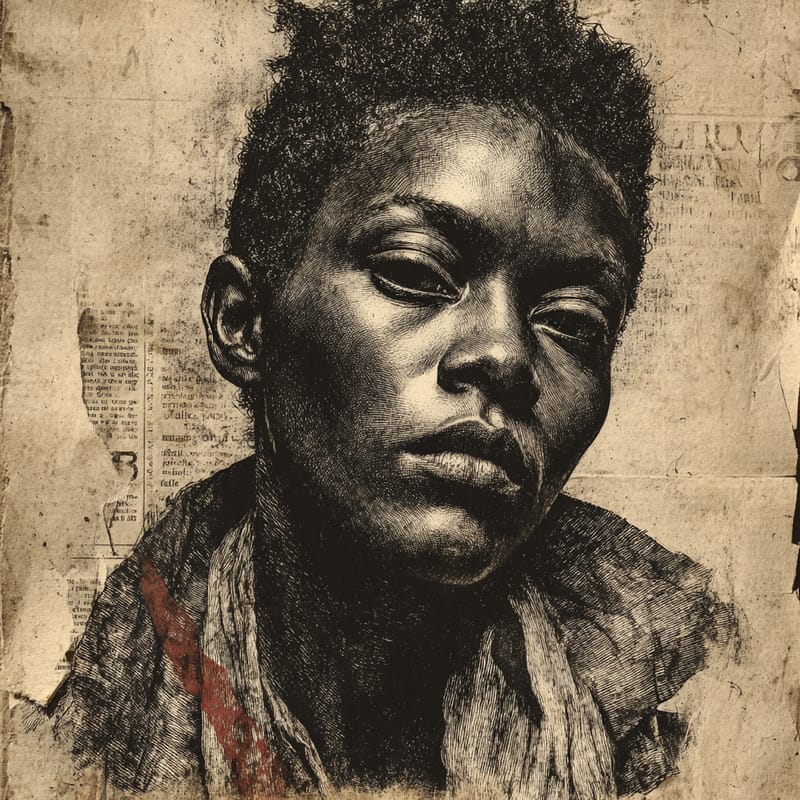
Lauren Olamina
Earthseed
Community and adaptation amid collapse.
Progressive Eco-SocialistOne of 729 ideologies · enter the Eco-Socialist hall →- Role
- Visionary founder (fiction)
- From
- Parable of the Sower
- Region
- United States
- Social band
- Progressive
- Placement
- −70 · −50 · +72
§ Where Lauren Olamina stands
3 axesAcorn runs on shared labour and common resources: members farm, build, teach and defend the settlement together, and Earthseed presents community as the only defence against chaos. Butler sets this against the novel's privatised alternatives, above all the coastal company town of Olivar, where a corporation offers security in exchange for wages that slide into debt servitude.
With government reduced to a remote, ineffectual presence, Lauren builds order from below. Her band on the road north survives through armed night watches and shared decisions, and Acorn is a voluntary community held together by persuasion, common belief and collective self-defence rather than law or police. Yet Lauren is plainly its founder and guide, so this is organised leadership, not anarchy.
Lauren rejects her father's Baptist faith for Earthseed, whose central verse declares that God is Change, and she welcomes anyone willing to work and learn, forming a mixed-race band that includes escaped debt slaves. Her faith looks forward, toward adaptation and a destiny among the stars, rather than back to a lost order.
How close are you to Lauren Olamina?
Three statements, one per axis. Answer them and we’ll drop you on the compass next to them.
§ The story
FictionLauren Oya Olamina is the narrator and protagonist of Octavia E. Butler's novel Parable of the Sower (1993) and its sequel Parable of the Talents (1998). A Black teenager growing up in a walled neighbourhood outside Los Angeles in the 2020s, as climate change, economic collapse and violence tear California apart, she suffers from hyperempathy, feeling the pain she sees in others. In her diary she composes the verses of Earthseed, a new faith built on the idea that God is Change.
After her community is destroyed, Lauren leads a band of refugees north and founds Acorn, a self-reliant settlement where Earthseed is practised, only to see it crushed by a Christian nationalist movement in the sequel. Butler used her to explore how people might rebuild solidarity when states and markets fail, and a demagogue in the sequel who promises to 'make America great again' made the books newly prominent in the late 2010s. Lauren has become an icon of climate fiction, Afrofuturism and movements organised around mutual aid.
Notable for
- 01Protagonist of 'Parable of the Sower'
- 02Founds the Earthseed faith
- 03Climate-collapse survival narrative
Key works & moments
- 1993Octavia E. Butler publishes Parable of the Sower, set in a collapsing 2020s California.
- Early chaptersIn walled Robledo, teenage Lauren secretly writes the first verses of Earthseed.
- Mid-novelRobledo is overrun and burned; Lauren flees north along the highways with two fellow survivors.
- Novel's endFounds Acorn, the first Earthseed community, on land in northern California.
- 1998Parable of the Talents sees Acorn seized by Christian America zealots and turned into a camp.
- 2020Parable of the Sower reaches The New York Times best-seller list, 27 years after publication.
In Lauren Olamina's words
“All that you touch / You Change. / All that you Change / Changes you. / The only lasting truth / Is Change. / God / Is Change.”
§ Minds closest to Lauren Olamina
All minds →





§ Also in the Eco-Socialist hall
Enter the hall →§ Common questions
4 answersWhat is Lauren Olamina's political ideology?
Lauren Olamina is a communitarian visionary: on the 99ideologies three-axis compass, a Progressive Eco-Socialist. Economically she sits well to the left (−70), building Acorn on shared labour and mutual aid in place of corporate debt servitude. On governance she leans libertarian (−50), creating a voluntary community rather than relying on a failed state. Socially she is strongly progressive (+72), founding an inclusive new faith that embraces change and looks to the future.
Is Lauren Olamina left-wing or right-wing?
Broadly left-wing, though she never uses the label. Butler gives her none of the vocabulary of socialist politics; instead Lauren answers social collapse with communal self-help, shared property and an inclusive faith. Her enemies in the sequel are a theocratic nationalist movement and the corporations profiting from disorder, which sets her against the authoritarian right. Her reliance on voluntary community rather than the state gives her politics a libertarian, mutual-aid flavour within that left-wing frame.
Did Octavia Butler's Parable novels predict 'Make America Great Again'?
In part. The slogan appears in the 1998 sequel, Parable of the Talents, where the presidential candidate Andrew Steele Jarret, backed by a militant Christian America movement, promises to make America great again. Butler was not forecasting a specific politician; she extrapolated from trends of the 1990s, including religious nationalism, privatisation and climate neglect. The echo of a 2016 campaign slogan, together with the books' depiction of fires, drought and inequality, made both novels best-sellers decades after publication.
Which minds are closest to Lauren Olamina?
On the 99ideologies three-axis compass, the minds closest to Lauren Olamina are Vandana Shiva (98% alike), Naomi Klein (98% alike) and Rachel Carson (96% alike). The furthest is Adam Sutler (0% alike).