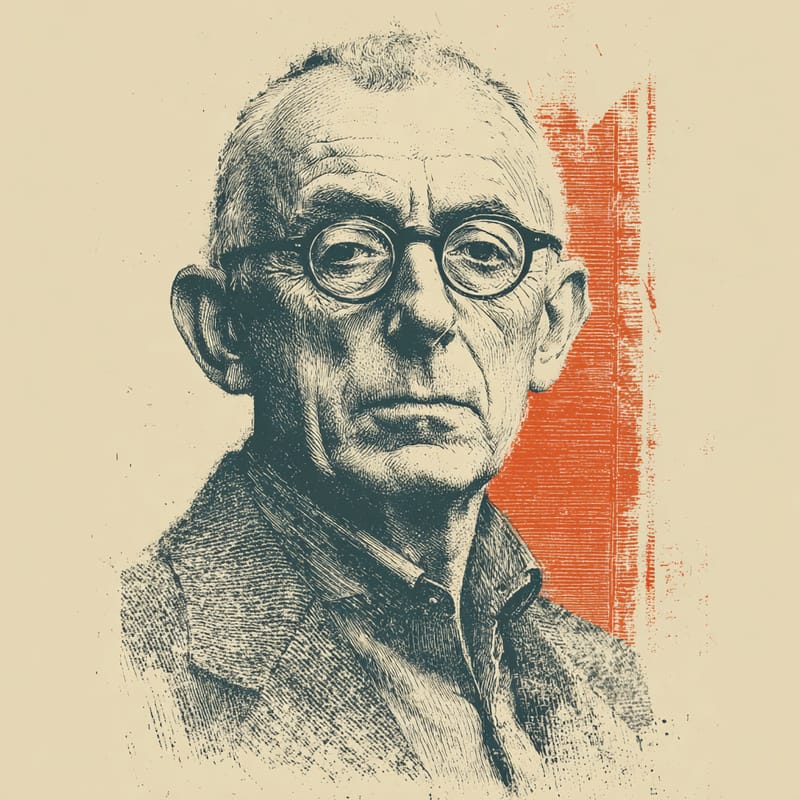
André Gorz
Farewell to the working class
Less work, more life, within ecological limits.
Reformist Eco-SocialistOne of 729 ideologies · enter the Eco-Socialist hall →- Role
- Philosopher
- Era
- 1923–2007
- Region
- Austria / France
- Social band
- Reformist
- Placement
- −76 · −52 · +60
§ Where André Gorz stands
3 axesGorz argued in Ecology as Politics (1975) that capitalism's need for endless growth was incompatible with a finite planet, and he is often credited with first using the word décroissance, degrowth, in 1972. His alternative was to produce less and better and to cut working time drastically, as Critique of Economic Reason (1988) proposed, and by the 1990s to guarantee everyone an income independent of employment.
Gorz's lodestar was autonomy: he wanted to shrink the sphere of necessary, centrally organised labour and expand the sphere in which individuals and communities govern themselves. In Ecology and Freedom (1977) he warned against an eco-technocracy imposing limits from above, while accepting that some planned social production would always remain, which kept him short of anarchism.
An existentialist shaped by Sartre, Gorz saw freedom as self-creation and attacked consumer society for manufacturing needs. His post-work vision, from Farewell to the Working Class (1980) onward, imagined people freed from wage labour to pursue care, craft, culture and community, a liberation of daily life rather than only of economic relations.
How close are you to André Gorz?
Three statements, one per axis. Answer them and we’ll drop you on the compass next to them.
§ The story
HistoricalAndré Gorz (1923–2007), born Gerhart Hirsch in Vienna to a Jewish father and a Catholic mother, spent the war years in Switzerland, where he studied chemical engineering and in 1946 met Jean-Paul Sartre. Settling in Paris in 1949, he joined the circle of Les Temps modernes and worked as a journalist under the name Michel Bosquet, helping to found Le Nouvel Observateur in 1964, while publishing philosophy and political theory as André Gorz.
Gorz moved from Sartrean existentialism and the New Left to become a founder of political ecology. His 1964 idea of non-reformist reforms, changes that shift power toward workers rather than merely improving conditions, shaped the New Left, and Farewell to the Working Class (1980) provoked the left by arguing that automation had ended the industrial proletariat's historical mission. He championed shorter working time, autonomy and limits to growth, and later a guaranteed basic income. In 2007, a year after publishing Letter to D. to his terminally ill wife Dorine, the couple ended their lives together.
Notable for
- 01Pioneer of political ecology
- 02'Farewell to the Working Class'
- 03Theory of post-work autonomy
Key works & moments
- 1958Publishes The Traitor, an autobiographical essay with a preface by Jean-Paul Sartre.
- 1964Helps found Le Nouvel Observateur; Strategy for Labour proposes non-reformist reforms.
- 1972Writing as Michel Bosquet, uses the word décroissance, degrowth, in a Nouvel Observateur debate.
- 1980Publishes Farewell to the Working Class (Adieux au prolétariat).
- 1988Critique of Economic Reason argues for a sharply shorter working life.
- 2007Dies with his wife Dorine in a joint suicide, a year after Letter to D.
§ Minds closest to André Gorz
All minds →

§ Also in the Eco-Socialist hall
Enter the hall →§ Common questions
4 answersWhat was André Gorz's political ideology?
André Gorz was a founder of political ecology and a theorist of post-work socialism: on the 99ideologies three-axis compass, a Reformist Eco-Socialist. Economically he sat well to the left (−76), arguing that capitalist growth was ecologically unsustainable and calling for degrowth, shorter working time and a guaranteed income. On governance he leaned libertarian (−52), prizing autonomy and self-management over both market and state. Socially he was progressive (+60), an existentialist critic of consumerism and the work ethic.
Was André Gorz left-wing or right-wing?
Left-wing, though an unorthodox one. Gorz came out of Sartre's circle and the New Left and remained anti-capitalist throughout, but he broke with traditional Marxism by arguing that the industrial working class would not be the agent of liberation and that socialism must mean less work and less production, not more. His ideas of non-reformist reforms, degrowth and basic income have influenced Green parties, the alter-globalisation movement and post-work thinkers more than communist parties.
Did André Gorz invent degrowth?
He is usually credited with first using the word. In 1972, writing as Michel Bosquet in Le Nouvel Observateur, Gorz asked whether the Earth's balance, which required no growth or even a décroissance of material production, was compatible with the survival of capitalism. The question came in the same year as the Club of Rome's report The Limits to Growth. Gorz did not build a full degrowth programme, which later thinkers such as Serge Latouche developed, but his writing on ecology, work and autonomy laid much of its groundwork.
Which minds are closest to André Gorz?
On the 99ideologies three-axis compass, the minds closest to André Gorz are Chico Mendes (98% alike), William Morris (97% alike) and John Bellamy Foster (97% alike). The furthest is Adam Sutler (0% alike).