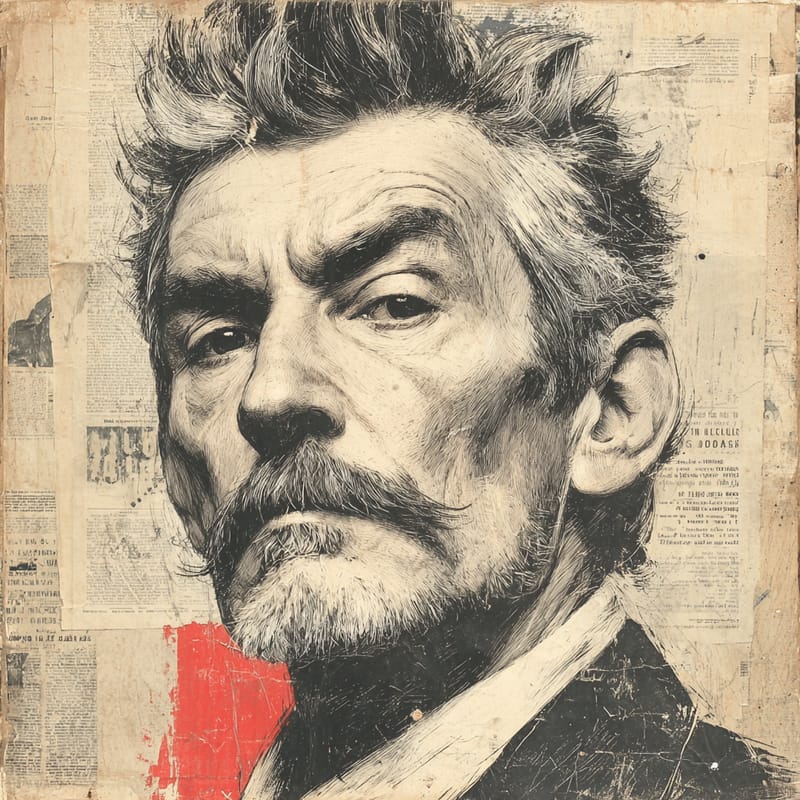
Carlos Cardoen in the 1980s
The regime's arms maker
Supplier to Chile's armed forces and seller of cluster bombs to Iraq.
Traditional PinochetistOne of 729 ideologies · enter the Pinochetist hall →- Role
- Arms manufacturer
- Era
- 1977–1990
- Region
- Chile
- Social band
- Traditional
- Placement
- +92 · +90 · −50
§ Where Carlos Cardoen in the 1980s stands
3 axesA period profile. This page places the Carlos Cardoen of the arms years, 1977 to 1990, by the order he worked in: he armed the forces of Chile’s military government and prospered under it. It is not a statement of his beliefs, and it is not where he stands now. By the Guardian correspondent’s account he fell out with Pinochet in the mid-1980s and went on to fund the democratic opposition. Carlos Cardoen today is placed as a Centrist.
In these years Cardoen was a private exporter in an economy the military government had thrown open to trade, and his company sold nearly all its arms abroad. The placement at the market end records that model. It needs one qualification: by Forecast International’s account the arms line began with army contracts and low-interest government loans, so this was private enterprise with the state as its first customer.
The placement records the order he served, not a creed. His first customers were the armed forces of a military dictatorship, his arms line was created at their request, and his business grew while Chile’s Congress was closed. He held no office, and by the Guardian correspondent’s account he had fallen out with Pinochet before the decade was over.
Nothing in the record shows Cardoen campaigning on moral or cultural questions in these years. The traditional lean is that of his milieu, the business class of the military period, and should be read as no more than that.
How close are you to Carlos Cardoen in the 1980s?
Three statements, one per axis. Answer them and we’ll drop you on the compass next to them.
§ The story
HistoricalThis is the period profile of Carlos Cardoen Cornejo (born 1942), the Chilean engineer who built his country’s most successful private arms exporter. It covers the years of Industrias Cardoen, from its founding in 1977 to the Gulf crisis of 1990. His main profile covers the whole life, including the United States indictment and his later career as a museum and wine entrepreneur in Colchagua.
In these years Cardoen was the leading private arms maker of Chile’s military government. A United States embargo had cut the regime off from American weapons, the armed forces turned to local industry, and a company that had started with explosives for mining grew in under a decade into a group selling bombs, mines and armoured vehicles to Chile’s forces and, above all, cluster bombs to Iraq.
How Industrias Cardoen began
Cardoen trained as an engineer in Chile and took a doctorate in metallurgy at the University of Utah. He worked for the American firm Ireco Chemicals before going home to start a mining-explosives company, Industrias Cardoen, in 1977.
The timing mattered. Under the Kennedy Amendment the United States had stopped selling arms to Chile’s military government, and the regime wanted suppliers at home. Cardoen’s first defence contract, for anti-tank mines, came in 1978, according to the defence analysts Forecast International, and a cluster bomb followed at the request of the Chilean Air Force, financed with low-interest government loans. In testimony to Chile’s Supreme Court in 2019 Cardoen said the army’s commander-in-chief, who at the time was Augusto Pinochet, had called him and other businessmen in and asked them to develop mines and bombs as quickly as they could.
What Industrias Cardoen made
A Library of Congress study published in 1994 called the firm the most successful Chilean defence manufacturer in the export field, grown in less than eight years from a modest maker of demolition charges into a diversified industrial group. By 1987, according to Forecast International, it employed about 1,200 people in Chile and sold between 100 and 150 million dollars of goods a year. Almost all its arms went abroad, three-quarters of them to Iraq.
- Armoured vehicles. The Alacrán half-track, which grew out of a project to rebuild the army’s Second World War carriers; the Swiss Mowag Piranha, assembled under licence from the early 1980s, with 180 in Chilean Army service by 1993; and the Orca and Escarabajo personnel carriers.
- Explosives and munitions. Demolition charges, detonators, hand grenades, anti-personnel and anti-tank mines, rockets and aircraft bombs.
- The cluster bomb. A 227-kilogram bomb that scattered 240 bomblets, patented by the company and its most successful product.
- A helicopter. A low-cost combat helicopter based on the Bell 206. A civilian version gained a United States aviation licence in 1990; the prototype was later impounded in the United States.
Cluster bombs for Iraq, 1984–1988
Iraq was the customer that made the company. The first reported airlift of Cardoen cluster bombs left Santiago in March 1984, four years into the Iran–Iraq War. The Library of Congress study put sales to Iraq at more than 200 million dollars between 1984 and 1988, and noted that by early 1991 the firm was described as the world’s leading producer of cluster bombs. Iraq paid partly in oil. Cardoen has always said the trade had the knowledge and approval of the United States, which then sided with Iraq against Iran.
On 25 January 1986 an explosion at the company’s plant at Alto Hospicio, near Iquique, where the bombs were made, killed about 29 workers.
Was Cardoen a Pinochet loyalist?
The label most often attached to these years is the one the investigative outlet CIPER uses: Pinochet’s favourite arms maker of the 1980s. The business relationship is not in doubt. It began with army contacts and state loans, and the armed forces were his first customers.
The loyalty is in doubt. Malcolm Coad, the Guardian’s correspondent in Santiago, wrote in 1994 that it was an over-neat impression to see Cardoen merely as a Pinochet acolyte: in the mid-1980s, at the height of the cluster-bomb business, he fell out with the general, became a leading backer of the Christian Democratic and centre-left opposition and was probably the most outspoken dissident in Chilean business at the time. Coad traced the quarrel partly to a company linked to the army that tried to sell a rival cluster bomb, which Cardoen sued for industrial espionage. By Coad’s account, and Time magazine’s, Cardoen then helped pay for Patricio Aylwin’s victorious presidential campaign in 1989.
That is why this placement is a description of the order he worked in during these years and not of the man. What he did afterwards is in his main profile.
How the arms years ended
Iraq’s invasion of Kuwait in August 1990 turned the company’s best customer into an international embarrassment. In 1992 United States officials moved to seize Cardoen’s properties in Florida, and in May 1993 a grand jury in Miami indicted him over the American zirconium used in the bombs. The company took a new name, Metalnor, and played up its civilian businesses.
Cardoen has never been tried on those charges, which he denies, and in 2020 Chile’s Supreme Court refused to extradite him. The indictment, the extradition case and his reinvention in the Colchagua Valley are told in his main profile.
Notable for
- 01Founding Industrias Cardoen in 1977
- 02Arming Chile's forces under the United States embargo
- 03Cluster-bomb sales to Iraq, 1984–1988
Key works & moments
- 1977Founds Industrias Cardoen to make explosives for the mining industry.
- 1978Wins a first defence contract, for anti-tank mines, according to Forecast International.
- 1979Takes over the army’s project to rebuild its half-track carriers, which becomes the Alacrán.
- 1984The first reported airlift of the company’s cluster bombs leaves Santiago for Iraq.
- 1986An explosion at the plant near Iquique kills about 29 workers.
- 1987The company employs about 1,200 people; three-quarters of its arms sales go to Iraq.
- 1989Helps fund the presidential campaign of the opposition leader Patricio Aylwin, by press accounts.
- 1990Iraq invades Kuwait in August, and the sales to Baghdad become a scandal.
- 1993Indicted in Miami over zirconium exports; the company is by now called Metalnor.
Sources and further reading
- Rex A. Hudson (ed.), Chile: A Country Study (Library of Congress, 1994), pp. 323–325
- Forecast International, “Industria Metalúrgica del Norte (Metalnor)”, September 1998
- Corte Suprema de Chile, ruling of Justice Carlos Aránguiz on the extradition request (Rol 7744-2019), 6 March 2020
- Malcolm Coad, letter, London Review of Books, 7 April 1994 (replying to Paul Foot, “Licence to Kill”, 10 February 1994)
- Time, “Of Cluster Bombs and Kiwis”, 10 December 1990
- MERIP, “Iraq Buys Cluster Bombs from Chile”, March 1984
- CIPER Chile, “La historia de los US$50 millones que le quedó debiendo Saddam Hussein a Cardoen por las bombas de racimo”, 1 February 2019
- Cooperativa, “Carlos Cardoen: Por supuesto que Pinochet traficó armas”, 10 July 2006
Fact-checked by the 99Ideologies editors · last reviewed
§ Minds closest to Carlos Cardoen in the 1980s
All minds →
§ Also in the Pinochetist hall
Enter the hall →§ Common questions
8 answersWhat was Industrias Cardoen?
Industrias Cardoen was the Chilean company founded by Carlos Cardoen in 1977. It began by making explosives for the mining industry and, after the United States stopped selling arms to Chile, became the country's most successful private arms exporter, producing cluster bombs, mines, grenades and armoured vehicles. By 1987 it employed about 1,200 people. It was renamed Metalnor in the early 1990s.
What did Industrias Cardoen make?
Explosives and munitions first: demolition charges, detonators, hand grenades, mines, rockets and aircraft bombs. Then armoured vehicles, including the Alacrán half-track, the Swiss Mowag Piranha built under licence for the Chilean Army, and the Orca and Escarabajo personnel carriers. Its most successful product was a patented 227-kilogram cluster bomb. It also developed a low-cost helicopter based on the Bell 206.
Did Industrias Cardoen sell cluster bombs to Iraq?
Yes. The first reported shipment left Santiago in March 1984, during the Iran–Iraq War, and a Library of Congress study put the sales at more than 200 million dollars between 1984 and 1988. By 1987 about three-quarters of the company's arms sales went to Iraq. Carlos Cardoen does not dispute the trade; he says it had the knowledge and approval of the United States.
Was Carlos Cardoen a supporter of Pinochet?
He was a supplier to Pinochet's armed forces, and this profile places him by that role. The evidence of political loyalty is thin. The Guardian's correspondent in Santiago wrote that Cardoen fell out with Pinochet in the mid-1980s and became a leading backer of the Christian Democratic and centre-left opposition, and Time reported that he gave a million dollars to Patricio Aylwin's 1989 campaign against the regime's candidate. In 2006 he said publicly that Pinochet had trafficked in arms and taken bribes.
What happened at the Cardoen plant in Iquique in 1986?
On 25 January 1986 an explosion at the Industrias Cardoen plant at Alto Hospicio, near Iquique in northern Chile, killed about 29 workers. The plant made the company's cluster bombs.
What happened to Industrias Cardoen?
After Iraq invaded Kuwait in 1990 the company's sales to Baghdad became a scandal. United States officials moved to seize Carlos Cardoen's properties in Florida in 1992 and indicted him in 1993 over zirconium exports, and the company changed its name to Metalnor and shifted toward civilian businesses. Cardoen himself turned to museums, wine and tourism in the Colchagua Valley.
Why are there two profiles of Carlos Cardoen?
Because his public life has two parts that sit in different places on the compass. This profile covers the arms years, 1977 to 1990, and places him by the order he worked in, Chile's military government. The main profile covers his whole life and places him where his record as a whole puts him, near the centre.
Which minds are closest to Carlos Cardoen in the 1980s?
On the 99ideologies three-axis compass, the minds closest to Carlos Cardoen in the 1980s are Vladimiro Montesinos (97% alike), Park Chung-hee (97% alike) and José Piñera (96% alike). The furthest is Emma Goldman (0% alike).