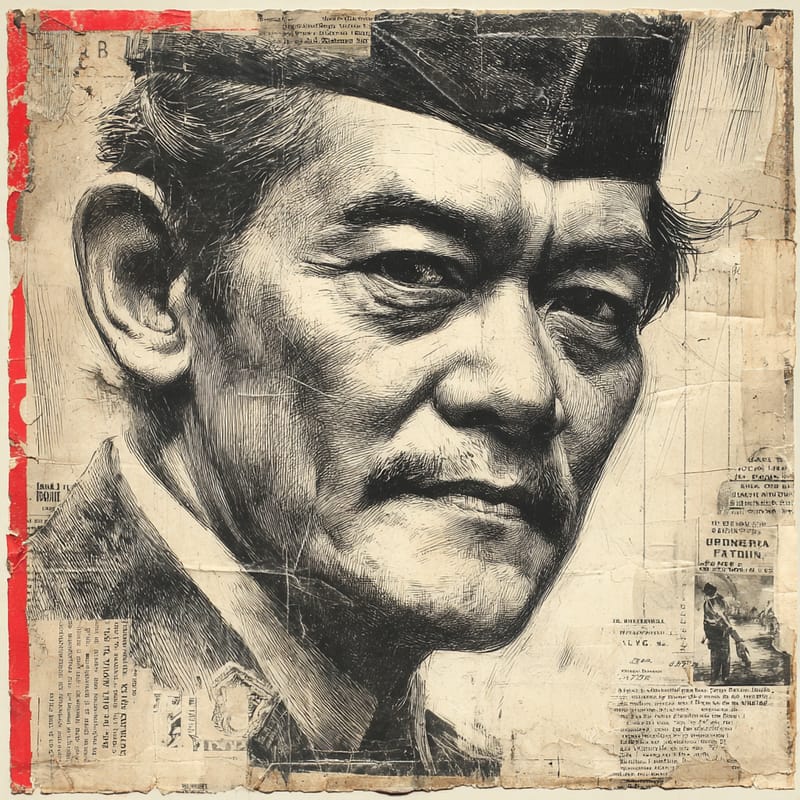
Suharto
The New Order
Market growth, crony capital, dictatorship.
Traditional PinochetistOne of 729 ideologies · enter the Pinochetist hall →- Role
- President
- Era
- 1921–2008
- Region
- Indonesia
- Social band
- Traditional
- Placement
- +90 · +94 · −60
§ Where Suharto stands
3 axesSuharto handed economic policy to US-trained technocrats, the so-called Berkeley Mafia, who tamed hyperinflation and opened Indonesia to foreign capital through the 1967 Foreign Investment Law. Oil revenues, rice self-sufficiency in the 1980s and export manufacturing drove rapid growth. The market had limits, however: the state oil company Pertamina dominated the energy sector, and licences and monopolies were steered to the president's family and cronies.
The New Order rested on the army's 'dual function' in politics and security, on controlled elections won by the government party Golkar, and on the memory of 1965–66, when hundreds of thousands were killed and many more imprisoned, some for over a decade on Buru Island. The 1975 invasion of East Timor led to an occupation in which an estimated 100,000–180,000 people died.
Suharto's order was paternalist and nationalist. Laws passed in 1985 made the state ideology Pancasila the sole permitted basis for all organisations, and citizens had to profess a recognised religion. A 1967 presidential instruction restricted Chinese religious and cultural expression, Chinese Indonesians were pressed to adopt Indonesian names, and civil servants' wives were organised in Dharma Wanita to promote a domestic ideal of womanhood.
How close are you to Suharto?
Three statements, one per axis. Answer them and we’ll drop you on the compass next to them.
§ The story
HistoricalSuharto (1921–2008), who like many Javanese used a single name, was the second president of Indonesia, ruling from 1967 to 1998. Born in the village of Kemusuk near Yogyakarta, he served in the Dutch colonial army and the Japanese-sponsored PETA militia, fought in the war of independence against the Netherlands and rose to command the army's strategic reserve, Kostrad. In October 1965, after the killing of six generals by the 30 September Movement, he took control of the army and crushed the movement.
Blaming the Indonesian Communist Party, the army and allied militias killed an estimated 500,000 to one million people in 1965–66, and Suharto edged Sukarno from power, becoming acting president in 1967. His New Order brought three decades of growth, foreign investment and falling poverty, alongside military rule, the 1975 invasion of East Timor and corruption on a vast scale; in 2004 Transparency International estimated that he had embezzled $15–35 billion. The Asian financial crisis and mass protests forced him to resign in May 1998.
Notable for
- 0132-year 'New Order' rule
- 02Market-opening growth
- 03Pervasive crony capitalism
Key works & moments
- 1965Crushes the 30 September Movement and leads the army's campaign against the Communist Party.
- 1966Receives the Supersemar order of 11 March, transferring effective authority from Sukarno.
- 1967Becomes acting president; the Foreign Investment Law opens the economy to Western capital.
- 1975Launches the invasion of East Timor, beginning a 24-year occupation.
- 1998Resigns on 21 May amid the Asian financial crisis, riots and mass student protests.
§ Minds closest to Suharto
All minds →


§ Also in the Pinochetist hall
Enter the hall →§ Common questions
4 answersWhat was Suharto's political ideology?
Suharto was an anti-communist military developmentalist: on the 99ideologies three-axis compass, a Traditional Pinochetist. Economically he sat near the market end (+90), opening Indonesia to foreign investment under technocratic management, though cronyism and state firms distorted the market. On governance he was near the authoritarian maximum (+94), ruling for three decades through the army and controlled elections, and socially he was traditionalist (−60), imposing a paternalist, religious and nationalist order.
Was Suharto left-wing or right-wing?
Right-wing. Suharto came to power by destroying the Indonesian Communist Party, then the largest communist party outside the communist states, in a wave of killings in 1965–66, and he aligned Indonesia with the West in the Cold War. His economic policy welcomed foreign capital and private business, even as his family and associates captured monopolies, and his rule rested on the army. That combination places him on the authoritarian right.
How did Suharto come to power?
Through the aftermath of the 30 September Movement of 1965, in which rebel officers killed six army generals. As commander of the army's strategic reserve, Suharto crushed the movement within days and blamed the Communist Party, and the army and allied militias then killed an estimated 500,000 to one million suspected communists. On 11 March 1966 President Sukarno signed the Supersemar order granting Suharto authority to restore order. He became acting president in 1967 and president in 1968.
Which minds are closest to Suharto?
On the 99ideologies three-axis compass, the minds closest to Suharto are Park Chung-hee (99% alike), Carlos Cardoen (illustrative) (96% alike) and Coriolanus Snow (96% alike). The furthest is Emma Goldman (0% alike).