
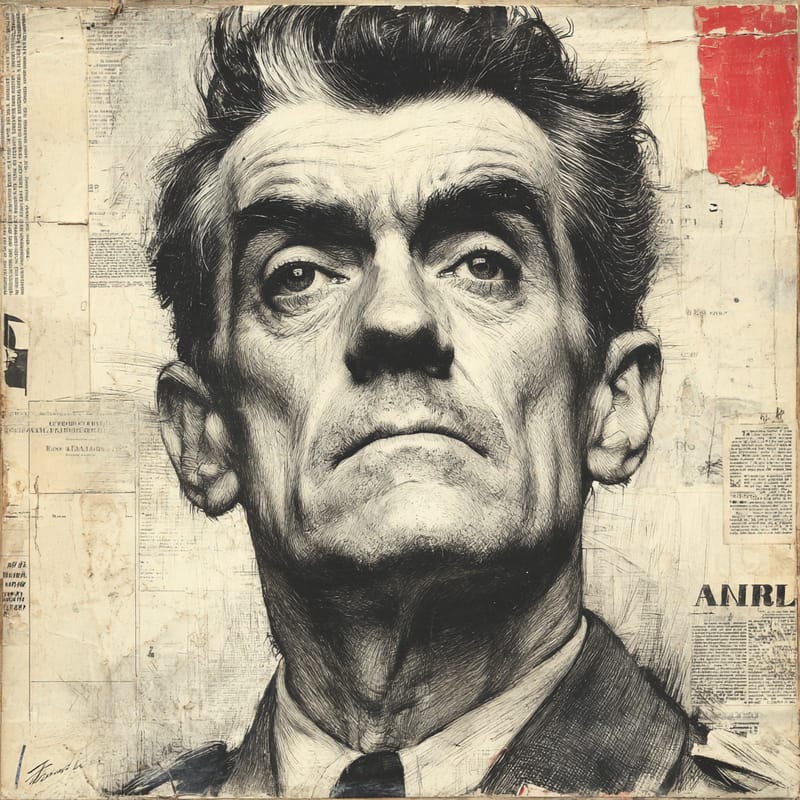
Augusto Pinochet
Free markets at gunpoint
Radical capitalism under military terror.
Reactionary PinochetistOne of 729 ideologies · enter the Pinochetist hall →- Role
- Dictator
- Era
- 1915–2006
- Region
- Chile
- Social band
- Reactionary
- Placement
- +92 · +97 · −75
§ Where Augusto Pinochet stands
3 axesPinochet handed the economy to the Chicago Boys, who imposed shock spending cuts in 1975, privatised hundreds of state firms, cut tariffs to a uniform 10 per cent by 1979 and replaced public pensions with private accounts in 1980. The limits were telling: the copper giant Codelco stayed in state hands, partly funding the military, and in the 1982–83 crash the state took over failing banks.
Pinochet closed Congress, banned parties and ruled through the junta and the secret police, first DINA and later the CNI. In October 1973 the Caravan of Death executed scores of prisoners, DINA agents assassinated the exiled former minister Orlando Letelier in Washington in 1976, and the 1980 constitution, approved in a plebiscite held without electoral registers, entrenched military power beyond his rule.
Pinochet cast his rule as a defence of Western Christian civilisation against Marxism. The 1980 constitution outlawed parties that preached class struggle, universities were purged, books were burned after the coup and divorce remained illegal. Yet the Catholic Church, through the Vicariate of Solidarity founded in 1976, became the regime's main domestic critic on human rights.
How close are you to Augusto Pinochet?
Three statements, one per axis. Answer them and we’ll drop you on the compass next to them.
§ The story
HistoricalAugusto José Ramón Pinochet Ugarte (1915–2006) ruled Chile as military dictator from 1973 to 1990. Born in Valparaíso, he made his career in the army and was appointed its commander-in-chief by President Salvador Allende in August 1973, weeks before he joined and then led the coup of 11 September that overthrew Allende's elected socialist government. Allende killed himself as troops stormed the bombed La Moneda palace, and Pinochet became head of the military junta and, from 1974, president.
Pinochet's regime killed or disappeared more than 3,000 people and imprisoned and tortured tens of thousands, according to Chile's official truth commissions, while the Chicago Boys remade the economy along radical free-market lines. Defeated in a 1988 plebiscite, he handed power to an elected president in 1990 but stayed army commander until 1998. Arrested in London that year on a Spanish warrant, he returned home in 2000 and died in 2006 facing charges of human rights abuses and tax fraud, never convicted.
Notable for
- 011973 coup against Allende
- 02'Chicago Boys' market reforms
- 03Systematic political repression
Key works & moments
- 1973Leads the 11 September coup that overthrows Salvador Allende's elected government.
- 1975Backs the Chicago Boys' shock programme of spending cuts, liberalisation and privatisation.
- 1976DINA agents kill exiled former minister Orlando Letelier with a car bomb in Washington.
- 1980A plebiscite approves his constitution, entrenching military influence and banning Marxist parties.
- 1988Loses a plebiscite on extending his rule; hands the presidency to Patricio Aylwin in 1990.
- 1998Arrested in London on a Spanish warrant for human rights crimes; released in 2000.
§ Minds closest to Augusto Pinochet
All minds →


§ Also in the Pinochetist hall
Enter the hall →§ Common questions
4 answersWhat was Augusto Pinochet's political ideology?
Augusto Pinochet was a military dictator who combined radical free-market economics with anti-communist repression: on the 99ideologies three-axis compass, a Reactionary Pinochetist. Economically he sat near the market extreme (+92), privatising state firms, pensions and services. On governance he was near the authoritarian maximum (+97), ruling through a junta and secret police, and socially he was strongly reactionary (−75), casting his rule as a Christian, nationalist crusade against Marxism.
Was Pinochet left-wing or right-wing?
Right-wing, on the far right. Pinochet overthrew an elected socialist government, banned left-wing parties, persecuted socialists and communists and imposed one of the most thoroughly free-market economic programmes of the twentieth century. His regime combined that economic liberalism with military authoritarianism and social conservatism, a pairing that has made Pinochetism a byword for capitalism without democracy.
Did Pinochet's free-market reforms work?
Partly, and at a heavy cost. The 1975 shock tamed inflation and the reforms built a dynamic export economy, but in the 1982–83 crash output fell by more than a tenth, unemployment soared and the state had to rescue the banks. Growth resumed from 1985 under more pragmatic policies, and the democratic governments after 1990 kept the open economy while expanding social spending, cutting poverty sharply. Critics point to high inequality, weak labour rights and the repression that made the experiment possible.
Which minds are closest to Augusto Pinochet?
On the 99ideologies three-axis compass, the minds closest to Augusto Pinochet are António Salazar (98% alike), Coriolanus Snow (97% alike) and Adam Sutler (96% alike). The furthest is Emma Goldman (0% alike).