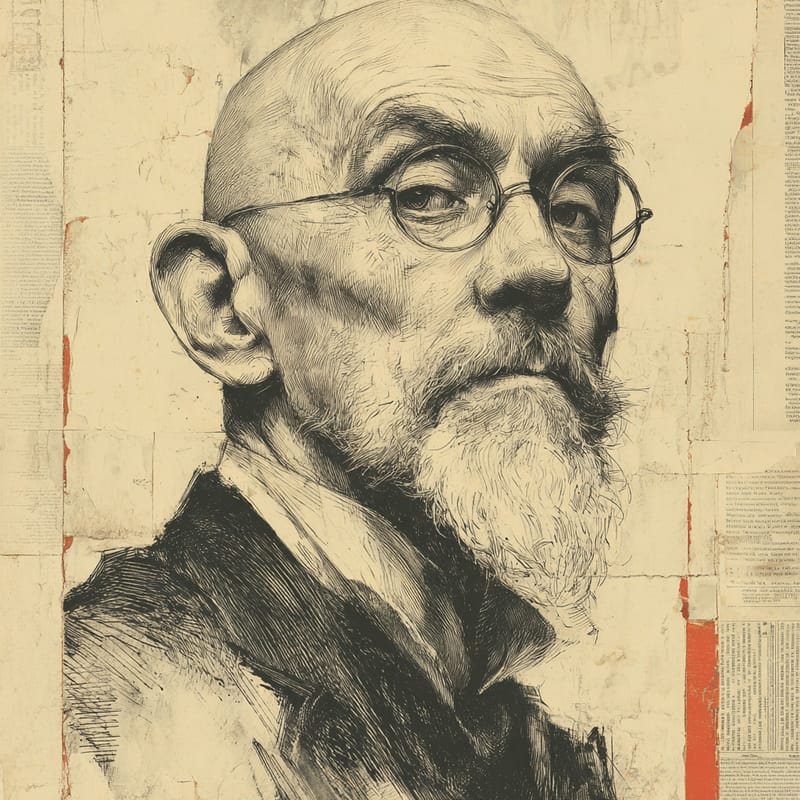
Antonio Negri
Empire and multitude
Self-organised power against capital.
Reformist AutonomistOne of 729 ideologies · enter the Autonomist hall →- Role
- Theorist
- Era
- 1933–2023
- Region
- Italy
- Social band
- Reformist
- Placement
- −56 · −76 · +62
§ Where Antonio Negri stands
3 axesNegri's economics start from the workerist claim that labour's struggles drive capitalist development. Marx Beyond Marx (1979), lectures on the Grundrisse, reads Marx as a theorist of workers' power, and Empire (2000) ends by demanding global citizenship, a social wage and guaranteed income for all, and the right to reappropriate the means of production. He sought the common beyond both private and state property, not a planned economy.
Negri placed constituent power, the creative force of people acting together, above constituted states and parties, the argument of Insurgencies (1992). The multitude he theorised with Hardt organises itself through networks rather than a vanguard. Yet he could be pragmatic about institutions: in 2005 he backed the proposed European constitution as a step beyond the nation-state.
Negri's social outlook was radically progressive and cosmopolitan. Empire (2000) celebrates migration and the crossing of national borders and closes by invoking St Francis of Assisi as a model of joyful militancy, and Multitude (2004) presents the diverse struggles of workers, women, migrants and minorities as a single democratic force against global capital.
How close are you to Antonio Negri?
Three statements, one per axis. Answer them and we’ll drop you on the compass next to them.
§ The story
HistoricalAntonio Negri (1933–2023) was an Italian Marxist philosopher and political activist. Born in Padua, he became a professor of state theory at the University of Padua in the 1960s, wrote for the workerist journals Quaderni Rossi and Classe Operaia, and in 1969 co-founded the revolutionary group Potere Operaio, later becoming the best-known intellectual of Autonomia Operaia. On 7 April 1979 he was arrested in a sweep against the autonomist movement and accused of masterminding the Red Brigades, a charge that later collapsed.
Held for four years without trial, Negri was elected to parliament for the Radical Party in 1983 and released, then fled to France when the Chamber of Deputies lifted his immunity; he was later convicted in absentia of offences linked to the armed movements of the 1970s. He taught and wrote in Paris, and after returning voluntarily to Italy in 1997 he served out his sentence, which ended in 2003. With Michael Hardt he wrote Empire (2000), Multitude (2004) and Commonwealth (2009), which made him a guiding thinker of the anti-globalisation movement.
Notable for
- 01Co-wrote 'Empire'
- 02Theorist of the 'multitude'
- 03Italian autonomist movement
Key works & moments
- 1969Co-founds the revolutionary workerist group Potere Operaio.
- 1979Publishes Marx Beyond Marx; arrested on 7 April in a sweep against Autonomia.
- 1983Elected to parliament from prison for the Radical Party, then flees to France.
- 1997Returns voluntarily to Italy to serve the rest of his sentence.
- 2000Publishes Empire with Michael Hardt, a landmark of the anti-globalisation era.
- 2004Publishes Multitude: War and Democracy in the Age of Empire with Hardt.
§ Minds closest to Antonio Negri
All minds →

§ Also in the Autonomist hall
Enter the hall →§ Common questions
4 answersWhat was Antonio Negri's political ideology?
Antonio Negri was an autonomist Marxist: on the 99ideologies three-axis compass, a Reformist Autonomist. Economically he sat left of centre (−56), seeking the common beyond private and state property and backing a guaranteed income for all. On governance he was strongly libertarian (−76), trusting the self-organising multitude over parties and states. Socially he was clearly progressive (+62), a cosmopolitan who celebrated migration and the convergence of diverse struggles against global capital.
Was Antonio Negri left-wing or right-wing?
Left-wing, on the far left. Negri was a revolutionary Marxist who helped lead Italy's workerist and autonomist movements in the 1960s and 1970s and later became a theorist of the global anti-capitalist movement. He belonged to the anti-Leninist current of that left: he rejected the vanguard party and Soviet-style socialism, and fiercely opposed the Italian Communist Party's historic compromise of the 1970s, arguing instead for self-organised power from below.
Was Antonio Negri involved with the Red Brigades?
No link was ever proved. After his arrest on 7 April 1979, prosecutors accused Negri of being the secret leader of the Red Brigades and of involvement in the kidnapping and murder of Aldo Moro, but those charges were dropped. He was later convicted of other offences connected with the armed fringes of the autonomist movement, convictions he always contested. Negri had been a leading theorist of Autonomia, which defended mass illegality, but he denied belonging to the Red Brigades and rejected their vanguardist strategy.
Which minds are closest to Antonio Negri?
On the 99ideologies three-axis compass, the minds closest to Antonio Negri are The Refusal of Work (archetype) (99% alike), Harry Cleaver (98% alike) and Franco 'Bifo' Berardi (97% alike). The furthest is Adam Sutler (0% alike).