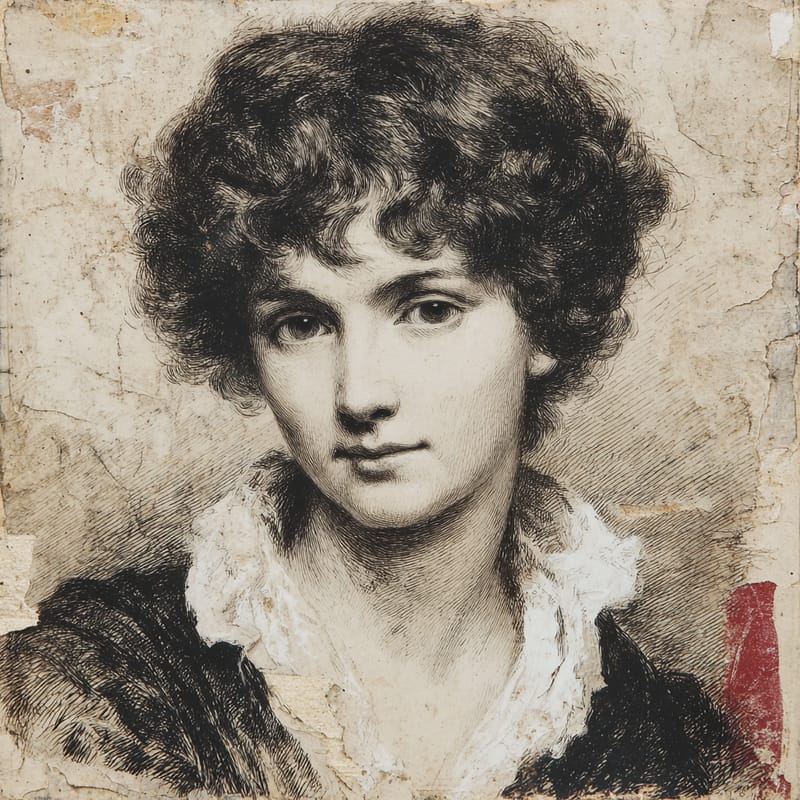
Mary Wollstonecraft
Vindication of the rights of woman
Liberty, reason, and equality.
Progressive Social LibertarianOne of 729 ideologies · enter the Social Libertarian hall →- Role
- Philosopher
- Era
- 1759–1797
- Region
- United Kingdom
- Social band
- Progressive
- Placement
- −6 · −54 · +70
§ Where Mary Wollstonecraft stands
3 axesWollstonecraft accepted property and commerce but attacked the inherited wealth that sustained aristocratic idleness. Her 1790 reply to Burke, A Vindication of the Rights of Men, condemned a property order that kept the poor degraded and asked why great estates could not be divided into small farms. In the Rights of Woman she wanted women able to earn independent livelihoods in medicine and business, a reformist rather than socialist economics.
She rejected hereditary authority in every form, arguing in A Vindication of the Rights of Men (1790) that monarchy, aristocracy and an established church corrupted rulers and ruled alike, and that rights rest on reason rather than precedent. She welcomed the French Revolution, though the Terror she witnessed in Paris appalled her. Her ideal was self-government by educated, independent citizens, not a stronger state.
Wollstonecraft was a feminist pioneer. A Vindication of the Rights of Woman (1792) answered Talleyrand's plan for a merely domestic education for girls and Rousseau's ideal of the pleasing wife in Émile, demanding rational education for both sexes, co-educational national day schools and women's economic independence. She even hinted that women ought to have political representatives, a claim she expected to be laughed at.
How close are you to Mary Wollstonecraft?
Three statements, one per axis. Answer them and we’ll drop you on the compass next to them.
§ The story
HistoricalMary Wollstonecraft (1759–1797) was an English writer and philosopher, born in Spitalfields, London, into a family whose fortunes her father squandered on failed farming ventures and drink. She worked as a lady's companion, ran a school at Newington Green, where she came to know the Dissenting minister Richard Price, and served as a governess in Ireland before the radical publisher Joseph Johnson employed her in London as a reviewer and translator. Her first book, Thoughts on the Education of Daughters, appeared in 1787.
Her A Vindication of the Rights of Woman (1792) argued that women were rational beings degraded by an education designed to make them pleasing, and it made her a founding figure of modern feminism. She lived through the Terror in Paris, had a daughter with the American Gilbert Imlay and twice attempted suicide after he left her. She married William Godwin in 1797 and died eleven days after giving birth to the future Mary Shelley. Godwin's candid memoir of 1798 scandalised readers and clouded her reputation for a century.
Notable for
- 01'A Vindication of the Rights of Woman'
- 02Enlightenment feminism
- 03Rational individualism
Key works & moments
- 1784Opens a school at Newington Green with her sisters and her friend Fanny Blood.
- 1787Publishes Thoughts on the Education of Daughters, her first book.
- 1790Answers Edmund Burke with A Vindication of the Rights of Men, among the first replies.
- 1792Publishes A Vindication of the Rights of Woman and leaves for revolutionary Paris.
- 1796Publishes Letters Written During a Short Residence in Sweden, Norway, and Denmark.
- 1797Marries William Godwin; dies eleven days after giving birth to the future Mary Shelley.
In their own words
“I do not wish them to have power over men; but over themselves.”
§ Minds closest to Mary Wollstonecraft
All minds →




§ Also in the Social Libertarian hall
Enter the hall →The closest minds above are this hall’s whole roster.
§ Common questions
4 answersWhat was Mary Wollstonecraft's political ideology?
Mary Wollstonecraft was an Enlightenment radical and early feminist: on the 99ideologies three-axis compass, a Progressive Social Libertarian. Economically she sat near the centre (−6), defending property and honest work while attacking inherited aristocratic wealth. On governance she was firmly anti-authoritarian (−54), rejecting monarchy and hereditary privilege in favour of rights grounded in reason. Socially she was strongly progressive (+70), demanding equal education and independence for women.
Was Mary Wollstonecraft left-wing or right-wing?
Left-wing by the standards of her time. In the 1790s she stood with the radicals of Joseph Johnson's circle, including Thomas Paine and William Godwin, against Edmund Burke's defence of monarchy, aristocracy and tradition, and she welcomed the French Revolution. She was no socialist, however: she defended property and wanted women to earn their own living within a commercial society. Her radicalism lay in applying the Enlightenment language of rights and reason to women and the poor.
Was Mary Wollstonecraft a feminist?
Yes, in substance, though the word did not exist in her lifetime. A Vindication of the Rights of Woman (1792) argued that women are rational creatures whose apparent weakness comes from an education designed to make them decorative and dependent, and it demanded equal schooling, useful work and respect within marriage. She grounded her case in reason and virtue rather than in sexual difference. Later suffragists such as Millicent Garrett Fawcett revived her work, and she is widely regarded as a founder of feminist philosophy.
Which minds are closest to Mary Wollstonecraft?
On the 99ideologies three-axis compass, the minds closest to Mary Wollstonecraft are Aryeh Neier (97% alike), Russell Means (96% alike) and Floyd Abrams (95% alike). The furthest is Adam Sutler (5% alike).