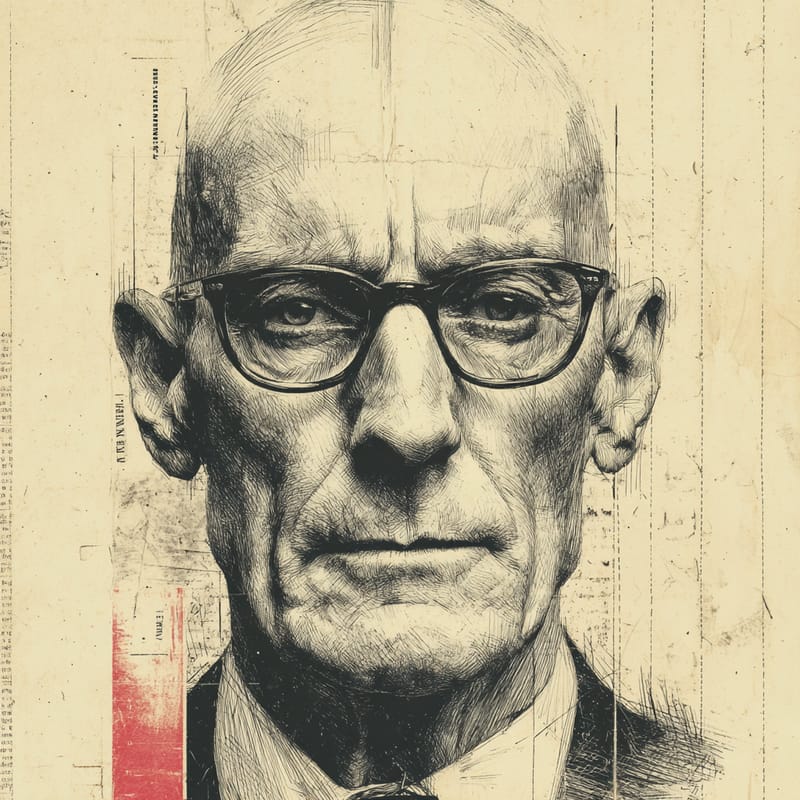
Aryeh Neier
Defend the freedom you hate
Civil liberties without exception.
Progressive Social LibertarianOne of 729 ideologies · enter the Social Libertarian hall →- Role
- Civil-liberties leader
- Era
- b. 1937
- Region
- Germany / US
- Social band
- Progressive
- Placement
- −6 · −50 · +64
§ Where Aryeh Neier stands
3 axesEconomics has never been Neier's battleground, and his near-centre placement reflects that restraint. Within the human-rights field he is known for arguing that economic and social claims are better settled through democratic politics than framed as enforceable rights, the case of his 2006 essay 'Social and Economic Rights: A Critique'. His slight leftward lean shows in the liberal philanthropy he directed at Open Society from 1993 to 2012.
Neier's career is a sustained argument for limits on state power. At the ACLU he defended speech for the most hated groups, as recounted in Defending My Enemy (1979), and in 1973 the organisation became the first national group to call for President Nixon's impeachment. Abroad, Helsinki Watch monitored Soviet-bloc compliance with the human-rights promises of the 1975 Helsinki Final Act.
Neier's progressivism is the rights revolution itself. The ACLU's Women's Rights Project, launched in 1972 with Ruth Bader Ginsburg, and its work on reproductive freedom and prisoners' rights grew during his directorship. At Human Rights Watch he pressed for international justice for atrocities, campaigning for the war-crimes tribunal for the former Yugoslavia that the UN Security Council created in 1993.
How close are you to Aryeh Neier?
Three statements, one per axis. Answer them and we’ll drop you on the compass next to them.
§ The story
HistoricalAryeh Neier (born 1937) is an American civil-liberties and human-rights leader. Born in Berlin to a Jewish family, he escaped Nazi Germany as a small child, spent his early years in England and settled in the United States in 1947. After graduating from Cornell University he joined the American Civil Liberties Union in 1963, led its New York affiliate and served as the ACLU's national executive director from 1970 to 1978.
Neier's ACLU years are remembered above all for Skokie: in 1977–78 the organisation defended the right of a small neo-Nazi group to march through an Illinois suburb home to many Holocaust survivors, and thousands of members resigned in protest. He then helped found Helsinki Watch in 1978, led what became Human Rights Watch from 1981 to 1993 and served as president of George Soros's Open Society foundations from 1993 to 2012, shaping the modern international human-rights movement.
Notable for
- 01Led the ACLU
- 02Defended free speech in Skokie
- 03Co-founded Human Rights Watch
Key works & moments
- 1939His Jewish family flees Nazi Berlin for England; they settle in the United States in 1947.
- 1970Becomes national executive director of the American Civil Liberties Union.
- 1973The ACLU becomes the first national organisation to call for Richard Nixon's impeachment.
- 1977–78Defends neo-Nazis' right to march in Skokie, Illinois, later explained in Defending My Enemy (1979).
- 1978Co-founds Helsinki Watch, forerunner of Human Rights Watch, which he leads from 1981 to 1993.
- 1993Becomes president of George Soros's Open Society Institute, a post he holds until 2012.
§ Minds closest to Aryeh Neier
All minds →

§ Also in the Social Libertarian hall
Enter the hall →The closest minds above are this hall’s whole roster.
§ Common questions
4 answersWhat is Aryeh Neier's political ideology?
Aryeh Neier is a liberal civil libertarian and human-rights advocate: on the 99ideologies three-axis compass, a Progressive Social Libertarian. Economically he sits near the centre (−6), arguing that economic questions belong to democratic politics rather than to rights litigation. On governance he is strongly anti-authoritarian (−50), defending speech, due process and privacy against governments of every kind. Socially he is clearly progressive (+64), having helped build the women's-rights, prisoners'-rights and international human-rights causes of the late twentieth century.
Is Aryeh Neier left-wing or right-wing?
Left of centre, but on principle rather than by party. Neier's causes, from women's rights to the prosecution of war crimes, are associated with liberal politics in the United States, and he spent nearly two decades leading George Soros's Open Society foundations. Yet he has applied his rules to everyone: he defended American Nazis in Skokie, exposed abuses by communist as well as right-wing governments, and has resisted folding economic redistribution into human-rights law.
Why did Aryeh Neier defend the Nazis' right to march in Skokie?
Because he believed free speech means nothing if it protects only popular views. In 1977 the ACLU represented the National Socialist Party of America after Skokie, Illinois, a suburb home to many Holocaust survivors, moved to block its march. Neier, himself a Jewish refugee from Nazi Germany, argued that any power to silence hated groups would be turned against minorities and dissenters, and he set out his case in Defending My Enemy (1979). The courts sided with the ACLU, but the group eventually rallied in Chicago instead.
Which minds are closest to Aryeh Neier?
On the 99ideologies three-axis compass, the minds closest to Aryeh Neier are Floyd Abrams (97% alike), Mary Wollstonecraft (97% alike) and Russell Means (97% alike). The furthest is Adam Sutler (7% alike).