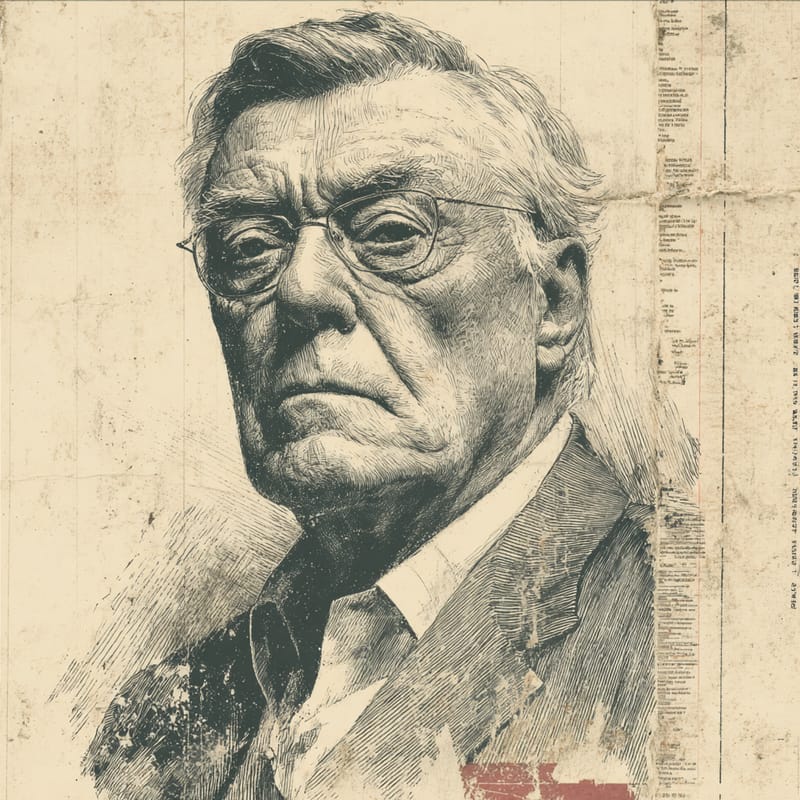
Jean-Marie Le Pen
The nationalist insurgency
France for the French.
Reactionary Right-Wing NationalistOne of 729 ideologies · enter the Right-Wing Nationalist hall →- Role
- Party founder
- Era
- 1928–2025
- Region
- France
- Social band
- Reactionary
- Placement
- +48 · +50 · −64
§ Where Jean-Marie Le Pen stands
3 axesLe Pen came out of Poujadism, a revolt of small shopkeepers and artisans against taxes, and in the 1980s presented the National Front as a party of tax cuts and a smaller state. From the 1990s it shifted towards protectionism and national preference, the principle of reserving jobs, housing and welfare benefits for French citizens first, so his market economics always stopped at the national border.
Le Pen fought elections but stood outside the republican consensus. He campaigned to restore the death penalty, abolished in 1981, for far tougher policing and immigration control, and for referendums to bypass the political class. He remained an unapologetic defender of French Algeria and of the army's conduct in that war, and he led his party without interruption for almost four decades.
Opposition to immigration, above all from North Africa, defined Le Pen's politics: from the 1970s the National Front linked unemployment to immigrants and called for reversing immigration flows. He courted traditionalist Catholics and opposed abortion and same-sex marriage, and his repeated convictions for inciting racial hatred or minimising Nazi crimes kept him outside the mainstream right.
How close are you to Jean-Marie Le Pen?
Three statements, one per axis. Answer them and we’ll drop you on the compass next to them.
§ The story
HistoricalJean-Marie Le Pen (1928–2025) was a French politician who founded the National Front in 1972 and led it until 2011. The son of a Breton fisherman killed when his boat struck a mine in 1942, he studied law in Paris and volunteered for the Foreign Legion's paratroops in Indochina. In 1956, aged 27, he became the youngest member of the National Assembly as a deputy for Pierre Poujade's anti-tax shopkeepers' movement, then took leave to serve with the army at Suez and, in 1957, in Algeria.
Le Pen built the National Front into one of Western Europe's most durable radical-right parties, campaigning on immigration, crime and national identity. It broke through in the 1984 European elections, and in 2002 he stunned France by beating the Socialist prime minister Lionel Jospin to reach the presidential run-off, where Jacques Chirac defeated him with 82% of the vote. He was convicted repeatedly for racist and antisemitic remarks, including his 1987 description of the Nazi gas chambers as a detail of the history of the Second World War, and his daughter Marine, who succeeded him, had him expelled from the party in 2015.
Notable for
- 01Founded the National Front
- 022002 presidential run-off
- 03Template for Europe's hard right
Key works & moments
- 1956Elected at 27 as the youngest deputy in the National Assembly, for Pierre Poujade's movement.
- 1972Becomes founding president of the National Front.
- 1984The National Front breaks through with about 11% of the vote in the European elections.
- 1987Calls the Nazi gas chambers a detail of the history of the Second World War.
- 2002Beats Lionel Jospin to reach the presidential run-off, then loses heavily to Jacques Chirac.
- 2015Expelled from the National Front, then led by his daughter Marine, after repeating the remark.
In their own words
“I believe it is a point of detail in the history of the Second World War.”
§ Minds closest to Jean-Marie Le Pen
All minds →

§ Also in the Right-Wing Nationalist hall
Enter the hall →§ Common questions
4 answersWhat was Jean-Marie Le Pen's political ideology?
Jean-Marie Le Pen was a far-right nationalist: on the 99ideologies three-axis compass, a Reactionary Right-Wing Nationalist. Economically he sat on the right (+48), starting from Poujadist tax revolt and ending with protectionist national preference. On governance he was authoritarian-leaning (+50), calling for the death penalty, harsher policing and drastic cuts to immigration. Socially he was strongly reactionary (−64): hostility to immigration, defence of French Algeria and repeated convictions for racist and antisemitic remarks defined his career.
Was Jean-Marie Le Pen left-wing or right-wing?
Right-wing, and on the far right by almost every scholarly classification. He came from the anti-parliamentary nationalist tradition of Poujadism and French Algeria, and the National Front he led united Catholic traditionalists, former Vichy collaborators, veterans of the colonial wars and younger nationalist militants. In later decades the party won many working-class voters from the left and adopted protectionist economics, but its core programme of immigration restriction, national preference, law and order and traditional values remained firmly of the right.
Why was Jean-Marie Le Pen expelled from the National Front?
Because he kept repeating views that his daughter Marine Le Pen, party leader from 2011, was trying to purge in order to make the party electable. In April 2015 he again described the Nazi gas chambers as a detail of history and, in an interview with the far-right weekly Rivarol, defended Marshal Pétain. The party suspended him in May and expelled him in August 2015. He challenged the decision in court, and the party abolished his post of honorary president in 2018.
Which minds are closest to Jean-Marie Le Pen?
On the 99ideologies three-axis compass, the minds closest to Jean-Marie Le Pen are Jair Bolsonaro (98% alike), Coriolanus (97% alike) and Viktor Orbán (96% alike). The furthest is Emma Goldman (0% alike).