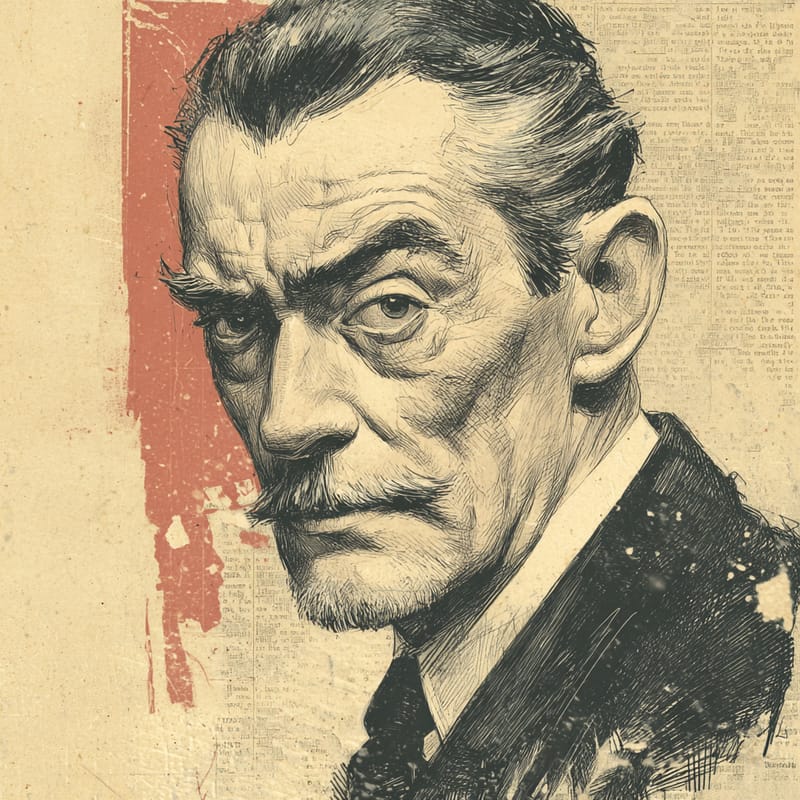
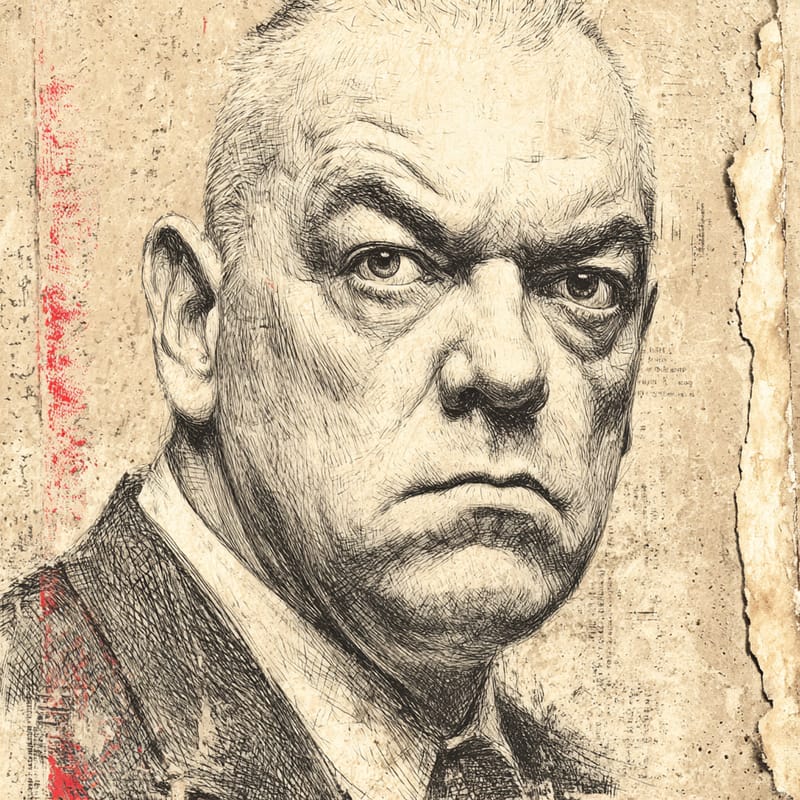
Enoch Powell
Free markets, closed borders
Classical economics, hard nationalism.
Traditional Right-Wing NationalistOne of 729 ideologies · enter the Right-Wing Nationalist hall →- Role
- Politician
- Era
- 1912–1998
- Region
- United Kingdom
- Social band
- Traditional
- Placement
- +52 · +44 · −58
§ Where Enoch Powell stands
3 axesPowell was a free-market economist before it was fashionable on the right. He resigned from the Treasury in January 1958, alongside Chancellor Peter Thorneycroft, when the cabinet refused spending cuts; he argued that inflation was caused by governments creating money, not by trade unions, and denounced Edward Heath's statutory prices and incomes policy of 1972. He also called for denationalising state industries.
His guiding principle was the sovereignty of the Crown in Parliament. Powell opposed the European Communities Act of 1972 as a surrender of that sovereignty, joined Labour's Michael Foot in 1969 to defeat Harold Wilson's plan to reform the House of Lords, and as an Ulster Unionist fought the 1985 Anglo-Irish Agreement as a threat to the Union.
Powell's 1968 Birmingham speech warned that continued Commonwealth immigration would bring civil conflict, opposed the bill outlawing racial discrimination in housing and employment, and called for state-assisted re-emigration. He defended an idea of England rooted in the monarchy, Parliament and the established Church of England, and treated the nation as the only true basis of political loyalty.
How close are you to Enoch Powell?
Three statements, one per axis. Answer them and we’ll drop you on the compass next to them.
§ The story
HistoricalJohn Enoch Powell (1912–1998) was a British politician, classical scholar and poet. Born in Birmingham, he became professor of Greek at the University of Sydney at 25, enlisted as a private in 1939 and rose to brigadier by the end of the Second World War. Conservative MP for Wolverhampton South West from 1950 to 1974, he resigned as financial secretary to the Treasury in 1958 in protest at higher public spending and served as minister of health from 1960 to 1963, launching the 1962 Hospital Plan.
Powell's speech in Birmingham on 20 April 1968, attacking Commonwealth immigration and the Race Relations Bill, led Edward Heath to sack him from the shadow cabinet. It brought him mass popular support, including marches by London dockers, and lasting condemnation as an incitement to racial hostility. A fierce opponent of membership of the European Economic Community, he urged voters to back Labour in February 1974 and then sat as an Ulster Unionist MP for South Down until 1987. His free-market monetarism anticipated much of Thatcherism.
Notable for
- 01Free-market monetarism
- 02Anti-immigration nationalism
- 03Anti-EEC sovereigntist
Key works & moments
- 1958Resigns as financial secretary to the Treasury with Peter Thorneycroft over rising public spending.
- 1962As health minister, launches the Hospital Plan for England and Wales.
- 1968Delivers the 'Rivers of Blood' speech in Birmingham; Edward Heath sacks him from the shadow cabinet.
- 1974Urges voters to back Labour over the EEC, then returns as Ulster Unionist MP for South Down.
- 1977Publishes Joseph Chamberlain, his study of the Victorian statesman.
- 1987Loses South Down to the SDLP's Eddie McGrady, ending a Commons career begun in 1950.
In their own words
“As I look ahead, I am filled with foreboding; like the Roman, I seem to see 'the River Tiber foaming with much blood'.”
“All political lives, unless they are cut off in midstream at a happy juncture, end in failure, because that is the nature of politics and of human affairs.”
§ Minds closest to Enoch Powell
All minds →



§ Also in the Right-Wing Nationalist hall
Enter the hall →§ Common questions
4 answersWhat was Enoch Powell's political ideology?
Enoch Powell was a Tory nationalist and early free-market monetarist: on the 99ideologies three-axis compass, a Traditional Right-Wing Nationalist. Economically he sat clearly on the market right (+52), opposing incomes policies and calling for denationalisation. On governance he leaned authoritarian (+44), placing absolute weight on the sovereignty of Parliament and the unity of the nation. Socially he was firmly traditional (−58), best known for his hostility to Commonwealth immigration and his defence of monarchy, Church and nation.
Was Enoch Powell left-wing or right-wing?
Right-wing, but never a party loyalist. His monetarism, hostility to state planning, nationalism and opposition to immigration all belong to the right, and he was a Conservative minister in the 1950s and 1960s. Yet his absolute commitment to parliamentary sovereignty led him to urge a Labour vote in February 1974 because Labour promised to renegotiate EEC membership, and from October 1974 until 1987 he sat in the Commons as an Ulster Unionist rather than a Conservative.
What was Enoch Powell's Rivers of Blood speech?
It was the speech Powell gave to a Conservative meeting in Birmingham on 20 April 1968, attacking Commonwealth immigration and Labour's Race Relations Bill. Quoting constituents' fears and alluding to a prophecy in Virgil's Aeneid of the Tiber foaming with blood, he warned of future civil conflict and called for re-emigration. He never used the phrase rivers of blood. Edward Heath sacked him from the shadow cabinet the next day; polls showed wide public support, while critics condemned it as racist incitement.
Which minds are closest to Enoch Powell?
On the 99ideologies three-axis compass, the minds closest to Enoch Powell are Jair Bolsonaro (97% alike), Nigel Farage (97% alike) and Coriolanus (96% alike). The furthest is Emma Goldman (2% alike).