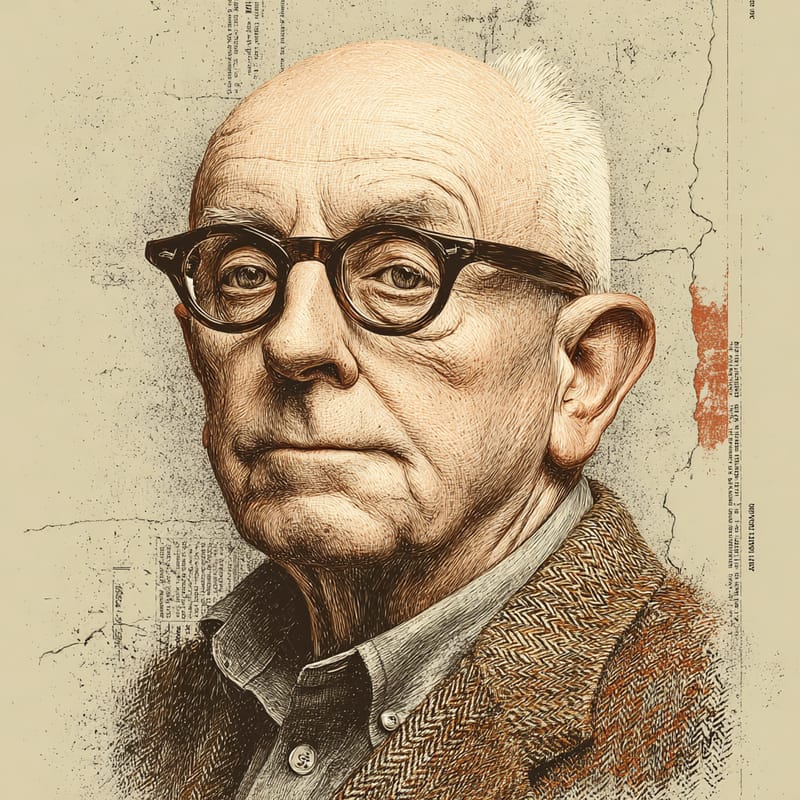
Alec Nove
Feasible socialism
A mixed, market-using socialism that could work.
Heterodox Market SocialistOne of 729 ideologies · enter the Market Socialist hall →- Role
- Economist
- Era
- 1915–1994
- Region
- Russia / UK
- Social band
- Heterodox
- Placement
- −70 · −2 · +30
§ Where Alec Nove stands
3 axesNove's feasible socialism, set out in The Economics of Feasible Socialism (1983), mixed centralised state corporations for natural monopolies, autonomous public enterprises, worker cooperatives and small private firms, with markets coordinating most exchange. That keeps him on the socialist left, since large-scale private capital disappears, but his acceptance of markets and small private business pulls him away from the planning pole.
He insisted that feasible socialism must be democratic and pluralist, with competing parties, a free press and decentralised decisions. His work on Soviet history, including Stalinism and After (1975), documented how concentrating economic power in a single planning hierarchy fed political tyranny, which made him wary of any socialism built on total control.
Nove was a humane, sceptical progressive rather than a cultural radical. He wanted socialism to deliver greater equality and dignity at work, but he mocked utopian blueprints that ignored scarcity and human motivation, and he valued the cultural freedoms that Soviet society denied. That moderation places him modestly on the progressive side.
How close are you to Alec Nove?
Three statements, one per axis. Answer them and we’ll drop you on the compass next to them.
§ The story
HistoricalAlec Nove (1915–1994) was a British economist and historian of the Soviet Union. Born Aleksandr Novakovsky in Petrograd, he came to Britain with his family as a child, studied at the London School of Economics, served in the British Army during the Second World War and then spent years as a government economist before turning to academic life. From 1963 he was professor of economics at the University of Glasgow, where he directed the Institute of Soviet and East European Studies, and he became one of the West's most respected authorities on the Soviet economy.
Nove's An Economic History of the USSR (1969) became a standard textbook, but his most influential political work was The Economics of Feasible Socialism (1983). Drawing on decades of studying Soviet shortages and waste, he argued that comprehensive central planning could never handle the vast number of decisions a modern economy requires, and that Marxist hopes of abolishing markets and money were utopian. His alternative, a mixed socialism of state, cooperative and small private enterprises coordinated mainly by markets, angered orthodox Marxists but shaped the democratic left's thinking after the Soviet collapse.
Notable for
- 01'The Economics of Feasible Socialism'
- 02Critique of total planning
- 03Mixed-ownership model
Key works & moments
- 1961Publishes The Soviet Economy, an influential introduction for Western readers.
- 1963Becomes professor of economics at Glasgow and head of its Soviet studies institute.
- 1969An Economic History of the USSR appears and becomes a standard text.
- 1983The Economics of Feasible Socialism argues for a market-using, mixed-ownership socialism.
- 1991Updates the case in The Economics of Feasible Socialism Revisited as Soviet communism collapses.
§ Minds closest to Alec Nove
All minds →

§ Also in the Market Socialist hall
Enter the hall →§ Common questions
4 answersWhat was Alec Nove's political ideology?
Alec Nove was a democratic market socialist: on the 99ideologies three-axis compass, a Heterodox Market Socialist. Economically he sat well to the left (−70), favouring a socialism of state, cooperative and small private enterprises coordinated mainly through markets. On governance he was near the centre (−2), insisting on multi-party democracy and decentralised decisions, and socially he was moderately progressive (+30), committed to equality but sceptical of utopian schemes that ignored human motivation.
Was Alec Nove left-wing or right-wing?
Left-wing, but a critic of much of the left. Nove remained a socialist who wanted large-scale private capital replaced by public and cooperative ownership. Yet his long study of the Soviet economy convinced him that full central planning and the abolition of markets were unworkable, and he said so bluntly, which made him a heretic to orthodox Marxists. He belongs to the realist, market-socialist current of the democratic left.
What did Alec Nove mean by feasible socialism?
He meant a socialism that could work in a complex modern economy in the foreseeable future, rather than a distant utopia free of scarcity. In The Economics of Feasible Socialism (1983) Nove proposed five forms of ownership: centralised state corporations, autonomous socialised enterprises, cooperatives, small private businesses and self-employed individuals. Markets would coordinate most activity, with planning reserved for major investment and natural monopolies, all within a multi-party democracy.
Which minds are closest to Alec Nove?
On the 99ideologies three-axis compass, the minds closest to Alec Nove are Oskar Lange (99% alike), Jaroslav Vanek (98% alike) and Abba Lerner (98% alike). The furthest is Adam Sutler (11% alike).