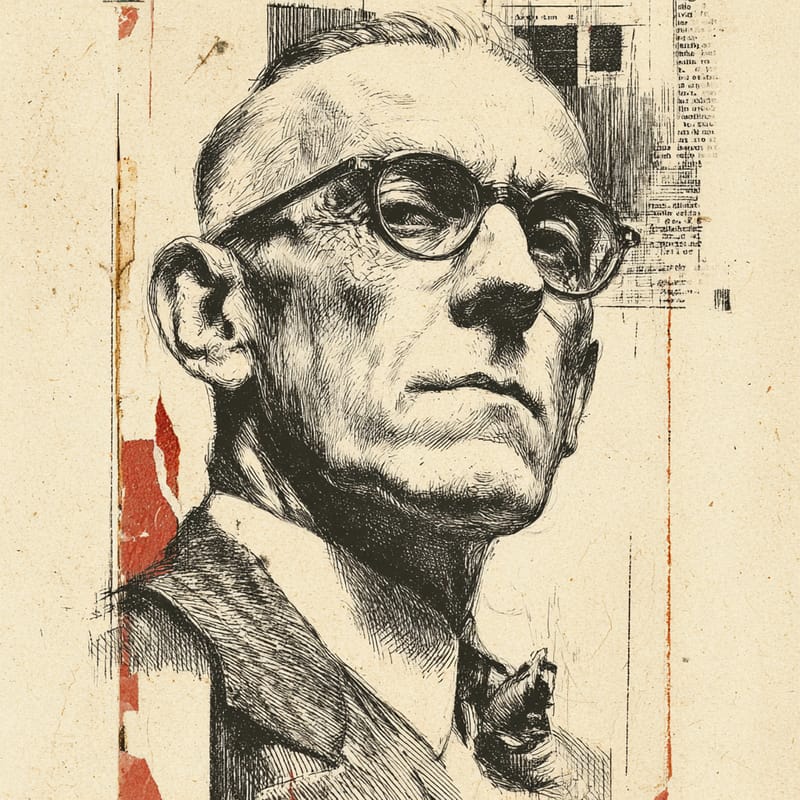
Oskar Lange
The socialist calculation reply
Markets can serve a planned economy.
Heterodox Market SocialistOne of 729 ideologies · enter the Market Socialist hall →- Role
- Economist
- Era
- 1904–1965
- Region
- Poland
- Social band
- Heterodox
- Placement
- −72 · 0 · +30
§ Where Oskar Lange stands
3 axesLange's model, set out in On the Economic Theory of Socialism (1936–37), combined public ownership of the means of production with markets for consumer goods and labour, while a central planning board set the prices of capital goods by trial and error. That places him firmly on the socialist left, but his reliance on price signals rather than physical output targets separates him from Soviet-style command planning.
In theory Lange's socialism was liberal: consumers chose freely what to buy, workers chose their occupations, and planners answered to society rather than ruling over it. In practice he served communist Poland's one-party state from 1945 until his death, while backing the decentralisation debated after the 1956 thaw. That tension between a liberal blueprint and an authoritarian employer leaves him at the centre.
Lange was a secular moderniser who saw socialism as the rational, scientific organisation of society, and his later interest in econometrics and cybernetics, visible in the posthumously published essay 'The Computer and the Market' (1967), reflects that faith in progress through technique. His commitment to equality and to modernising a largely agrarian Poland tilts him progressive, though he took little part in cultural debates.
How close are you to Oskar Lange?
Three statements, one per axis. Answer them and we’ll drop you on the compass next to them.
§ The story
HistoricalOskar Lange (1904–1965) was a Polish economist and politician. Born in Tomaszów Mazowiecki, he studied law and economics at the Jagiellonian University in Kraków, went abroad on a Rockefeller fellowship in the 1930s and taught at the University of Chicago from 1938 to 1945, becoming an American citizen. After the war he renounced that citizenship to serve as communist Poland's first ambassador to the United States and its delegate to the UN Security Council, then returned home as a professor, economic adviser and senior figure in the ruling party.
Lange's essay On the Economic Theory of Socialism (1936–37) became the classic reply to Ludwig von Mises's claim that socialism could not rationally calculate prices: a central planning board, he argued, could set prices by trial and error, raising them when shortages appeared and cutting them when surpluses did, and so mimic a competitive market. Friedrich Hayek countered that no board could gather the dispersed knowledge markets use. Lange's later career is more contested: he met Stalin in 1944, lent prestige to Poland's communist regime, and backed decentralising reforms after the 1956 thaw that the party largely shelved.
Notable for
- 01The Lange model
- 02Reply to Mises and Hayek
- 03Market-socialist theory
Key works & moments
- 1936–37Publishes On the Economic Theory of Socialism in the Review of Economic Studies.
- 1938A book edition pairs his essay with Fred M. Taylor's; he joins the University of Chicago.
- 1944Travels to Moscow and meets Stalin, a visit that stirs controversy in the United States.
- 1945–47Serves as communist Poland's first ambassador to Washington and its delegate to the UN Security Council.
- 1959Publishes the first volume of Political Economy, his treatise on Marxist economics.
- 1967'The Computer and the Market' appears posthumously, proposing computers to solve planning equations.
In their own words
“Let us put the simultaneous equations on an electronic computer and we shall obtain the solution in less than a second.”
§ Minds closest to Oskar Lange
All minds →


§ Also in the Market Socialist hall
Enter the hall →§ Common questions
4 answersWhat was Oskar Lange's political ideology?
Oskar Lange was a market socialist and Marxist economist: on the 99ideologies three-axis compass, a Heterodox Market Socialist. Economically he sat well to the left (−72), combining public ownership of industry with price signals set by a planning board. On governance he sits at the centre (0), since his blueprint preserved free choice of goods and jobs while he spent his later career serving communist Poland, and socially he was progressive (+30), a secular moderniser who trusted science to improve society.
Was Oskar Lange left-wing or right-wing?
Left-wing. Lange wanted the means of production owned publicly and believed socialism could outperform capitalism by eliminating monopoly and inequality. His heterodoxy was methodological rather than political: he borrowed the tools of neoclassical economics, especially general-equilibrium price theory, to defend socialist planning, which won him respect among Western economists even as he served Poland's communist government. He sat on the reformist, market-using wing of Marxism rather than at its Stalinist core.
Did Oskar Lange win the socialist calculation debate?
The verdict has shifted over time. In the 1930s and 1940s many economists believed Lange had refuted Ludwig von Mises by showing that a planning board could find equilibrium prices through trial and error. Friedrich Hayek replied that the real problem was dispersed, local knowledge that no central board could collect, and the stagnation and collapse of Soviet-type economies later strengthened that view. Lange himself suggested in the 1960s that electronic computers might solve the planning equations instead.
Which minds are closest to Oskar Lange?
On the 99ideologies three-axis compass, the minds closest to Oskar Lange are Alec Nove (99% alike), Jaroslav Vanek (98% alike) and Branko Horvat (97% alike). The furthest is Adam Sutler (11% alike).