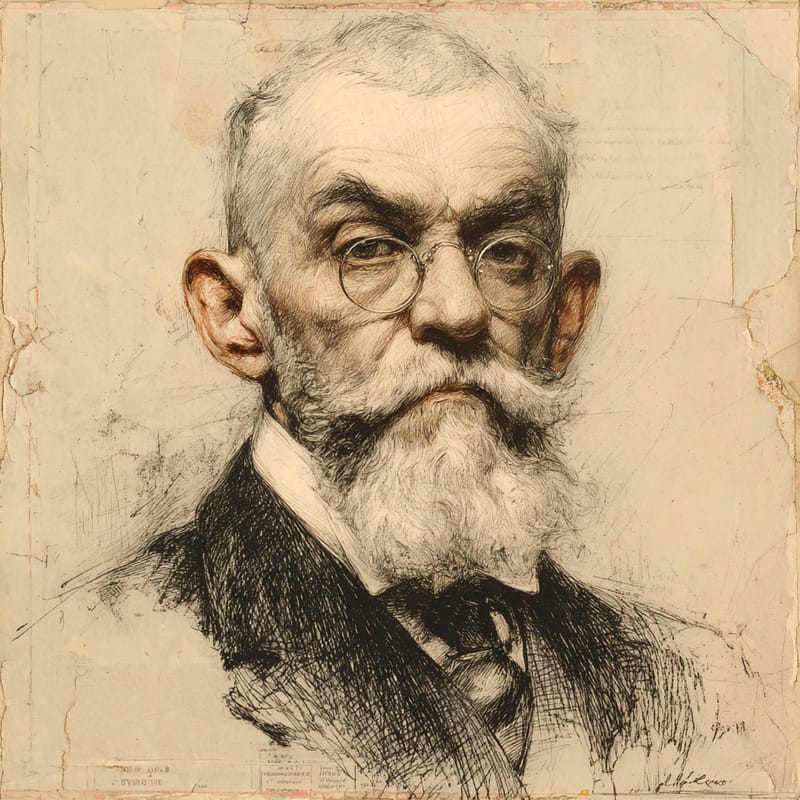
Georges Sorel
The myth of the general strike
Revolutionary syndicalism's theorist.
Heterodox SyndicalistOne of 729 ideologies · enter the Syndicalist hall →- Role
- Theorist
- Era
- 1847–1922
- Region
- France
- Social band
- Heterodox
- Placement
- −72 · −22 · +35
§ Where Georges Sorel stands
3 axesSorel wanted production taken over by workers organised in their own unions rather than by a socialist state. In Reflections on Violence (1908) he argued that the class struggle should be sharpened rather than softened by social reform, so that the proletariat would develop the discipline and morality of producers capable of running modern industry themselves.
Sorel despised parliamentary socialism, which he accused of turning the workers' movement into a career ladder for politicians and intellectuals, and he saw the general strike as a way to break the bourgeois state rather than capture it. His contempt for liberal democracy also drew him, around 1910–13, close to French nationalist and monarchist circles before he turned to the Bolsheviks.
Sorel was a moralist who distrusted bourgeois rationalism and the comfortable faith in progress, which he attacked in The Illusions of Progress (1908). He prized heroic virtues such as sacrifice, discipline and the dignity of work over hedonism, and he believed only a mobilising myth could regenerate a decadent society, a blend of radical and austere values that makes him heterodox.
How close are you to Georges Sorel?
Three statements, one per axis. Answer them and we’ll drop you on the compass next to them.
§ The story
HistoricalGeorges Sorel (1847–1922) was a French social theorist and the most influential philosopher of revolutionary syndicalism. Born in Cherbourg and trained at the École Polytechnique, he worked for more than two decades as a government engineer in the bridges and roads service, then retired in 1892 to devote himself to study. He turned to Marxism in the 1890s, helped launch the review Le Devenir social, and became a sharp critic of the determinism and parliamentary habits of the Second International's orthodox socialists.
Sorel's Reflections on Violence, serialised in 1906 and published as a book in 1908, argued that workers are moved not by programmes but by myths, above all the myth of the general strike, and that proletarian violence could regenerate a decadent bourgeois society. His restless politics later drew him towards nationalist circles and then to praise for Lenin. Benito Mussolini claimed him as an inspiration and Antonio Gramsci engaged closely with his ideas, which has made his legacy one of the most contested in modern political thought.
Notable for
- 01'Reflections on Violence'
- 02Theory of the general strike
- 03Revolutionary syndicalism
Key works & moments
- 1892Retires from the state engineering corps to devote himself to social theory.
- 1895Helps launch Le Devenir social, one of France's first Marxist theoretical reviews.
- 1906Reflections on Violence appears in instalments in the review Le Mouvement socialiste.
- 1908Publishes Reflections on Violence as a book, along with The Illusions of Progress.
- 1910–13Draws close to French nationalist circles and their short-lived reviews.
- 1919Adds a postscript in defence of Lenin to a new edition of Reflections on Violence.
§ Minds closest to Georges Sorel
All minds →

§ Also in the Syndicalist hall
Enter the hall →§ Common questions
4 answersWhat was Georges Sorel's political ideology?
Georges Sorel was the leading theorist of revolutionary syndicalism: on the 99ideologies three-axis compass, a Heterodox Syndicalist. Economically he sat well to the left (−72), wanting workers' unions rather than the state to take over production. On governance he leaned libertarian (−22), scorning parliamentary socialism in favour of direct action and the general strike. Socially he was moderately progressive but heterodox (+35), a revolutionary who distrusted rationalism and the bourgeois faith in progress and prized austere, heroic virtues.
Was Georges Sorel left-wing or right-wing?
Mainly left-wing, though his influence reached both extremes. Sorel's major work defended proletarian class struggle and the general strike against capitalism, and he ended his life praising Lenin's revolution. Yet his contempt for liberal democracy and parliamentary socialism led him into a brief rapprochement with French nationalists around 1910–13, and Mussolini later claimed him as an inspiration, so historians still debate whether he foreshadowed fascism as well as revolutionary socialism.
What did Georges Sorel mean by the myth of the general strike?
He meant that the general strike mattered less as a practical plan than as a mobilising image. In Reflections on Violence Sorel argued that people are moved to great collective action by myths: vivid pictures of a decisive struggle that cannot be refuted because they express a movement's will rather than predict events. The idea of a general strike that would sweep away capitalism, he believed, would keep workers united, combative and separate from bourgeois politics, whatever its literal chances of success.
Which minds are closest to Georges Sorel?
On the 99ideologies three-axis compass, the minds closest to Georges Sorel are Stephen Blackpool (illustrative) (97% alike), Victor Griffuelhes (96% alike) and Big Bill Haywood (95% alike). The furthest is Adam Sutler (6% alike).