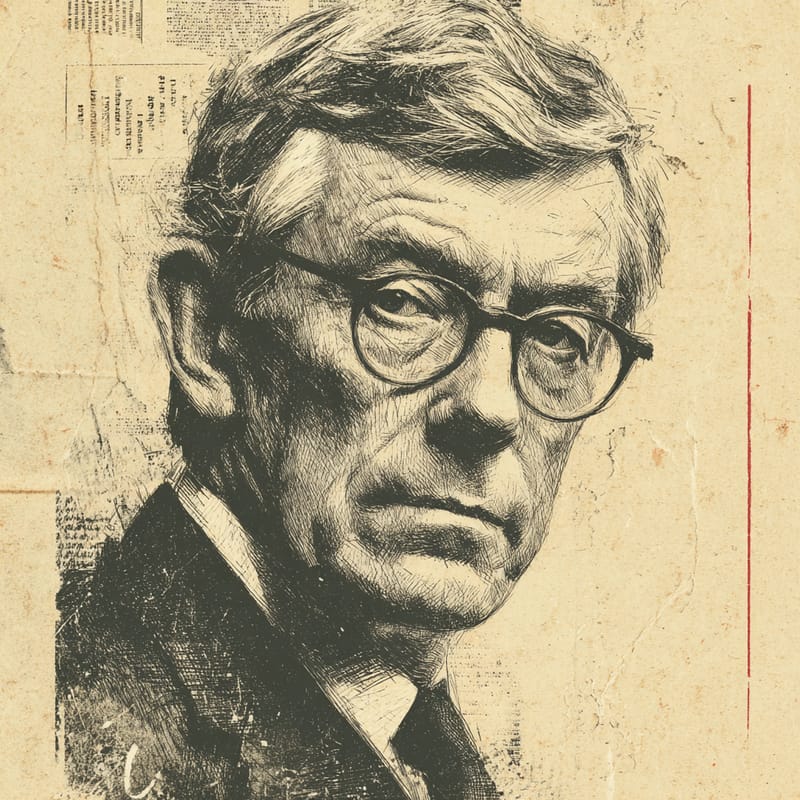
Wim Kok
The Polder model
Shedding ideological feathers.
Heterodox Third-Way LabouriteOne of 729 ideologies · enter the Third-Way Labourite hall →- Role
- Prime Minister
- Era
- 1938–2018
- Region
- Netherlands
- Social band
- Heterodox
- Placement
- +4 · +22 · +26
§ Where Wim Kok stands
3 axesKok's economics rested on consensus between unions and employers: as union leader he signed the 1982 Wassenaar Agreement trading wage moderation for shorter hours and job creation, and as prime minister he combined welfare reform, privatisation and the 1999 Flexibility and Security Act with a strong safety net. The result was a centrist model that cut unemployment without dismantling the welfare state.
Kok governed through broad coalitions and the Dutch tradition of bargaining between government, unions and employers. His purple cabinets of 1994–2002 joined Labour with the VVD and D66, keeping Christian democrats out of government for the first time since 1918, and in 2002 he accepted political responsibility for Srebrenica by resigning with his cabinet.
Kok's governments made the Netherlands a pioneer of social liberalism. They legalised same-sex marriage, in force from April 2001 as the first such law in the world, lifted the general ban on brothels in 2000 and passed a 2001 law protecting doctors who perform euthanasia under strict conditions. His own style was that of a pragmatic moderate rather than a crusader.
How close are you to Wim Kok?
Three statements, one per axis. Answer them and we’ll drop you on the compass next to them.
§ The story
HistoricalWillem 'Wim' Kok (1938–2018) was prime minister of the Netherlands from 1994 to 2002. Born in Bergambacht in South Holland, he trained in business before becoming a trade unionist, leading the socialist union federation NVV from 1973 and its successor, the FNV, from 1976 to 1985. In 1982 he and the employers' leader Chris van Veen signed the Wassenaar Agreement on wage restraint. He then led the Labour Party (PvdA) from 1986 and served as finance minister and deputy prime minister from 1989 to 1994.
Kok's two purple coalitions joined Labour with the free-market VVD and the liberal D66, and their mix of wage moderation, welfare reform and job growth was celebrated abroad as the polder model or Dutch miracle. In a 1995 lecture he urged his party to shed its ideological feathers. His governments also legalised same-sex marriage and regulated euthanasia. In April 2002 he resigned with his cabinet after an official report on the failure of Dutch peacekeepers to prevent the 1995 Srebrenica massacre, weeks before Pim Fortuyn's populist revolt transformed Dutch politics.
Notable for
- 01The 'Polder model'
- 02Purple coalitions
- 03Centre-left modernisation
Key works & moments
- 1982As FNV leader, signs the Wassenaar Agreement on wage moderation with employers.
- 1986Succeeds Joop den Uyl as leader of the Labour Party.
- 1994Forms the first purple coalition, the first Dutch cabinet without Christian democrats since 1918.
- 1995Urges Labour to shed its ideological feathers in a lecture honouring Joop den Uyl.
- 2001Same-sex marriage takes effect, a world first, under his second purple cabinet.
- 2002Resigns with his cabinet over a report on Dutch peacekeepers at Srebrenica.
§ Minds closest to Wim Kok
All minds →


§ Also in the Third-Way Labourite hall
Enter the hall →§ Common questions
4 answersWhat was Wim Kok's political ideology?
Wim Kok was a pragmatic social democrat who pioneered the Dutch version of the Third Way: on the 99ideologies three-axis compass, a Heterodox Third-Way Labourite. Economically he sat at the centre (+4), combining wage moderation, privatisation and labour-market flexibility with strong social protection. On governance he favoured a moderately active state working through coalitions and union-employer bargaining (+22), and socially he was progressive (+26), presiding over the world's first same-sex marriage law and the legal regulation of euthanasia.
Was Wim Kok left-wing or right-wing?
Centre-left. Kok came from the trade-union movement and led the Labour Party, but his signature achievements were compromises with employers and with the free-market VVD, and he told his party to shed its ideological feathers. Critics on the left saw the purple years as a drift to the right, while supporters credited them with combining job growth and a durable welfare state, which places him in the moderate, reformist wing of European social democracy.
Why did Wim Kok's government resign in 2002?
Because of Srebrenica. In July 1995 Bosnian Serb forces overran the UN safe area guarded by lightly armed Dutch peacekeepers and killed more than 8,000 Bosniak men and boys. In April 2002 the Netherlands Institute for War Documentation published a report criticising the Dutch government and military for sending the troops on an ill-defined mission. Kok accepted political responsibility and his cabinet resigned on 16 April 2002, a month before a general election that was already scheduled.
Which minds are closest to Wim Kok?
On the 99ideologies three-axis compass, the minds closest to Wim Kok are Gerhard Schröder (98% alike), Matteo Renzi (97% alike) and Gordon Brown (97% alike). The furthest is Hans-Hermann Hoppe (33% alike).