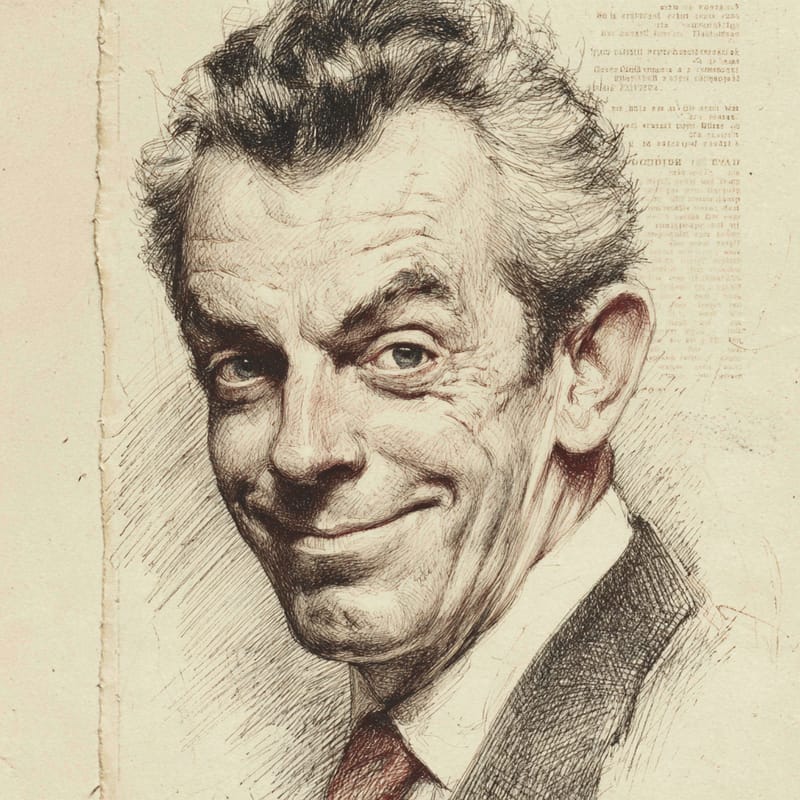
Tony Blair
New Labour
The Third Way, defined.
Heterodox Third-Way LabouriteOne of 729 ideologies · enter the Third-Way Labourite hall →- Role
- Prime Minister
- Era
- b. 1953
- Region
- United Kingdom
- Social band
- Heterodox
- Placement
- +2 · +26 · +35
§ Where Tony Blair stands
3 axesBlair accepted the market economy built under Margaret Thatcher, rewriting Clause IV in 1995 to drop Labour's commitment to common ownership and leaving the privatisations and most trade-union laws in place. Within that settlement his governments introduced the national minimum wage in 1999 and steeply raised spending on the NHS and schools, partly through private finance, which leaves him at the centre.
Blair ran a centralised, media-driven government from Downing Street and took a hard line on security: his governments passed the Anti-terrorism, Crime and Security Act 2001, sought 90-day pre-charge detention in 2005 and legislated for national identity cards in 2006. Abroad he committed British forces to Kosovo, Sierra Leone, Afghanistan and the 2003 invasion of Iraq.
Blair's governments were socially liberal: the Human Rights Act 1998 brought the European Convention on Human Rights into British law, the age of consent was equalised in 2000, Section 28 was repealed in England and Wales in 2003 and civil partnerships followed in 2004. Devolution to Scotland and Wales and the Good Friday Agreement also reshaped the constitution.
How close are you to Tony Blair?
Three statements, one per axis. Answer them and we’ll drop you on the compass next to them.
§ The story
LivingAnthony Charles Lynton Blair (b. 1953) was prime minister of the United Kingdom from 1997 to 2007, the Labour Party's longest-serving premier. Born in Edinburgh and educated at Fettes College and St John's College, Oxford, he practised as a barrister before winning the Sedgefield seat in 1983. As shadow home secretary he became known for promising to be tough on crime and tough on the causes of crime, and after John Smith's sudden death he was elected Labour leader in 1994.
Blair rebranded his party as New Labour, scrapped its commitment to common ownership and won landslides in 1997 and 2001 and a third consecutive victory in 2005, a first for a Labour leader. His governments made the Bank of England independent, introduced a minimum wage, devolved power to Scotland and Wales and helped secure the 1998 Good Friday Agreement. His decision to join the US-led invasion of Iraq in 2003, justified by claims about weapons of mass destruction that proved unfounded, divided the country and was sharply criticised by the Chilcot inquiry in 2016.
Notable for
- 01Founded 'New Labour'
- 02Minimum wage and devolution
- 03Three election victories
Key works & moments
- 1994Elected Labour leader after the death of John Smith.
- 1995Persuades Labour to rewrite Clause IV, dropping its commitment to common ownership.
- 1997Wins a landslide with a 179-seat majority and becomes prime minister.
- 1998Helps broker the Good Friday Agreement; the Human Rights Act and minimum wage law pass.
- 2003Commits British troops to the US-led invasion of Iraq.
- 2007Resigns as prime minister and becomes the Quartet's Middle East envoy.
In their own words
“Ask me my three main priorities for Government, and I tell you: education, education and education.”
§ Minds closest to Tony Blair
All minds →

§ Also in the Third-Way Labourite hall
Enter the hall →§ Common questions
4 answersWhat is Tony Blair's political ideology?
Tony Blair is the defining figure of the Third Way, the centrist renewal of social democracy he branded New Labour: on the 99ideologies three-axis compass, a Heterodox Third-Way Labourite. Economically he sits at the centre (+2), accepting markets and privatisation while raising public spending and introducing a minimum wage. On governance he leans towards a strong, centralising state (+26), especially on security and foreign intervention, and socially he is progressive (+35), from the Human Rights Act to civil partnerships.
Is Tony Blair left-wing or right-wing?
Centre-left, though many on the left dispute that he belongs on the left at all. Blair kept Labour's commitments to public services, a minimum wage and social liberalism, but embraced markets, private finance in public services and a tough line on crime, and he joined George W. Bush in the Iraq War. Supporters credit him with making the centre-left electable again; critics on the left call him a continuation of Thatcherism, while conservatives attacked his constitutional reforms and public spending.
Why is Tony Blair controversial over the Iraq War?
Because he took Britain into the 2003 invasion of Iraq on the basis of claims, including a September 2002 government dossier, that Saddam Hussein possessed weapons of mass destruction; no such stockpiles were found. The war prompted mass protests, including a huge London march in February 2003, and a long insurgency followed. The Chilcot inquiry reported in 2016 that Britain had joined before peaceful options were exhausted and that the threat had been presented with unjustified certainty. Blair has accepted responsibility but maintains that removing Saddam was right.
Which minds are closest to Tony Blair?
On the 99ideologies three-axis compass, the minds closest to Tony Blair are Gordon Brown (97% alike), Josiah Bartlet's centrists (archetype) (97% alike) and Anthony Giddens (97% alike). The furthest is Hans-Hermann Hoppe (30% alike).