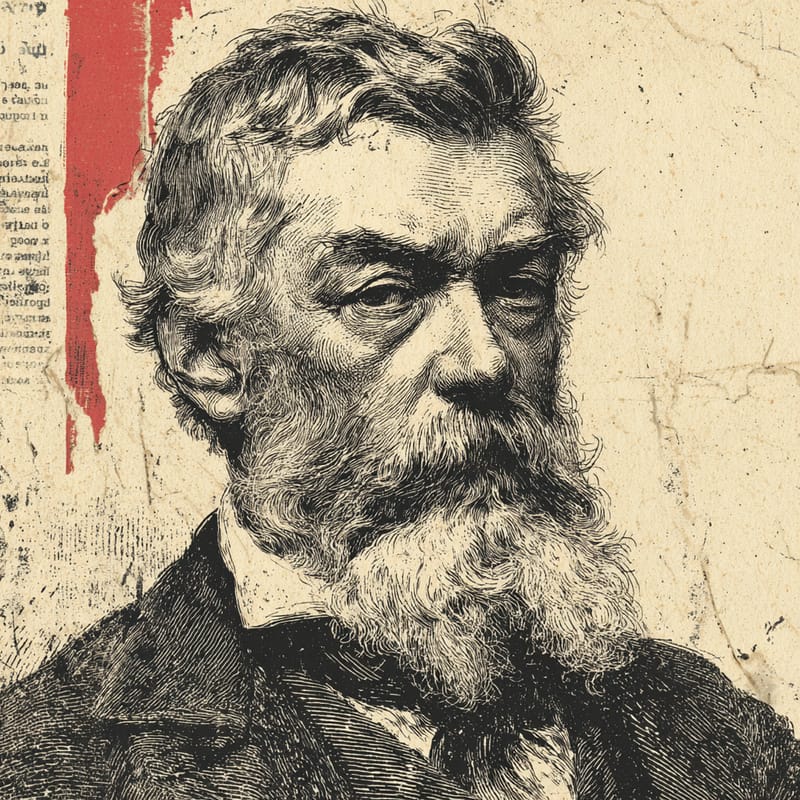
Dyer Lum
Mutualism and the unions
Anarchism rooted in labour.
Reformist Anarcho-MutualistOne of 729 ideologies · enter the Anarcho-Mutualist hall →- Role
- Theorist & organiser
- Era
- 1839–1893
- Region
- United States
- Social band
- Reformist
- Placement
- −28 · −92 · +50
§ Where Dyer Lum stands
3 axesLum's economics sit just left of centre. In The Economics of Anarchy (1890) he argued that wage labour and exploitation rest on state-protected monopolies of land and credit, and that mutual banks issuing free credit, together with cooperative production, would let workers own their tools and trade freely, ending capitalism without abolishing markets or private possession.
He rejected the state and electoral politics entirely, looking to unions and voluntary associations as the institutions of a stateless society. More militant than Benjamin Tucker, he defended the revolutionary Chicago anarchists and workers' right to meet force with force, and after the executions of 1887 he edited The Alarm to keep their cause alive.
Lum's progressivism was that of a militant labour radical. A Union veteran of the Civil War, he devoted his later life to industrial workers and the Haymarket defendants, and he mentored the young feminist and free-thinker Voltairine de Cleyre, part of a circle that joined labour militancy to free thought.
How close are you to Dyer Lum?
Three statements, one per axis. Answer them and we’ll drop you on the compass next to them.
§ The story
HistoricalDyer Daniel Lum (1839–1893) was born in Geneva, New York, trained as a bookbinder and fought for the Union in the Civil War. After the war he moved through the labour-reform and Greenback movements before turning to anarchism in the early 1880s, when he grew close to Albert Parsons and the revolutionary anarchists of Chicago while keeping ties to the individualist anarchists around Benjamin Tucker.
When Parsons and his comrades were sentenced to death after the Haymarket bombing of 1886, Lum campaigned for them, wrote A Concise History of the Great Trial of the Chicago Anarchists (1887) and kept Parsons's paper The Alarm going after the executions. He tried to fuse mutualist economics with militant trade unionism in The Economics of Anarchy (1890) and wrote The Philosophy of Trade Unions (1892) for the American Federation of Labor. A mentor to Voltairine de Cleyre, he took his own life in New York in 1893.
Notable for
- 01Mutualist labour theory
- 02Haymarket defender
- 03'The Economics of Anarchy'
Key works & moments
- 1860sServes in the Union army during the Civil War.
- 1886Campaigns for the Chicago anarchists condemned to death after the Haymarket bombing.
- 1887Publishes A Concise History of the Great Trial of the Chicago Anarchists; revives The Alarm.
- 1890Publishes The Economics of Anarchy, uniting mutualism with labour militancy.
- 1892Writes The Philosophy of Trade Unions for the American Federation of Labor.
§ Minds closest to Dyer Lum
All minds →


§ Also in the Anarcho-Mutualist hall
Enter the hall →The closest minds above are this hall’s whole roster.
§ Common questions
4 answersWhat was Dyer Lum's political ideology?
Dyer Lum was a mutualist anarchist who sought to unite market anarchism with militant labour: on the 99ideologies three-axis compass, a Reformist Anarcho-Mutualist. Economically he sat just left of centre (−28), favouring mutual banks and cooperative exchange in place of capitalist monopoly. On governance he was near the libertarian extreme (−92), rejecting the state and electoral politics, and socially he was moderately progressive (+50), a Civil War veteran and champion of industrial workers.
Was Dyer Lum left-wing or right-wing?
Left-wing, within the anarchist tradition. Lum spent his life in labour and anarchist movements, defended the Haymarket anarchists and saw trade unions as the seeds of a free society. His economics were mutualist rather than communist, accepting markets and private possession while attacking the monopolies he blamed for wage labour, which places him only just left of centre. That blend made him a bridge between Benjamin Tucker's individualists and the revolutionary labour anarchists of Chicago.
What was Dyer Lum's role in the Haymarket affair?
He was not a defendant, but he was one of the condemned men's closest allies. A friend of Albert Parsons, Lum campaigned against the death sentences passed in 1886 on the Chicago anarchists accused over the Haymarket bombing. In 1887 he published A Concise History of the Great Trial of the Chicago Anarchists, defending the men and attacking the trial's fairness, and after four of them were hanged that November he kept Parsons's paper The Alarm alive to carry on their cause.
Which minds are closest to Dyer Lum?
On the 99ideologies three-axis compass, the minds closest to Dyer Lum are William B. Greene (99% alike), The Cost-Price Market (archetype) (98% alike) and Stephen Pearl Andrews (97% alike). The furthest is Adam Sutler (0% alike).