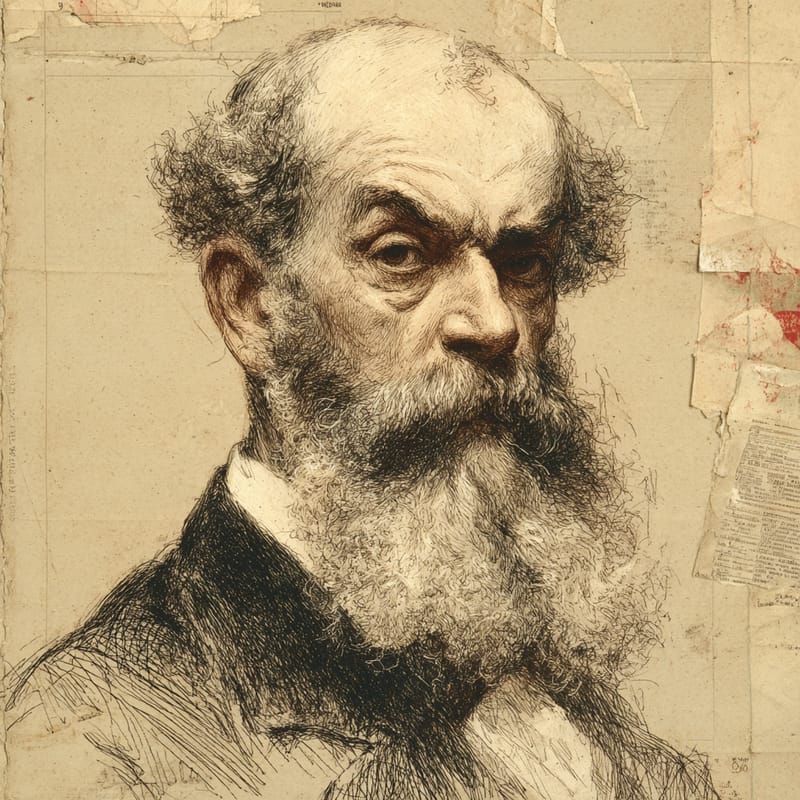
Stephen Pearl Andrews
The science of society
Individual sovereignty, cost the limit of price.
Reformist Anarcho-MutualistOne of 729 ideologies · enter the Anarcho-Mutualist hall →- Role
- Theorist
- Era
- 1812–1886
- Region
- United States
- Social band
- Reformist
- Placement
- −24 · −92 · +55
§ Where Stephen Pearl Andrews stands
3 axesAndrews stood just left of centre: he accepted markets and private ownership of what one produces, but condemned profit, interest and rent as unjust. Cost the Limit of Price, the second part of The Science of Society (1851), argued that prices should reflect only the labour and burden of production, measured in labour notes, rather than whatever the market would bear.
His starting point was the sovereignty of the individual, which the first part of The Science of Society (1851) called the true constitution of government: each person free to act at their own cost, with no state imposing its will. Modern Times, founded that year with Warren, tried to live this out without government, laws or courts.
Andrews was a radical progressive for his age: an abolitionist driven out of Texas in 1843, a supporter of women's rights and, in his 1853 newspaper debate with Horace Greeley and Henry James Sr., published as Love, Marriage and Divorce, a defender of free love against marriage enforced by law. His later association with Victoria Woodhull deepened that reputation.
How close are you to Stephen Pearl Andrews?
Three statements, one per axis. Answer them and we’ll drop you on the compass next to them.
§ The story
HistoricalStephen Pearl Andrews (1812–1886) was born in Templeton, Massachusetts, and practised law in New Orleans and then in Texas, where his campaign to abolish slavery led a mob to drive him out of Houston in 1843. He travelled to London seeking British support for ending slavery in Texas, discovered Isaac Pitman's shorthand and promoted it in America, and met Josiah Warren, whose ideas of individual sovereignty and cost-price exchange he made his own.
Andrews systematised Warren's individualist anarchism in The Science of Society (1851) and joined him that year in founding Modern Times, a community on Long Island run without government or fixed rules. A tireless polymath, he debated free love with Horace Greeley and Henry James Sr. in 1853, invented a universal language called Alwato, built an all-embracing philosophy he called Universology and wrote for Victoria Woodhull's radical weekly in the 1870s. His defence of free love made him notorious, but he helped lay the foundations of American individualist anarchism.
Notable for
- 01'The Science of Society'
- 02Individual sovereignty
- 03Equitable-commerce theory
Key works & moments
- 1843Driven out of Houston by a mob for campaigning to abolish slavery in Texas.
- 1851Publishes The Science of Society, systematising individual sovereignty and cost-price exchange.
- 1851Co-founds the anarchist community of Modern Times on Long Island with Josiah Warren.
- 1853Debates free love with Horace Greeley and Henry James Sr., published as Love, Marriage and Divorce.
- 1870sWrites for Victoria Woodhull's radical paper, Woodhull & Claflin's Weekly.
- 1872Publishes The Basic Outline of Universology, his all-embracing philosophical system.
§ Minds closest to Stephen Pearl Andrews
All minds →


§ Also in the Anarcho-Mutualist hall
Enter the hall →The closest minds above are this hall’s whole roster.
§ Common questions
4 answersWhat was Stephen Pearl Andrews's political ideology?
Stephen Pearl Andrews was an individualist anarchist in the mutualist tradition of Josiah Warren: on the 99ideologies three-axis compass, a Reformist Anarcho-Mutualist. Economically he sat just left of centre (−24), favouring markets in which goods trade at their labour cost, without profit, interest or rent. On governance he was near the libertarian extreme (−92), resting everything on the sovereignty of the individual, and socially he was progressive (+55), an abolitionist and advocate of free love and women's rights.
Was Stephen Pearl Andrews left-wing or right-wing?
He was a libertarian of the radical left, though not a socialist in the collectivist sense. Andrews opposed capitalist profit, interest and rent and wanted labour to receive its full product, which puts him left of centre economically, but he defended individual ownership and market exchange rather than common property. Combined with his rejection of the state, his abolitionism and his advocacy of free love, that makes him a forerunner of the individualist anarchism later developed by Benjamin Tucker.
What does cost the limit of price mean?
It is the principle, coined by Josiah Warren and systematised by Andrews in The Science of Society (1851), that the price of a good should equal the cost of producing it, measured chiefly in the labour and burden involved, and nothing more. Charging what the market will bear, or taking profit, interest and rent, was in this view a form of plunder. Warren tested the idea in his Cincinnati Time Store from 1827, where goods were exchanged for labour notes promising equivalent hours of work.
Which minds are closest to Stephen Pearl Andrews?
On the 99ideologies three-axis compass, the minds closest to Stephen Pearl Andrews are The Cost-Price Market (archetype) (99% alike), Voltairine de Cleyre (98% alike) and Dyer Lum (97% alike). The furthest is Adam Sutler (0% alike).