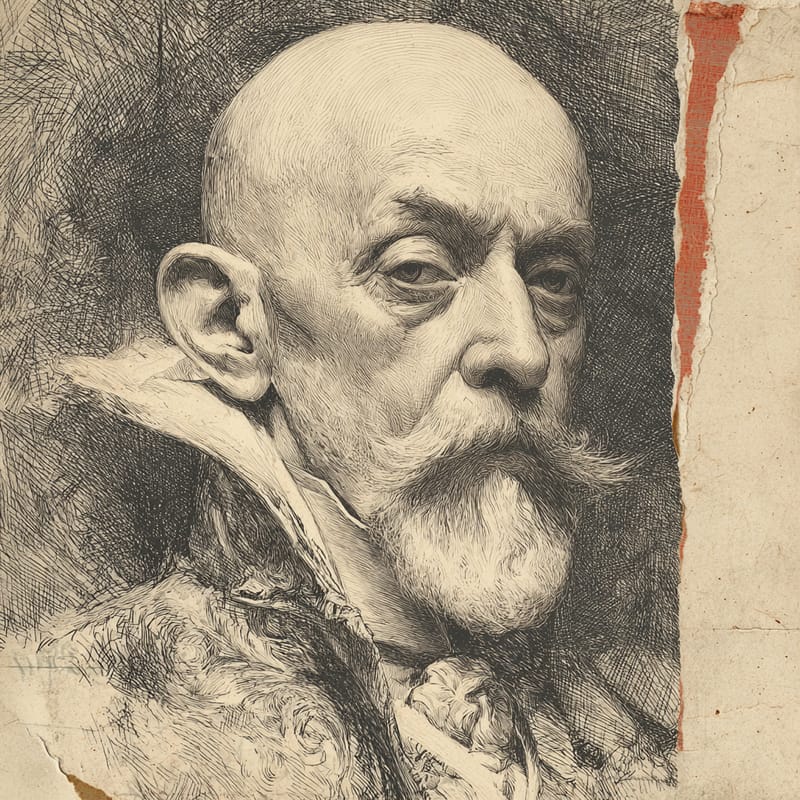
Gabriele D'Annunzio
The Fiume adventure
Aesthetic politics and the corporatist charter.
Reactionary FalangistOne of 729 ideologies · enter the Falangist hall →- Role
- Poet & proto-fascist
- Era
- 1863–1938
- Region
- Italy
- Social band
- Reactionary
- Placement
- −20 · +90 · −72
§ Where Gabriele D'Annunzio stands
3 axesD'Annunzio's economics came from the Charter of Carnaro of 1920, drafted with the syndicalist Alceste De Ambris, which grouped citizens into ten corporations by occupation, guaranteed a minimum wage and recognised property as a social function rather than an absolute right. That corporatism, hostile to liberal capitalism but not to private ownership, puts him modestly left of centre.
In Fiume D'Annunzio governed as the Comandante, by charisma, decree and spectacle. He addressed crowds from the balcony in call-and-response rallies, and the 1920 charter, despite its democratic trappings, provided for a Commandant with full powers in times of emergency, a model of theatrical one-man rule that Mussolini's movement studied and copied.
D'Annunzio's politics were romantic and backward-looking: he exalted Italy's Roman and Venetian heritage, irredentist claims on the Adriatic and the heroic cult of war and sacrifice. The Charter of Carnaro did promise equal rights for women and religious freedom, but the Fiume enterprise of 1919–20 rested on a mystique of national glory, ritual and martial virtue that places him firmly on the traditional side.
How close are you to Gabriele D'Annunzio?
Three statements, one per axis. Answer them and we’ll drop you on the compass next to them.
§ The story
HistoricalGabriele D'Annunzio (1863–1938) was an Italian poet, novelist, dramatist and war hero whose politics helped shape fascism. Born in Pescara, he became famous in his twenties for decadent verse and the 1889 novel Il piacere, and his flamboyant life made him a celebrity across Europe. In 1915 his speeches helped push Italy into the First World War, in which he served as an aviator, lost the sight of one eye and in August 1918 led a propaganda flight over Vienna.
Furious at what he called Italy's mutilated victory, D'Annunzio led mutinous soldiers and volunteers into the Adriatic port of Fiume in September 1919 and ruled it for some fifteen months, proclaiming the Italian Regency of Carnaro under a corporatist constitution in 1920. The Italian army drove him out at the end of 1920. His balcony speeches, black-shirted arditi, Roman salutes and war cries were taken up by Mussolini's movement, and although he held no office under fascism, the regime honoured him until his death at his estate, the Vittoriale, on Lake Garda.
Notable for
- 01Seized Fiume (1919)
- 02Charter of Carnaro
- 03Proto-fascist political style
Key works & moments
- 1889Publishes Il piacere, a defining novel of Italian decadentism.
- 1915Urges Italy into the First World War in fiery speeches, beginning at Quarto in May.
- 1918Leads a flight over Vienna on 9 August, dropping propaganda leaflets on the enemy capital.
- 1919Seizes the port of Fiume on 12 September with mutinous troops and volunteers.
- 1920Proclaims the Italian Regency of Carnaro under the corporatist Charter of Carnaro.
- 1920–21Italian forces drive him out of Fiume in the fighting known as Bloody Christmas.
§ Minds closest to Gabriele D'Annunzio
All minds →

§ Also in the Falangist hall
Enter the hall →The closest minds above are this hall’s whole roster.
§ Common questions
4 answersWhat was Gabriele D'Annunzio's political ideology?
D'Annunzio was a romantic nationalist and proto-fascist: on the 99ideologies three-axis compass, a Reactionary Falangist. Economically he sat slightly left of centre (−20), thanks to the corporatist Charter of Carnaro, which treated property as a social function. On governance he was strongly authoritarian (+90), ruling Fiume as a charismatic Comandante, and socially he was firmly traditional (−72), devoted to national glory, irredentism and the cult of heroic war.
Was Gabriele D'Annunzio left-wing or right-wing?
Right-wing, as a nationalist whose style fed directly into fascism, though he defies easy labels. His Fiume regime drew syndicalists and anarchists as well as nationalists, and its charter mixed corporatism with women's equality and religious freedom, which is why some on the left once admired it. But the enterprise was an act of irredentist conquest led by a charismatic strongman, and its rituals passed straight to Mussolini, placing D'Annunzio on the nationalist right.
Was Gabriele D'Annunzio a fascist?
Not formally, but he was fascism's most important forerunner. D'Annunzio never held office in Mussolini's regime and kept his distance from the party, yet the movement adopted the rituals he pioneered at Fiume in 1919–20: the balcony address, the call-and-response chants, the black shirts of the arditi, the Roman salute and the cult of the leader. Mussolini treated him as a rival to be honoured and contained, and in 1924 the king made him Prince of Montenevoso.
Which minds are closest to Gabriele D'Annunzio?
On the 99ideologies three-axis compass, the minds closest to Gabriele D'Annunzio are Roderick Spode (98% alike), Léon Degrelle (98% alike) and Plínio Salgado (98% alike). The furthest is Emma Goldman (0% alike).