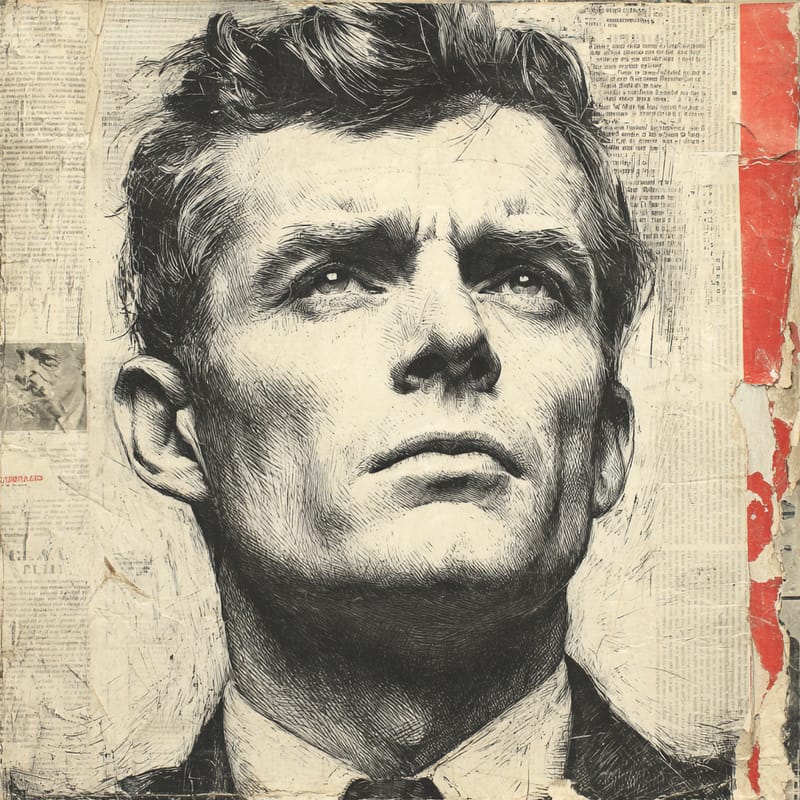
Léon Degrelle
The Rexist movement
Catholic-corporatist authoritarian nationalism.
Reactionary FalangistOne of 729 ideologies · enter the Falangist hall →- Role
- Rexist leader
- Era
- 1906–1994
- Region
- Belgium
- Social band
- Reactionary
- Placement
- −22 · +91 · −76
§ Where Léon Degrelle stands
3 axesDegrelle's early Rexism drew on Catholic social teaching, notably Pope Pius XI's 1931 encyclical Quadragesimo Anno, to demand a corporatist reordering of the economy. Rex built its 1936 breakthrough on attacks against the bankers and politicians it accused of corruption, a populist hostility to finance capitalism that puts him slightly left of centre without any commitment to socialism.
Degrelle led Rex as a personal movement, styling himself its chief and rejecting parliamentary politics as rotten. Under German occupation from 1940 he offered collaboration, joined the Walloon Legion in 1941 and ended the war commanding a Waffen-SS formation, binding his movement to Hitler's dictatorship.
Degrelle began as a militant Catholic, and Rex's early appeal was a crusade for Christian morals and Belgian national renewal, although Cardinal van Roey publicly condemned the movement in 1937. During the war he embraced Nazi racial ideology, and after 1945 he became a prominent Holocaust denier, prompting a landmark 1991 ruling by Spain's Constitutional Court in favour of the Auschwitz survivor Violeta Friedman.
How close are you to Léon Degrelle?
Three statements, one per axis. Answer them and we’ll drop you on the compass next to them.
§ The story
HistoricalLéon Degrelle (1906–1994) was a Belgian politician who founded the Rexist movement and became one of the most prominent collaborators with Nazi Germany. Born into a Catholic family in Bouillon, he studied at the Catholic University of Leuven and ran the Christus Rex publishing house, from which his movement took its name. Breaking with the Catholic Party in 1935, he campaigned against corrupt politicians and bankers, and in the 1936 election Rex won 21 seats in the Chamber of Representatives, with about 11 per cent of the vote.
Rex faded after Degrelle lost a 1937 Brussels by-election to Prime Minister Paul van Zeeland, and it drifted toward open fascism. After Germany occupied Belgium in 1940 he collaborated, joined the Walloon Legion to fight on the Eastern Front in 1941 and rose to command it as an SS officer. Sentenced to death in absentia in Belgium, he escaped to Spain in 1945, where Franco's government refused to extradite him. He lived there until his death in 1994, glorifying Hitler and denying the Holocaust.
Notable for
- 01Led the Rexist movement
- 02Catholic-corporatist nationalism
- 03Wartime collaboration
Key works & moments
- 1935Breaks with the Catholic Party and launches Rex as a political movement.
- 1936Rex wins 21 seats in Belgium's parliamentary election in May.
- 1937Loses a Brussels by-election to Prime Minister Paul van Zeeland.
- 1941Joins the Walloon Legion to fight for Germany on the Eastern Front.
- 1945Escapes to Spain after a Belgian court sentences him to death in absentia.
- 1991Spain's Constitutional Court rules for Auschwitz survivor Violeta Friedman against his Holocaust denial.
§ Minds closest to Léon Degrelle
All minds →



§ Also in the Falangist hall
Enter the hall →The closest minds above are this hall’s whole roster.
§ Common questions
4 answersWhat was Léon Degrelle's political ideology?
Degrelle led Rexism, a Catholic-corporatist nationalism that turned into fascism and Nazi collaboration: on the 99ideologies three-axis compass, a Reactionary Falangist. Economically he sat slightly left of centre (−22), attacking finance and corruption in the name of a corporatist order. On governance he was strongly authoritarian (+91), leading a personal movement and serving Hitler's war, and socially he was firmly traditional (−76), moving from militant Catholicism to Nazi racial ideology.
Was Léon Degrelle left-wing or right-wing?
Far right. Degrelle began as a Catholic populist whose attacks on banks and corrupt politicians, framed in corporatist terms, place him slightly left of centre economically. But his movement was nationalist, anti-communist and anti-parliamentary, and from 1940 he collaborated with Nazi Germany, fought in the Waffen-SS and spent the rest of his life defending Hitler. That trajectory places him squarely on the extreme right of European politics.
Was Léon Degrelle a Nazi?
By the end, yes. Rex began in 1935 as a Catholic-corporatist protest movement distinct from German National Socialism. But after the 1940 occupation Degrelle embraced collaboration, joined the Walloon Legion, which was transferred to the Waffen-SS in 1943, and won high German decorations as its commander. In Spanish exile after 1945 he praised Hitler and denied the Holocaust, which led Spain's Constitutional Court in 1991 to uphold a complaint brought by the Auschwitz survivor Violeta Friedman.
Which minds are closest to Léon Degrelle?
On the 99ideologies three-axis compass, the minds closest to Léon Degrelle are Plínio Salgado (99% alike), Gabriele D'Annunzio (98% alike) and Roderick Spode (98% alike). The furthest is Emma Goldman (0% alike).