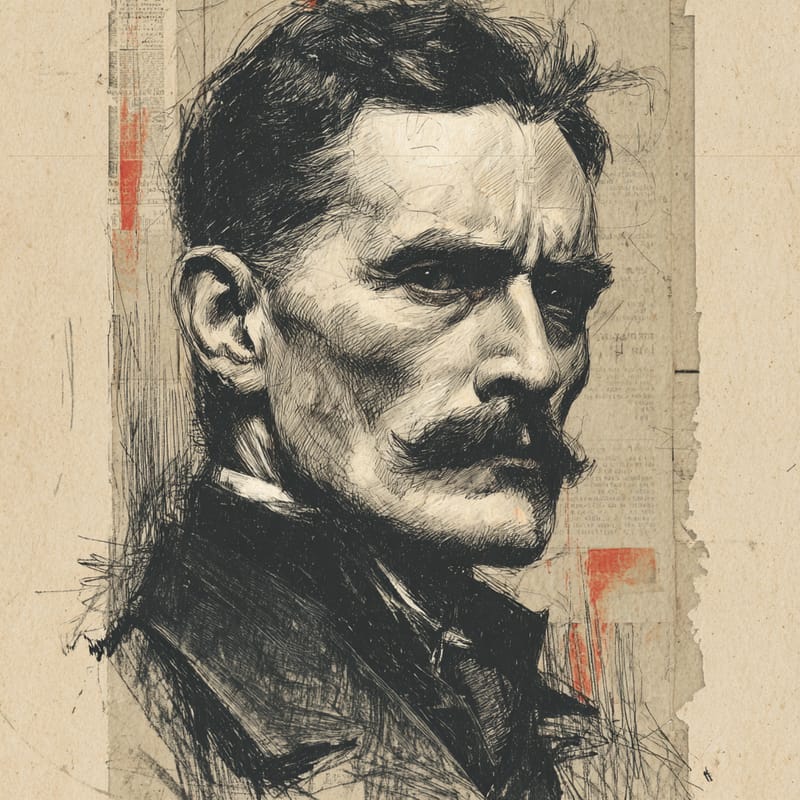
Oswald Mosley
Britain's blackshirt
Founded the British Union of Fascists.
Reactionary FascistOne of 729 ideologies · enter the Fascist hall →- Role
- Fascist leader
- Era
- 1896–1980
- Region
- United Kingdom
- Social band
- Reactionary
- Placement
- +70 · +90 · −65
§ Where Oswald Mosley stands
3 axesMosley's economics began as radical Keynesianism and ended as corporatism. The 1930 Mosley Memorandum proposed public works, credit expansion and protection to fight unemployment, and his book The Greater Britain (1932) called for a corporate state in which industries would be organised into corporations under government direction, behind an insulated imperial economy. Private ownership remained, which places him well right of centre.
Mosley adopted the leader principle and the trappings of continental fascism: black uniforms, salutes and a uniformed corps of stewards. At the Olympia rally of June 1934 his stewards violently ejected hecklers, and he promised a government armed with sweeping executive powers to override the old party politicians. The 1936 Public Order Act, which banned political uniforms, was a direct response to his movement.
From 1934 Mosley's movement turned openly antisemitic, staging marches through the Jewish East End of London that culminated in the Battle of Cable Street in October 1936. After 1945 he shifted to campaigning against Commonwealth immigration, standing in Kensington North in 1959 after the Notting Hill riots, while promoting a nationalist vision of Europe as a single nation.
How close are you to Oswald Mosley?
Three statements, one per axis. Answer them and we’ll drop you on the compass next to them.
§ The story
HistoricalSir Oswald Mosley (1896–1980), sixth baronet of Ancoats, was the founder of the British Union of Fascists. Injured while serving in the First World War, he was elected Conservative MP for Harrow in 1918 at the age of 22, crossed the floor to sit as an independent and joined Labour in 1924. As a minister in Ramsay MacDonald's second Labour government he proposed an ambitious plan against unemployment, the Mosley Memorandum, and resigned in 1930 when the cabinet rejected it.
After his New Party failed in 1931, Mosley visited Mussolini and in 1932 launched the British Union of Fascists, whose black-shirted rallies, street violence and antisemitic campaigns in London's East End made it the most notorious extremist movement in interwar Britain. In 1936 he married Diana Mitford in Berlin, with Hitler among the guests. Interned from 1940 to 1943, he returned after the war with the Union Movement and campaigned against Commonwealth immigration, but never again won significant support. He died in France in 1980.
Notable for
- 01Founded the British Union of Fascists
- 02Cable Street confrontation, 1936
- 03Interned during WWII
Key works & moments
- 1930Resigns from the Labour government after the cabinet rejects the Mosley Memorandum on unemployment.
- 1932Founds the British Union of Fascists after visiting Mussolini; publishes The Greater Britain.
- 1934BUF stewards beat hecklers at the Olympia rally; the Daily Mail soon withdraws its support.
- 1936Anti-fascists block his march through the East End at the Battle of Cable Street on 4 October.
- 1940Interned without trial under Defence Regulation 18B until his release in 1943.
- 1959Stands in Kensington North on an anti-immigration platform and loses his deposit.
§ Minds closest to Oswald Mosley
All minds →


§ Also in the Fascist hall
Enter the hall →§ Common questions
4 answersWhat was Oswald Mosley's political ideology?
Oswald Mosley was a fascist and the founder of Britain's main fascist movement: on the 99ideologies three-axis compass, a Reactionary Fascist. Economically he sat well right of centre (+70), proposing a corporate state and an insulated imperial economy that kept private ownership. On governance he was strongly authoritarian (+90), adopting the leader principle and a uniformed movement, and socially he was reactionary (−65), turning to antisemitism in the 1930s and to anti-immigration campaigns after the war.
Was Oswald Mosley left-wing or right-wing?
Far right, although he started elsewhere. Mosley was first a Conservative MP and then a Labour minister whose 1930 plan for public works and economic planning won admirers on the left. But from 1932 he led the British Union of Fascists, modelled on Mussolini's movement, with its leader cult, uniformed stewards and antisemitic campaigns. His fascist career, not his Labour interlude, defines him, and it places him on the authoritarian far right.
What happened at the Battle of Cable Street?
On 4 October 1936 tens of thousands of anti-fascists, among them Jewish residents, communists, socialists, trade unionists and Irish dockers, blocked a planned British Union of Fascists march through the East End of London. Barricades went up on Cable Street, and police trying to clear a route for the marchers clashed with the crowd. The Metropolitan Police commissioner called off the march through the East End, and the day became a lasting symbol of anti-fascist resistance. Parliament passed the Public Order Act later that year, banning political uniforms.
Which minds are closest to Oswald Mosley?
On the 99ideologies three-axis compass, the minds closest to Oswald Mosley are Engelbert Dollfuss (99% alike), Ion Antonescu (98% alike) and Benito Mussolini (97% alike). The furthest is Emma Goldman (0% alike).