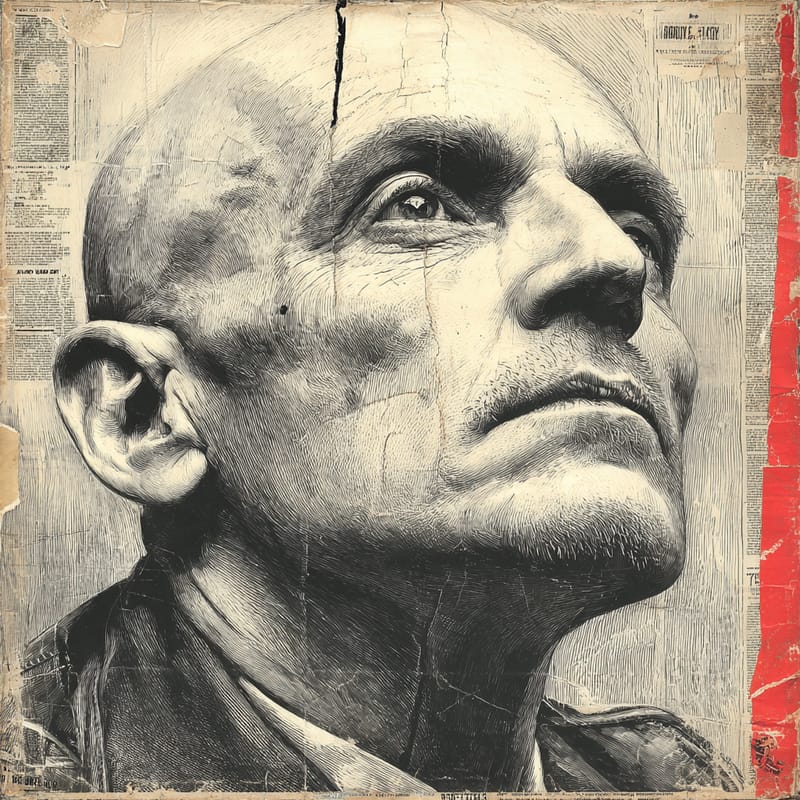
Benito Mussolini
The original fascist
Coined the name; built the corporate state.
Reactionary FascistOne of 729 ideologies · enter the Fascist hall →- Role
- Dictator (Duce)
- Era
- 1883–1945
- Region
- Italy
- Social band
- Reactionary
- Placement
- +72 · +95 · −70
§ Where Benito Mussolini stands
3 axesMussolini kept private property but placed it under the corporate state. The 1926 Rocco law banned strikes and recognised only fascist unions, the 1927 Charter of Labour proclaimed class collaboration under the state, and from 1933 the IRI rescued failing banks, making the state a major owner of industry. This was capitalism under political command, which places him well right of centre.
Mussolini built the first fascist dictatorship. After claiming responsibility for the Matteotti crisis in January 1925, he passed the 'very fascist laws' of 1925–26 that banned opposition parties and the free press, created a Special Tribunal for the Defence of the State and the OVRA secret police, and sent opponents into internal exile. He adopted the word totalitarian, coined by his critics, as a boast.
Mussolini glorified war, hierarchy and the legacy of ancient Rome, and made peace with the Church in the 1929 Lateran Pacts, which recognised Catholicism as the state religion. His battle for births taxed bachelors and pushed women towards motherhood, his troops used poison gas in Ethiopia, and the racial laws of 1938 expelled Jews from schools, professions and public life.
How close are you to Benito Mussolini?
Three statements, one per axis. Answer them and we’ll drop you on the compass next to them.
§ The story
HistoricalBenito Mussolini (1883–1945) founded fascism and ruled Italy as dictator from 1922 to 1943. The son of a socialist blacksmith in Predappio, he became a revolutionary socialist journalist and editor of the party daily Avanti!, but was expelled from the Socialist Party in 1914 for demanding Italy's entry into the First World War. After serving at the front he founded the Fasci Italiani di Combattimento in Milan in 1919, and the March on Rome of October 1922 led King Victor Emmanuel III to appoint him prime minister.
Mussolini turned Italy into a one-party state after the murder of the socialist deputy Giacomo Matteotti in 1924, built the cult of the Duce and the corporate state, and conquered Ethiopia in 1935–36. Allied with Hitler, he imposed racial laws on Italian Jews in 1938 and entered the Second World War in 1940. Deposed in July 1943, he was rescued by German commandos to head the puppet Salò republic, and on 28 April 1945 partisans shot him near Lake Como. His movement became the template for fascism everywhere.
Notable for
- 01Founded the Fascist movement, 1919
- 02March on Rome, 1922
- 03Coined 'totalitarian'
Key works & moments
- 1919Founds the Fasci Italiani di Combattimento at a meeting in Milan on 23 March.
- 1922The March on Rome brings his appointment as prime minister at the end of October.
- 1925Takes responsibility for the Matteotti crisis on 3 January and moves to one-party dictatorship.
- 1929Signs the Lateran Pacts with the Holy See, creating the Vatican City state.
- 1935–36Invades and conquers Ethiopia, using poison gas against soldiers and civilians.
- 1943–45Deposed in July 1943, he heads the Salò republic until partisans shoot him in April 1945.
In their own words
“I declare here, before this Assembly and before all the Italian people, that I alone assume the political, moral and historical responsibility for all that has happened.”
§ Minds closest to Benito Mussolini
All minds →


§ Also in the Fascist hall
Enter the hall →§ Common questions
4 answersWhat was Benito Mussolini's political ideology?
Benito Mussolini was the founder of fascism: on the 99ideologies three-axis compass, a Reactionary Fascist. Economically he sat well right of centre (+72), keeping private property within a corporate state that banned strikes and free unions. On governance he was near the authoritarian maximum (+95), building a one-party dictatorship around the cult of the Duce, and socially he was strongly reactionary (−70), exalting war, hierarchy and ancient Rome and, from 1938, persecuting Jews.
Was Mussolini left-wing or right-wing?
Right-wing once in power, though he began on the left. Until 1914 Mussolini was a leading revolutionary socialist, and the first fascist programme of 1919 still contained radical demands. But fascism rose by attacking socialists and unions with squad violence, and in government it allied with industrialists, landowners, the monarchy and the Church, outlawed the left and imposed class collaboration. Historians classify it as the original movement of the radical, authoritarian right.
Was Mussolini a socialist?
He was until 1914, but fascism was not socialist. Mussolini was a prominent revolutionary socialist who edited the party newspaper Avanti! before his expulsion for backing Italy's entry into the First World War. The fascist programme of 1919 promised an eight-hour day and a heavy tax on capital, but by 1922 his squads were breaking strikes and burning union halls. In power he banned socialist parties, abolished free unions and preserved private ownership, so his mature politics were firmly anti-socialist.
Which minds are closest to Benito Mussolini?
On the 99ideologies three-axis compass, the minds closest to Benito Mussolini are Adenoid Hynkel (99% alike), Ante Pavelić (99% alike) and Ion Antonescu (99% alike). The furthest is Emma Goldman (0% alike).