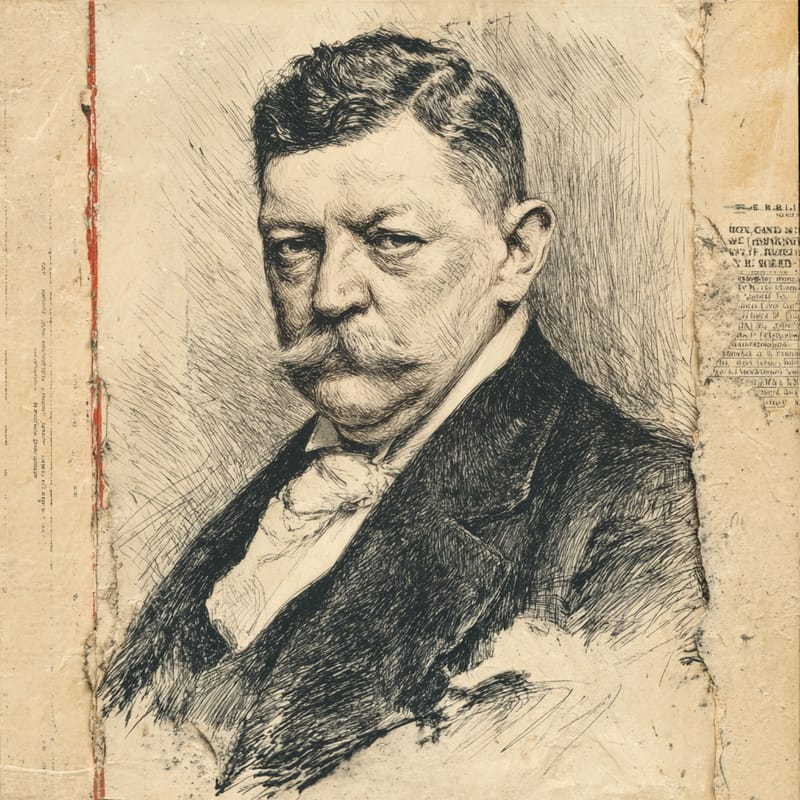
Engelbert Dollfuss
Austrofascism
A clerical corporate state.
Reactionary FascistOne of 729 ideologies · enter the Fascist hall →- Role
- Chancellor
- Era
- 1892–1934
- Region
- Austria
- Social band
- Reactionary
- Placement
- +70 · +90 · −68
§ Where Engelbert Dollfuss stands
3 axesDollfuss modelled his economics on Catholic social teaching, above all Pope Pius XI's 1931 encyclical Quadragesimo Anno, which proposed organising society into occupational estates rather than classes. His 1934 constitution created corporate bodies for agriculture, industry, trade and the professions and replaced free trade unions with a single state-sponsored federation, while private property and the fiscal orthodoxy of a 1932 League of Nations loan kept the system capitalist.
Dollfuss dismantled Austrian democracy in stages. After parliament's three presiding officers resigned on 4 March 1933, he declared that it had eliminated itself and governed through a 1917 wartime emergency law, banned opposition parties, opened the Wöllersdorf internment camp for political prisoners and in February 1934 turned the army and police on the socialists. The May Constitution of 1934 abolished parliamentary democracy.
Dollfuss's Austria was explicitly Catholic. Its 1934 constitution opened in the name of God, the 1933 concordat with the Holy See strengthened the Church's role in marriage and schooling, and his September 1933 Trabrennplatz speech promised a social, Christian, German Austria. He was anti-Marxist and anti-Nazi alike, rejecting racial nationalism in favour of a clerical Austrian-German identity.
How close are you to Engelbert Dollfuss?
Three statements, one per axis. Answer them and we’ll drop you on the compass next to them.
§ The story
HistoricalEngelbert Dollfuss (1892–1934) was chancellor of Austria from 1932 until his assassination and the founder of the authoritarian corporate state often called Austrofascism. Born into a farming family in Texing in Lower Austria, he studied law and economics, served as an officer on the Italian front in the First World War and rose through Catholic farmers' organisations to direct Lower Austria's chamber of agriculture, become minister of agriculture in 1931 and, in May 1932, lead a Christian Social coalition with a one-seat majority.
In March 1933 Dollfuss used a procedural crisis to shut out parliament and rule by decree, banned the Communists and the Nazis, and founded the Fatherland Front as his political movement. In February 1934 his forces crushed a Social Democratic uprising, shelling Vienna's workers' housing, and the May Constitution created a Christian, corporatist one-party state. Backed by Mussolini against Hitler, he was shot dead by Austrian Nazis during a failed coup on 25 July 1934. His legacy remains contested in Austria, where many conservatives long honoured him as a martyr against Nazism.
Notable for
- 01Established Austrofascism
- 02Crushed the 1934 socialist uprising
- 03Assassinated by Nazis
Key works & moments
- 1932Becomes chancellor in May, leading a coalition with a majority of one seat.
- 1933After parliament's presiding officers resign in March, he shuts it out and rules by decree.
- 1933Bans the Communists and Nazis and founds the Fatherland Front as the regime's mass movement.
- 1934Crushes the Social Democrats' February uprising; the army shells Vienna's Karl-Marx-Hof.
- 1934Proclaims the May Constitution, creating a Christian corporate state.
- 1934Shot dead on 25 July by Austrian Nazis storming the Chancellery in a failed putsch.
In their own words
“We want the social, Christian, German state of Austria, on a corporative basis and under strong authoritarian leadership!”
§ Minds closest to Engelbert Dollfuss
All minds →


§ Also in the Fascist hall
Enter the hall →§ Common questions
4 answersWhat was Engelbert Dollfuss's political ideology?
Engelbert Dollfuss was the founder of Austria's clerical corporate state, often called Austrofascism: on the 99ideologies three-axis compass, a Reactionary Fascist. Economically he sat well right of centre (+70), organising a capitalist economy into Catholic occupational estates. On governance he was strongly authoritarian (+90), shutting out parliament and ruling through a single Fatherland Front, and socially he was strongly traditionalist (−68), building an explicitly Catholic state hostile to both socialism and Nazism.
Was Engelbert Dollfuss left-wing or right-wing?
Right-wing. Dollfuss, a Christian Social chancellor, crushed the Social Democrats in the brief civil war of February 1934 and replaced parliamentary democracy with an authoritarian corporate state. He was also a fierce opponent of the Nazis, who murdered him, which has led some Austrians to remember him as a patriot. But his regime's suppression of the labour movement and its clerical authoritarianism place him clearly on the authoritarian right.
Was Dollfuss a fascist?
Historians disagree, and the debate remains politically charged in Austria. Critics call his regime Austrofascism: it abolished parliament, banned parties, built a single movement with a leader cult and militias, and copied Italian fascist forms with Mussolini's support. Defenders, especially on the conservative side, prefer the term corporate state, stressing that it was Catholic rather than revolutionary, lacked a true mass movement and fought Nazism to the death. Most scholars place it among the interwar dictatorships that borrowed heavily from fascism.
Which minds are closest to Engelbert Dollfuss?
On the 99ideologies three-axis compass, the minds closest to Engelbert Dollfuss are Oswald Mosley (99% alike), Ion Antonescu (98% alike) and Benito Mussolini (98% alike). The furthest is Emma Goldman (0% alike).