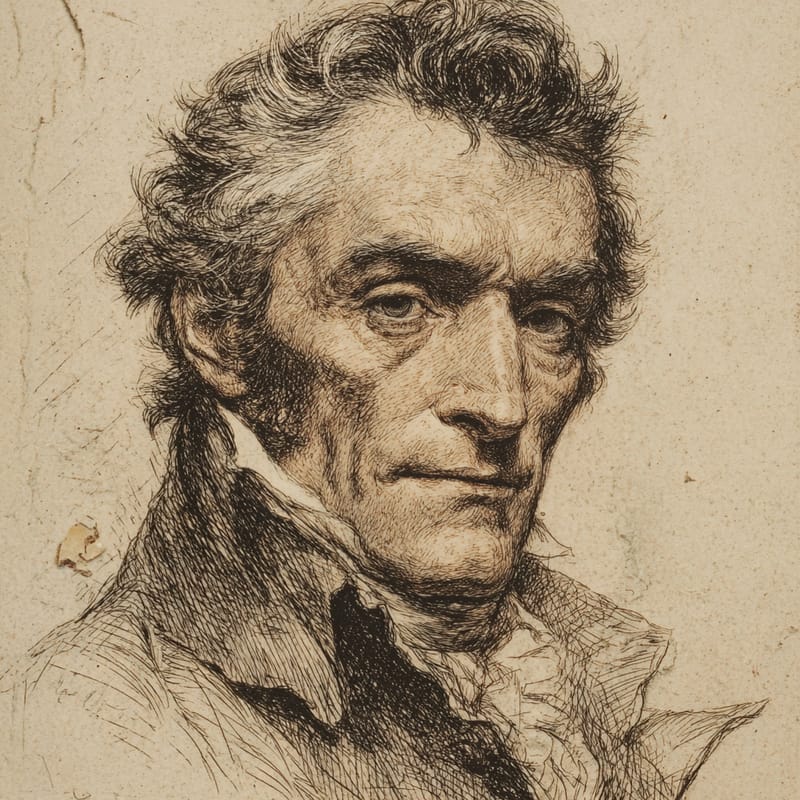
Thomas Paine
Government, a necessary evil
The least state, and the rights of man.
Reformist MinarchistOne of 729 ideologies · enter the Minarchist hall →- Role
- Revolutionary pamphleteer
- Era
- 1737–1809
- Region
- England / US
- Social band
- Reformist
- Placement
- 0 · −72 · +45
§ Where Thomas Paine stands
3 axesPaine sits at the economic centre because he combined faith in commerce with pioneering welfare proposals. He praised trade as a civilising force, yet Rights of Man, Part Two (1792) proposed pensions for the elderly, child allowances and a progressive tax on large estates, and Agrarian Justice (1797) called for a national fund paying every person a lump sum at 21, financed by a tax on inheritances.
Common Sense (1776) opened by distinguishing society, a blessing, from government, a necessary evil to be kept as small and accountable as possible. Paine attacked monarchy and hereditary rule as illegitimate and wanted power held by elected representatives under written constitutions, a republicanism that limits the state sharply without abolishing it.
Paine was a radical progressive for his age. Rights of Man (1791) grounded politics in the equal natural rights of every person and ridiculed hereditary aristocracy, while The Age of Reason (1794) attacked revealed religion and clerical authority in the name of deism and free inquiry. His welfare proposals treated poverty as a wrong society owed redress for, not a moral failing.
How close are you to Thomas Paine?
Three statements, one per axis. Answer them and we’ll drop you on the compass next to them.
§ The story
HistoricalThomas Paine (1737–1809) was an English-born pamphleteer whose writing helped launch two revolutions. The son of a staymaker from Thetford in Norfolk, he worked as an excise officer until his dismissal in 1774, then emigrated to Philadelphia with a letter of introduction from Benjamin Franklin. Common Sense, published in January 1776, made the case for American independence in plain, forceful prose and sold in enormous numbers, and his American Crisis essays sustained morale during the war.
Paine returned to Europe and answered Edmund Burke's attack on the French Revolution with Rights of Man (1791–92), for which he was tried in absentia for seditious libel in Britain. Elected to the French National Convention, he opposed the execution of Louis XVI and was imprisoned during the Terror. The Age of Reason (1794–95), a deist assault on organised Christianity, cost him much of his American reputation, and he died in New York in 1809, largely shunned. His Agrarian Justice (1797) is now cited as an early blueprint for basic income.
Notable for
- 01'Common Sense'
- 02'Rights of Man'
- 03'The Age of Reason'
Key works & moments
- 1776Publishes Common Sense in January, urging the American colonies to declare independence.
- 1776Begins The American Crisis essays during the Continental Army's desperate winter campaign.
- 1791–92Rights of Man answers Burke and defends the French Revolution; Britain tries him for seditious libel.
- 1793–94Imprisoned in Paris during the Terror after opposing the execution of Louis XVI.
- 1794–95The Age of Reason attacks organised religion and alienates many American admirers.
- 1797Agrarian Justice proposes a universal endowment funded by a tax on inheritances.
In their own words
“Society in every state is a blessing, but government even in its best state is but a necessary evil; in its worst state an intolerable one.”
“These are the times that try men's souls.”
§ Minds closest to Thomas Paine
All minds →

§ Also in the Minarchist hall
Enter the hall →§ Common questions
4 answersWhat was Thomas Paine's political ideology?
Thomas Paine was a radical republican and a pioneer of natural-rights liberalism: on the 99ideologies three-axis compass, a Reformist Minarchist. Economically he sat at the centre (0), pairing confidence in commerce with early proposals for pensions and a universal endowment. On governance he was strongly libertarian (−72), calling government at best a necessary evil, and socially he was clearly progressive (+45), attacking monarchy, hereditary privilege and established religion.
Was Thomas Paine left-wing or right-wing?
In his own time he was firmly on the radical left, an enemy of kings, aristocracy and established churches who defended the French Revolution. Today both sides claim him. Libertarians and conservatives cite Common Sense on the dangers of government, while progressives point to Agrarian Justice and the welfare plans in Rights of Man. On balance he belongs to the radical liberal left of the 1790s: anti-monarchist and egalitarian, but committed to private property and commerce.
Was Thomas Paine a libertarian?
Partly. Libertarians claim Paine for his insistence in Common Sense that government is at best a necessary evil and for his defence of natural rights against kings. But he was no advocate of a bare night-watchman state. Rights of Man, Part Two (1792) set out pensions, child allowances and public support for education, and Agrarian Justice (1797) argued that because private landownership dispossessed everyone else, each person was owed compensation from a national fund. He is better seen as a forerunner of both libertarianism and the welfare state.
Which minds are closest to Thomas Paine?
On the 99ideologies three-axis compass, the minds closest to Thomas Paine are Manuel 'Mannie' O'Kelly (95% alike), Robert Heinlein (94% alike) and Karl Hess (92% alike). The furthest is Adam Sutler (7% alike).