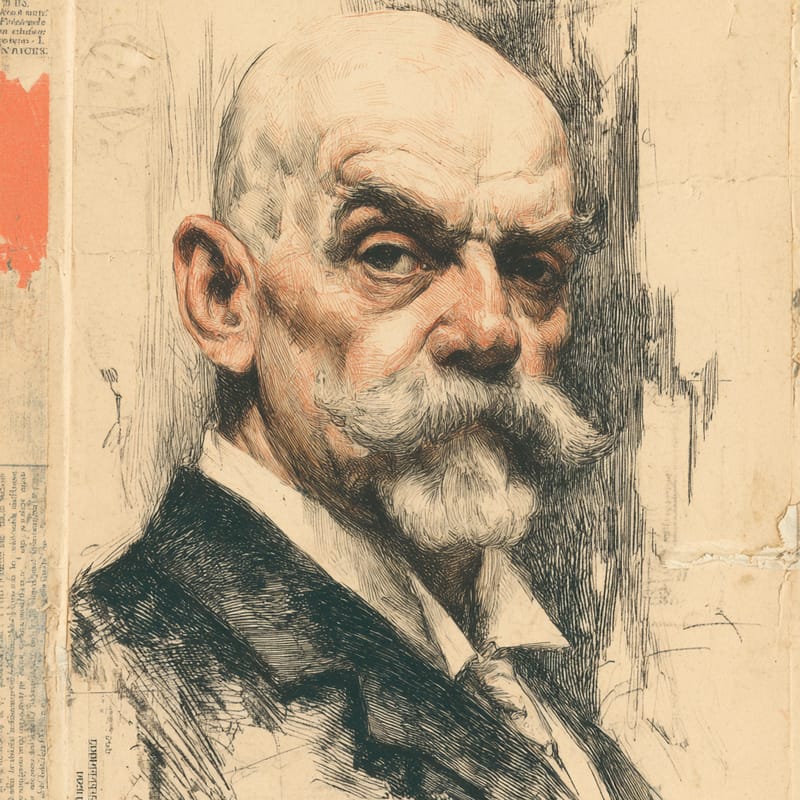
Spencer Heath
Land rent as the public revenue
Markets, with the commons paid for.
Heterodox Geo-LibertarianOne of 729 ideologies · enter the Geo-Libertarian hall →- Role
- Engineer & theorist
- Era
- 1876–1963
- Region
- United States
- Social band
- Heterodox
- Placement
- +26 · −74 · +30
§ Where Spencer Heath stands
3 axesHeath leans to the market because he wanted public services supplied by private enterprise rather than taxation. In Citadel, Market and Altar (1957) he argued that site rent is the natural fund for community services and that proprietors would reinvest it to raise the value of their land. His lean stops at the Georgist insight that land rent, not wages, should pay for the commons.
Heath's citadel stood for the coercive state, which he believed contractual, proprietary communities could replace. Citadel, Market and Altar (1957) proposed that landowners administer whole districts under voluntary agreements, with residents choosing communities as customers choose hotels, an anti-statist vision that anticipates later private-city and seasteading projects.
Heath's progressivism was a rationalist faith that society could be studied and improved scientifically. He founded the Science of Society Foundation to pursue that aim, and in Citadel, Market and Altar (1957) he treated religion, the altar, as one of three great institutions of human life alongside politics and commerce, analysing it rather than prescribing doctrine.
How close are you to Spencer Heath?
Three statements, one per axis. Answer them and we’ll drop you on the compass next to them.
§ The story
HistoricalSpencer Heath (1876–1963) was an American engineer, lawyer, inventor and social theorist. Trained in both engineering and law, he built a successful manufacturing business making aircraft propellers, which supplied American military aviation during the First World War. A follower of Henry George for much of his life, he later turned from industry to social philosophy, setting out his ideas in Citadel, Market and Altar (1957) and founding the Science of Society Foundation to promote them.
Heath's originality lay in breaking with George over who should collect land rent. Where George wanted the state to take it in taxes, Heath argued that landowners, as proprietors of whole communities, would compete to attract residents by providing roads, security and other public services from the rents they earned, as hotels and shopping centres already did. His grandson, the anthropologist Spencer Heath MacCallum, developed the idea in The Art of Community (1970), and it became a foundation of later thinking on private cities.
Notable for
- 01'Citadel, Market and Altar'
- 02Proprietary-community theory
- 03Geo-libertarian pioneer
Key works & moments
- 1910sHis firm manufactures aircraft propellers, supplying American military aviation in the First World War.
- 1950sFounds the Science of Society Foundation to promote a scientific study of social institutions.
- 1957Publishes Citadel, Market and Altar, his theory of proprietary communities.
- 1963Dies; his grandson Spencer Heath MacCallum carries his ideas forward.
- 1970MacCallum's The Art of Community develops Heath's proprietary-community idea.
§ Minds closest to Spencer Heath
All minds →


§ Also in the Geo-Libertarian hall
Enter the hall →The closest minds above are this hall’s whole roster.
§ Common questions
4 answersWhat was Spencer Heath's political ideology?
Spencer Heath was a geo-libertarian who believed proprietary communities funded by land rent could replace the state: on the 99ideologies three-axis compass, a Heterodox Geo-Libertarian. Economically he sits moderately right of centre (+26), wanting public services supplied by landowners competing in a market. On governance he was strongly libertarian (−74), treating the coercive state as replaceable by contract, and socially he was moderately progressive (+30), a rationalist who sought a science of society.
Was Spencer Heath left-wing or right-wing?
He belongs on the libertarian right, though his roots were in a movement with left-wing allies. Heath began as a follower of Henry George, whose single-tax campaign drew support from labour radicals. But he moved decisively toward private enterprise, arguing that landowners rather than governments should collect rent and provide public services. His vision of a society organised by contract and property, with no coercive state, places him among the forerunners of anarcho-capitalism and private-city projects.
What is a proprietary community?
A proprietary community is a settlement owned and managed as a single property, whose owner provides public services such as roads, security and utilities and recovers the cost through rents. Spencer Heath argued in Citadel, Market and Altar (1957) that hotels, shopping centres and planned developments already work this way, and that the model could replace government, since proprietors profit only by making their communities attractive. His grandson Spencer Heath MacCallum expanded the idea in The Art of Community (1970).
Which minds are closest to Spencer Heath?
On the 99ideologies three-axis compass, the minds closest to Spencer Heath are The Single-Tax Commons (archetype) (99% alike), Nicolaus Tideman (98% alike) and Bryan Caplan (geo-adjacent reading) (97% alike). The furthest is Gregor Strasser (12% alike).