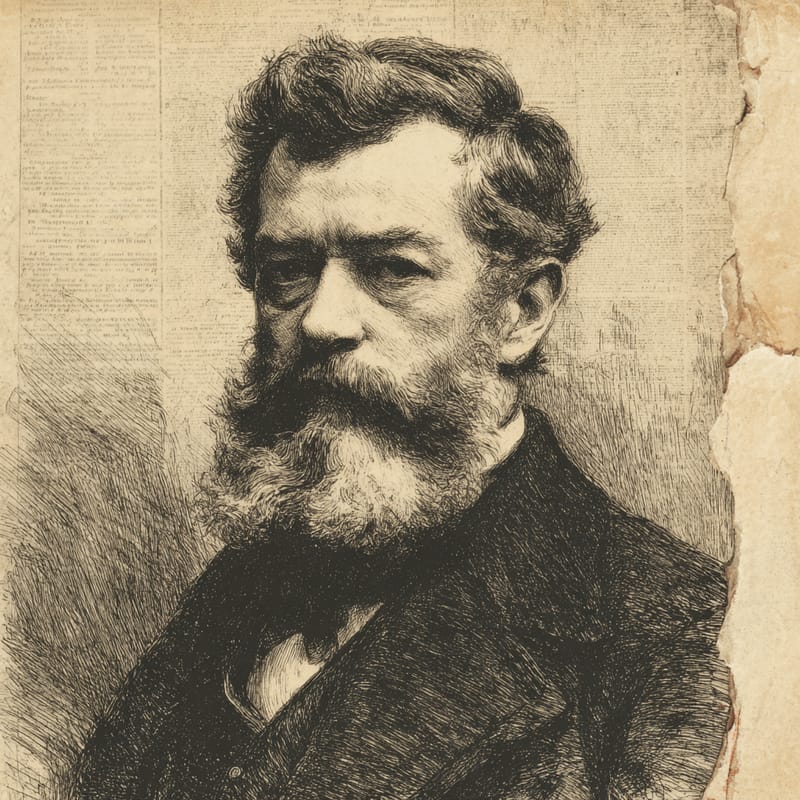
Carlo Cafiero
Insurrection in Italy
From collectivism toward communism.
Reformist Anarcho-CollectivistOne of 729 ideologies · enter the Anarcho-Collectivist hall →- Role
- Revolutionary
- Era
- 1846–1892
- Region
- Italy
- Social band
- Reformist
- Placement
- −58 · −93 · +50
§ Where Carlo Cafiero stands
3 axesCafiero began as a collectivist, wanting land, tools and capital expropriated and held by those who worked them, and his 1879 compendium of Marx's Capital brought the critique of exploitation to Italian workers. In Anarchy and Communism (1880) he went further, urging that products as well as means of production be shared, forming the bridge from Bakunin's collectivism to Kropotkin's communism.
He sought to destroy the state through insurrection rather than politics. In 1876 he and Malatesta declared the insurrectionary deed the most effective form of propaganda, and in 1877 their band entered Letino and Gallo, proclaimed King Victor Emmanuel deposed and burned official records, hoping to spark a peasant revolt that never came.
Cafiero's social radicalism was that of the romantic revolutionaries of the 1870s. An aristocrat by birth, he renounced his class, gave away his fortune to the cause and preached a secular, internationalist brotherhood of peasants and workers, though his writings focus on economics and revolution rather than on family, religion or culture.
How close are you to Carlo Cafiero?
Three statements, one per axis. Answer them and we’ll drop you on the compass next to them.
§ The story
HistoricalCarlo Cafiero (1846–1892) was born in Barletta, in Apulia, into a wealthy landowning family, and studied law in Naples. In 1870 he went to London, where he befriended Karl Marx and Friedrich Engels and returned to Italy as an organiser for the International's General Council. Within two years he had switched to Mikhail Bakunin's anti-authoritarian camp, helped found the Italian Federation at the Rimini conference of 1872 and begun spending his inheritance on the movement, including the purchase of the villa La Baronata near Locarno.
Cafiero became the leading figure of Italian collectivist anarchism and a pioneer of insurrectionary propaganda. In April 1877 he and Errico Malatesta led an armed band into the Matese mountains near Benevento, burning land and tax records in two villages; arrested, they were acquitted in 1878. In prison he wrote a popular compendium of Marx's Capital, which Marx himself praised, and in 1880 he argued for anarchist communism in Anarchy and Communism. From the early 1880s mental illness overtook him, and he died in an asylum at Nocera Inferiore in 1892.
Notable for
- 01Led Italian collectivist anarchism
- 02Benevento insurrection (1877)
- 03Condensed Marx's 'Capital'
Key works & moments
- 1870–71In London, befriends Marx and Engels and returns to Italy to organise for the International.
- 1872Helps found the Italian Federation at Rimini, breaking with Marx's General Council.
- 1873Buys the villa La Baronata near Locarno as a refuge for Bakunin and revolutionaries.
- 1877Leads the Matese insurrection with Malatesta, burning official records in Letino and Gallo.
- 1879Publishes his compendium of Marx's Capital, written in prison.
- 1880Champions anarchist communism in Anarchy and Communism at the Jura Federation's congress.
§ Minds closest to Carlo Cafiero
All minds →

§ Also in the Anarcho-Collectivist hall
Enter the hall →The closest minds above are this hall’s whole roster.
§ Common questions
4 answersWhat was Carlo Cafiero's political ideology?
Carlo Cafiero was an Italian anarchist who moved from Bakunin's collectivism towards anarchist communism: on the 99ideologies three-axis compass, a Reformist Anarcho-Collectivist. Economically he sat on the left (−58), demanding the expropriation of land and capital for common use. On governance he was at the libertarian extreme (−93), seeking to destroy the state through insurrection, and socially he was moderately progressive (+50), a secular internationalist who renounced his aristocratic wealth for the cause.
Was Carlo Cafiero left-wing or right-wing?
Left-wing. Cafiero gave away a landed fortune to the socialist movement, led an armed rising meant to spark peasant revolution and wrote to popularise Marx's critique of capitalism among Italian workers. He belonged to the anti-authoritarian left: he broke with Marx's General Council in 1872, rejected parliamentary politics and sought to abolish the state rather than take it over. His later championing of anarchist communism placed him at the radical end of that tradition.
Was Carlo Cafiero a Marxist?
No, though he admired Marx's economics. Cafiero met Marx and Engels in London in 1870 and first worked for their General Council, but by 1872 he had sided with Bakunin and led the Italian sections out of Marx's camp. He still believed Capital offered the best analysis of exploitation, and in 1879 he published a compendium of it for Italian workers, which Marx praised. He accepted Marx's critique of capitalism while rejecting his political strategy of winning state power.
Which minds are closest to Carlo Cafiero?
On the 99ideologies three-axis compass, the minds closest to Carlo Cafiero are The Free Commune (archetype) (98% alike), James Guillaume (97% alike) and Rafael Farga Pellicer (97% alike). The furthest is Adam Sutler (0% alike).