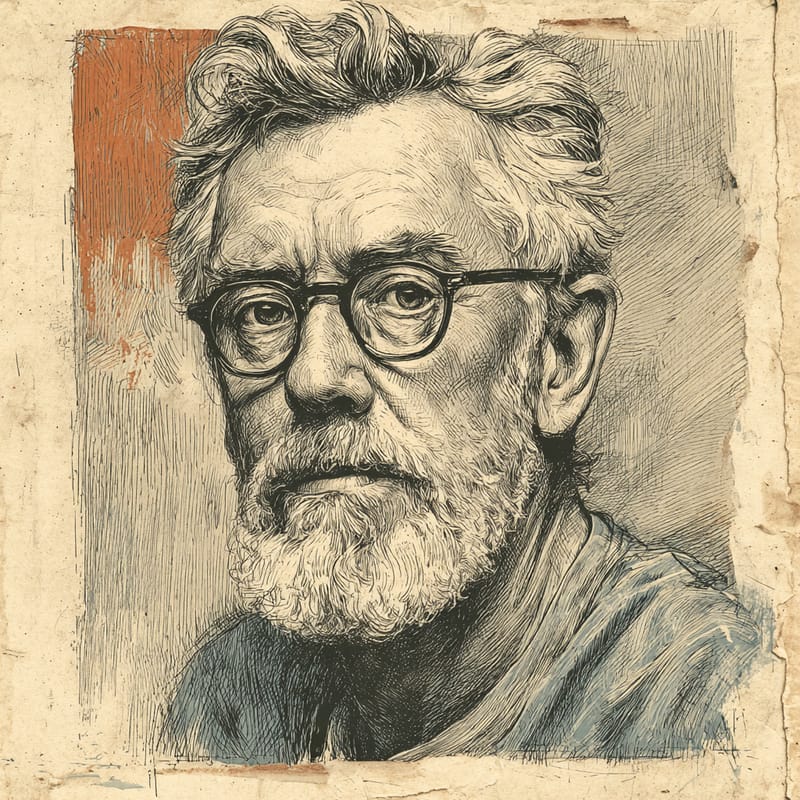
J. Neil Schulman
Alongside Night
Agorism, dramatised.
Heterodox AgoristOne of 729 ideologies · enter the Agorist hall →- Role
- Novelist
- Era
- 1953–2019
- Region
- United States
- Social band
- Heterodox
- Placement
- +7 · −92 · +35
§ Where J. Neil Schulman stands
3 axesSchulman sits just right of the economic centre. Alongside Night (1979) blames government money-printing for hyperinflation and shows black markets trading in gold and private currencies as the way out, celebrating free exchange; but like Konkin he framed this as a counter-economy against the state-corporate establishment rather than a defence of big business.
His politics were stateless: in Alongside Night, order emerges from an underground network that supplants a collapsing government rather than seizing it. He defended armed self-defence as a check on state power, arguing in Stopping Power (1994) that private gun ownership protects citizens, a stance consistent with his distrust of any monopoly on force.
Schulman was an individualist and civil libertarian rather than a social progressive. The Rainbow Cadenza (1983) imagines a future in which young women are conscripted into sexual service, a satire of state control over the body, while his defence of gun rights aligned him with social conservatives on that issue, giving him a mixed, mildly progressive profile.
How close are you to J. Neil Schulman?
Three statements, one per axis. Answer them and we’ll drop you on the compass next to them.
§ The story
HistoricalJ. Neil Schulman (1953–2019) was an American novelist, screenwriter and filmmaker and a leading writer of the libertarian movement. A close associate of Samuel Edward Konkin III, he drew on Konkin's ideas for his first novel, Alongside Night (1979), and won the Prometheus Award for his second, The Rainbow Cadenza (1983). He also wrote for television, including the 1986 Twilight Zone episode Profile in Silver, about a time-travelling historian who saves President John F. Kennedy.
Schulman's significance lies in giving agorism a popular form. Alongside Night imagines an America collapsing under hyperinflation in which an underground free market keeps people fed and free, a vision that made it the classic agorist novel. He was also an outspoken gun-rights advocate, author of Stopping Power (1994), and he directed a 2014 film adaptation of Alongside Night. He remained active as a writer and filmmaker until his death in 2019.
Notable for
- 01'Alongside Night'
- 02Dramatised agorism
- 03Libertarian SF
Key works & moments
- 1979Publishes Alongside Night, a novel of hyperinflation and an agorist underground.
- 1984The Rainbow Cadenza wins the Prometheus Award for best libertarian novel.
- 1986Writes Profile in Silver, an episode of CBS's revived The Twilight Zone.
- 1994Publishes Stopping Power, a defence of private gun ownership.
- 2014Directs the film adaptation of Alongside Night.
§ Minds closest to J. Neil Schulman
All minds →


§ Also in the Agorist hall
Enter the hall →§ Common questions
4 answersWhat was J. Neil Schulman's political ideology?
J. Neil Schulman was a libertarian anarchist and the leading novelist of agorism: on the 99ideologies three-axis compass, a Heterodox Agorist. Economically he sat just right of centre (+7), championing free exchange and sound money against state inflation. On governance he was near the libertarian extreme (−92), imagining order without government and defending armed self-defence, and socially he leaned mildly progressive (+35), an individualist civil libertarian rather than a social reformer.
Was J. Neil Schulman left-wing or right-wing?
He was a libertarian who fitted neither camp neatly. His defence of free markets, sound money and gun rights aligned him with the right on several issues, while his hostility to the state, to state-backed business and to government control of personal life put him at odds with conservatives. Like Samuel Edward Konkin III, he saw the decisive line as the one between voluntary exchange and coercion, which is why agorists claim him as one of their own.
Is Alongside Night an agorist novel?
Yes; it is usually regarded as the first. Published in 1979, a year before Samuel Edward Konkin III's New Libertarian Manifesto, it follows a teenager in a near-future America wrecked by hyperinflation who discovers an underground network of free traders operating outside the law. Schulman drew directly on Konkin's ideas of counter-economics, and the novel's picture of a black market that outlasts a failing state became agorism's best-known illustration. Schulman adapted it as a film in 2014.
Which minds are closest to J. Neil Schulman?
On the 99ideologies three-axis compass, the minds closest to J. Neil Schulman are Samuel Edward Konkin III (98% alike), The Crypto-Trader (archetype) (98% alike) and The Grey-Market Smuggler (archetype) (97% alike). The furthest is Adam Sutler (4% alike).