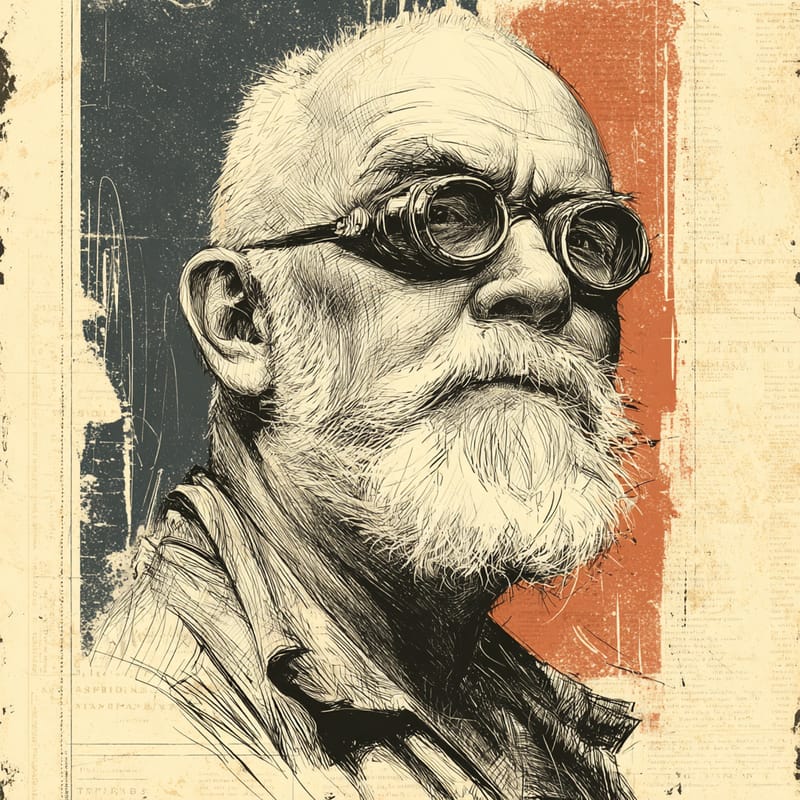
Karl Hess
Community technology
From speechwriter to anarchist tinkerer.
Reformist AgoristOne of 729 ideologies · enter the Agorist hall →- Role
- Writer & activist
- Era
- 1923–1994
- Region
- United States
- Social band
- Reformist
- Placement
- +5 · −90 · +50
§ Where Karl Hess stands
3 axesHess sits at the economic centre. He defended free exchange and private enterprise, but after 1964 he turned against corporate capitalism and big business as allies of the state, and in Dear America (1975) and Community Technology (1979) he championed small-scale, local production, barter and appropriate technology in place of both corporations and government programmes.
He became a thoroughgoing anarchist. The Death of Politics (1969) argued that libertarianism meant rejecting the state altogether, and that year he co-founded The Libertarian Forum with Murray Rothbard; he also refused to pay federal income tax. His neighbourhood experiments in Adams Morgan in the 1970s were meant to show that communities could govern and provide for themselves.
Hess's later politics were progressive and communitarian: he opposed the Vietnam War and the draft, worked with the New Left and the IWW, and championed local democracy and ecological self-reliance. His progressivism kept an individualist core, rooted in personal independence and self-reliance rather than collective identity, which places him only moderately on the progressive side.
How close are you to Karl Hess?
Three statements, one per axis. Answer them and we’ll drop you on the compass next to them.
§ The story
HistoricalKarl Hess (1923–1994) was born in Washington, D.C., left school at fifteen and became a journalist and editor before turning to Republican politics as a speechwriter and ghostwriter. He worked on Republican platforms and became a principal speechwriter for Barry Goldwater's 1964 presidential campaign, the high point of postwar conservatism's challenge to the liberal consensus. Goldwater's heavy defeat that November ended Hess's career in Republican politics and began a long rethinking of his beliefs.
Hess moved sharply to the libertarian left, aligning with the New Left against the Vietnam War, joining the Industrial Workers of the World and arguing for a stateless society in The Death of Politics (Playboy, 1969). He refused to pay federal income tax, lived by barter and welding after the IRS seized his property, and promoted neighbourhood self-reliance in Washington's Adams Morgan district. In later life he edited the Libertarian Party's newspaper. Karl Hess: Toward Liberty, a documentary about him, won an Academy Award in 1981.
Notable for
- 01'Dear America'
- 02Neighbourhood self-reliance projects
- 03Tax resistance
Key works & moments
- 1964Serves as a principal speechwriter for Barry Goldwater's presidential campaign.
- 1969Publishes The Death of Politics in Playboy, calling for a libertarian revolt against left and right.
- 1969Co-founds The Libertarian Forum with Murray Rothbard.
- 1975Publishes Dear America, his account of turning against both corporate and state power.
- 1979Publishes Community Technology, drawing on his neighbourhood self-reliance work.
- 1981Karl Hess: Toward Liberty wins the Academy Award for best documentary short.
§ Minds closest to Karl Hess
All minds →



§ Also in the Agorist hall
Enter the hall →The closest minds above are this hall’s whole roster.
§ Common questions
4 answersWhat was Karl Hess's political ideology?
Karl Hess was a left-libertarian anarchist who began as a Goldwater conservative: on the 99ideologies three-axis compass, a Reformist Agorist. Economically he sat at the centre (+5), defending free exchange while rejecting corporate capitalism in favour of local, small-scale production. On governance he was strongly libertarian (−90), rejecting the state outright and refusing to pay federal income tax, and socially he was moderately progressive (+50), anti-war and communitarian.
Was Karl Hess left-wing or right-wing?
Both, at different times, and finally neither. Hess made his name on the right as Barry Goldwater's speechwriter in 1964, then moved to the anarchist left, allying with the New Left and the IWW against the Vietnam War and corporate power. His mature politics were left-libertarian: hostile to the state and to big business alike, devoted to markets at human scale and to neighbourhood self-government. He argued that the old left-right spectrum mattered less than the divide between liberty and power.
Did Karl Hess write 'extremism in the defense of liberty is no vice'?
No. The famous line in Barry Goldwater's speech accepting the 1964 Republican nomination was written by the political scientist Harry Jaffa, although Hess, one of Goldwater's main speechwriters, is often credited with it. Hess did write much else for Goldwater and for Republican platforms. The confusion is understandable: the line's uncompromising defence of liberty foreshadowed the anarchist turn Hess took after 1964, when he concluded that the state itself was liberty's chief enemy.
Which minds are closest to Karl Hess?
On the 99ideologies three-axis compass, the minds closest to Karl Hess are Victor Koman (97% alike), The Crypto-Trader (archetype) (96% alike) and J. Neil Schulman (94% alike). The furthest is Adam Sutler (1% alike).