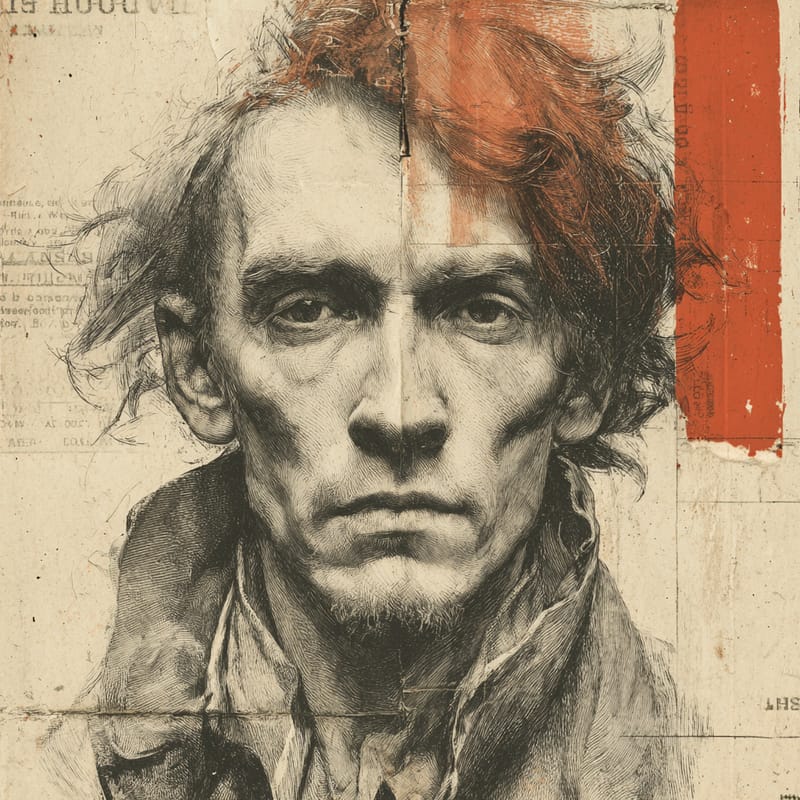
Howard Roark
The integrity of the creator
He'd rather destroy his work than compromise it.
Heterodox ObjectivistOne of 729 ideologies · enter the Objectivist hall →- Role
- Architect (fiction)
- From
- The Fountainhead
- Region
- United States
- Social band
- Heterodox
- Placement
- +52 · −90 · +35
§ Where Howard Roark stands
3 axesRoark accepts the market but refuses to be ruled by it. He will take only commissions that let him build as he designs, turning down lucrative work and labouring in a quarry instead, and his courtroom speech in Part Four defends the creator's right to the product of his mind. Money matters to him only as the means to build, which keeps him short of a pure profit-seeker.
Roark rejects every claim of the collective on the individual. His trial speech in The Fountainhead (1943) condemns the second-hander who lives through others, and his dynamiting of Cortlandt Homes, a government housing project built from his altered design, is presented as the defence of a broken agreement. The novel sides with him: the jury acquits, and the state's moral authority over the creator is denied.
Socially Roark is a rebel against tradition rather than a reformer. He scorns the classical styles his profession reveres, designs the Stoddard Temple as a shrine to the human spirit rather than to God, and lives by no code but his own. His egoism, and his treatment of Dominique Francon, keep the character far from the egalitarian progressive mainstream.
How close are you to Howard Roark?
Three statements, one per axis. Answer them and we’ll drop you on the compass next to them.
§ The story
FictionHoward Roark is the architect-hero of Ayn Rand's novel The Fountainhead, published in 1943. Expelled from architecture school in the opening chapter for refusing to copy classical styles, he apprentices himself to the declining modernist Henry Cameron and spends years in poverty, even working in a granite quarry, rather than compromise his designs. His rivals include the conformist Peter Keating and the collectivist critic Ellsworth Toohey, and his story climaxes when he dynamites the Cortlandt housing project after his design is altered.
Roark is Rand's portrait of the uncompromising creator, and his courtroom speech, which wins his acquittal, became one of the founding texts of her philosophy before Objectivism had a name. King Vidor's 1949 film, scripted by Rand herself, cast Gary Cooper in the role. The character remains a touchstone for architects, entrepreneurs and libertarian readers, and a target for critics who see his egoism as contempt for other people; his violent sexual encounter with Dominique Francon is widely read as a rape and remains the novel's most controversial scene.
Notable for
- 01Protagonist of 'The Fountainhead'
- 02The courtroom speech
- 03Dynamites his own project
Key works & moments
- 1943Ayn Rand publishes The Fountainhead, introducing Howard Roark.
- Part OneExpelled from architecture school, Roark goes to work for the declining modernist Henry Cameron.
- Part TwoThe Stoddard Temple, designed as a shrine to the human spirit, ends in a lawsuit Roark loses.
- Part FourDynamites the Cortlandt Homes housing project after his design is altered.
- Part FourDelivers his courtroom speech on the creator and the second-hander; the jury acquits him.
- 1949Gary Cooper plays Roark in King Vidor's film, with a screenplay by Rand.
In Howard Roark's words
“I don't intend to build in order to have clients. I intend to have clients in order to build.”
“Thousands of years ago, the first man discovered how to make fire. He was probably burned at the stake he had taught his brothers to light.”
§ Minds closest to Howard Roark
All minds →



§ Also in the Objectivist hall
Enter the hall →§ Common questions
4 answersWhat is Howard Roark's political ideology?
Howard Roark embodies Ayn Rand's ethic of rational egoism in fictional form: on the 99ideologies three-axis compass, a Heterodox Objectivist. Economically he is clearly pro-market (+52), trading his work only on his own terms and defending the creator's right to what he makes. On governance he is radically individualist (−90), denying the collective any claim on him, and socially he leans progressive (+35) as a rebel against tradition, though his egoism has nothing egalitarian about it.
Is Howard Roark left-wing or right-wing?
Mostly right, in the individualist rather than conservative sense. Roark's defence of the creator against the collective, and his courtroom attack on altruism and the second-hander, made The Fountainhead a favourite of free-market and libertarian readers. But he despises tradition and convention as much as he despises collectivism, and his only loyalty is to his own work, so he fits better among radical individualists than among conservatives who prize custom, faith and community.
What does Howard Roark's courtroom speech argue?
It argues that all progress comes from independent creators and that the collective has no moral claim on them. Roark opens with the first man who made fire and was probably burned for it, then divides humanity into creators, who live by their own judgement, and second-handers, who live through others. He attacks altruism as a doctrine that makes the creator a servant of the crowd and insists that the only good people can do one another is to leave each other free. The speech anticipates the ethics Rand later systematised as Objectivism.
Which minds are closest to Howard Roark?
On the 99ideologies three-axis compass, the minds closest to Howard Roark are Nathaniel Branden (98% alike), Dagny Taggart (97% alike) and John Galt (96% alike). The furthest is Gregor Strasser (2% alike).